AI in Financial Cybersecurity: Key Risks and Defenses for 2026
Explore AI cyber risks in banking and financial services, including technical vulnerabilities, voice phishing, deepfakes, contact-center fraud, and defenses.

AI is changing financial cybersecurity by making familiar attacks faster, cheaper, more personalized, and harder to judge by sight or sound. The issue is not a new bucket of “AI attacks.” It is that phishing copy, caller voices, video calls, support interactions, vulnerability research, and AI-agent outputs are less reliable trust signals than they used to be.
That matters in finance because the sector runs on trust signals. A bank, insurer, exchange, fintech, or payment provider has to verify identities, authorize money movement, protect customer accounts, manage third parties, and keep real-time systems available. AI touches all of those jobs.
Why AI changes cyber risk differently in financial services
Financial institutions already use AI for fraud detection, transaction monitoring, customer service, software development, threat intelligence, and operational analytics. That gives defenders useful speed and pattern recognition, but it also adds new control problems. The U.S. Treasury has treated AI-specific cybersecurity in financial services as an operational resilience and fraud issue, highlighting gaps around digital identity, explainability, data supply chains, regulatory coordination, and AI-skilled personnel in its financial-sector AI cybersecurity report.
The Financial Stability Board makes the same point at the system level. Its report on AI adoption and related vulnerabilities in the financial sector flags third-party dependencies, service-provider concentration, cyber risk, governance problems, and market correlations as vulnerabilities that can matter beyond a single firm.
That is the financial-sector difference. AI risk does not sit neatly inside security operations. It crosses fraud, compliance, model risk, vendor management, customer support, payments operations, legal, and executive governance.
Technical vulnerabilities: AI is accelerating the attack workflow
The most credible technical risk is acceleration. LLMs and agentic systems can help attackers read documentation, inspect code, generate exploit ideas, interpret errors, revise payloads, write phishing infrastructure, summarize logs, and produce cleaner reports. They reduce the time and skill needed to move through parts of the offensive workflow.
Public research supports that direction, with caveats. In one study, LLM agents showed meaningful success against one-day vulnerabilities when given vulnerability descriptions, but performed far worse without that context. The paper, “LLM Agents can Autonomously Exploit One-day Vulnerabilities”, is useful because it shows both sides of the issue: AI can accelerate exploitation when the target and vulnerability are well described, but it is not magic.
For financial institutions, the practical concern is patch latency. If attackers can test more hypotheses per hour, weak asset inventories, unclear ownership, legacy systems, exposed APIs, slow regression testing, and brittle change-management windows become more dangerous. The answer is not to panic about autonomous AI hackers. It is to tighten vulnerability management around exploitability, exposure, business criticality, and compensating controls.
That means better software bills of materials, faster triage for internet-facing systems, clearer patch ownership, automated testing where possible, and executive visibility into systems that remain exposed after a high-risk disclosure.
The same logic applies to third-party software. Financial institutions rarely control every application, API, cloud service, payment connector, identity provider, or analytics tool in their operating environment. If AI-assisted vulnerability research shortens the time between disclosure and exploitation, vendor-risk teams need faster ways to identify where affected components are used, which business processes depend on them, and what temporary controls can reduce exposure while a supplier patches.
Prompt injection and AI agents create a new privileged attack surface
AI also creates risk inside the institution. Banks and fintechs are connecting models to emails, tickets, invoices, customer records, code repositories, fraud queues, document stores, and internal knowledge bases. Once an AI system can retrieve data or take action, it becomes part of the privileged software surface.
The OWASP Top 10 for LLM Applications puts prompt injection at the top of its risk list. The basic issue is that an attacker can place instructions inside content the model reads, such as an email, webpage, invoice, transaction memo, support ticket, or document. The model may treat hostile text as an instruction rather than untrusted data.
In financial workflows, indirect prompt injection can be subtle. A malicious supplier invoice might tell an invoice-review agent to ignore payment controls. A support message could try to make a customer-service assistant reveal internal account data. A pull request comment could manipulate a coding assistant connected to source code. A transaction memo could influence an analyst tool that summarizes risk.
Agent tools raise the stakes. If a model can search internal records, send messages, update tickets, run code, query databases, or trigger workflows, tool access has to be governed like production access. Least privilege, tool allowlists, sandboxing, logging, output validation, data-loss controls, and incident playbooks are not extras. They are the difference between a useful assistant and a poorly governed automation layer.
This is especially important for financial teams experimenting with internal copilots. A chatbot that only answers policy questions has one risk profile. A chatbot that can retrieve customer records, summarize suspicious activity, draft customer emails, open cases, or call internal APIs has another. The control question should be: what could this system do if a hostile instruction reached it through normal business content?
Social engineering is where AI impact is most visible today
AI’s clearest near-term impact is persuasion. Financial institutions have spent years teaching employees and customers to notice sloppy grammar, odd phrasing, suspicious formatting, and obviously fake senders. Those signals are weaker now.
AI-generated phishing and business email compromise can be clean, localized, and role-specific. Attackers can generate lures for treasury, payroll, procurement, legal, customer support, executives, and wealth-management teams. They can vary the tone for a regulator request, a vendor invoice, an internal IT alert, or a customer complaint.
The FBI’s 2025 Internet Crime Report press release said cyber-enabled crimes defrauded Americans of nearly $21 billion, with phishing/spoofing, extortion, and investment schemes among the most frequently reported complaints. Not every complaint is AI-related, but the pattern matters: social engineering remains one of the main ways attackers get people to open the door.
Smishing is a natural fit for AI abuse because SMS is short, urgent, and low-context. A fake bank alert, delivery notice, payroll message, or account lock warning does not need much text to work. AI makes it easier to produce variations, localize language, and run multi-turn conversations that feel less scripted.
Business email compromise follows the same pattern. AI can help attackers match an executive’s tone, reference public company events, translate messages cleanly, and vary lures across subsidiaries or regions. That does not guarantee success, but it removes many of the old clues employees were taught to rely on. For finance teams, the critical question becomes whether the workflow catches the request after the message succeeds.
Voice cloning and deepfakes break old identity assumptions
Voice is especially dangerous in financial services because it has long acted as a trust cue. A person sounds like an executive, a customer, a colleague, an auditor, or a bank employee, so the interaction feels legitimate. In some contact-center environments, voice biometrics have also been treated as part of authentication.
AI vishing weakens that assumption. Attackers can use voice cloning, synthetic speech, and real-time conversation systems to impersonate trusted people or institutions. The FBI has warned about malicious campaigns using AI-generated voice messages and smishing to build rapport and gain access to accounts.
Deepfake video is less common than text or voice fraud, but it can cause high-impact failures when payment authorization depends on perceived identity. The public Arup case is the useful example here: fraudsters used a deepfake video meeting to convince an employee to transfer roughly $25 million, according to The Guardian’s reporting. It was not a bank breach, but the control lesson is directly relevant to finance.
The response cannot be “look more carefully at the video” or “listen for artifacts.” Audio quality, compression, remote-work norms, urgency, hierarchy, and confirmation bias all favor the attacker. High-risk actions need controls that do not depend on a human being perfectly detecting synthetic media in the moment.
How AI-driven attacks show up in financial workflows
AI-driven cyber risk becomes concrete when it is mapped to workflows.
Account takeover is the obvious path. A customer receives a polished bank message, clicks a fake link, enters credentials, then gets a phone call from someone impersonating support. The attacker asks for an MFA code or OTP, resets the account, changes recovery details, and moves funds.
Contact centers are another pressure point. Many still rely on knowledge-based questions, caller ID, agent judgment, or voice biometrics. AI voice fraud can make account recovery, phone-number changes, password resets, and dispute handling harder to trust.
Payment authorization is exposed when urgent executive instructions, vendor bank-detail changes, acquisition-related secrecy, or regulator pressure cause employees to bypass normal checks. AI-generated voice or video does not create the control failure by itself. It exploits a process that lets perceived authority override verification.
Developer and analyst workflows also matter. A coding assistant with repository access, a fraud analyst chatbot connected to customer data, or an internal AI agent connected to ticketing and cloud tools can become a data-exfiltration or command pathway if permissions, logging, and prompt-injection defenses are weak.
Third-party concentration adds another layer. A shared identity vendor, core banking provider, cloud platform, market-data system, or AI service can become a common point of failure across many firms. That is why AI cybersecurity in financial services has to be handled through operational resilience planning as well as ordinary security controls.
These scenarios also blur the line between fraud and cybersecurity. A stolen session token, a manipulated support agent, and a fraudulent transfer may sit in different reporting systems, but the customer experiences one event. Security leaders need shared case data with fraud teams so AI-driven patterns are visible across channels.
Practical defenses: replace fragile trust signals with verifiable controls
Financial institutions should treat AI-enabled social engineering as a control-design problem, not an awareness-only problem.
For account access, use phishing-resistant MFA where possible, passkeys, device binding, transaction signing, and stricter step-up rules for high-risk changes. OTPs and push approvals are vulnerable when a convincing caller can pressure a customer or employee to share or approve them.
For payments, use dual control, out-of-band verification, callback to registered channels, transaction limits, segregation of duties, and no-exception workflows for bank-detail changes or urgent wires. If the process allows an executive voice or video call to override the control, the process is the problem.
For contact centers, avoid treating voice as a standalone authenticator. Combine device reputation, behavioral signals, registered-channel callbacks, liveness checks, app-based approvals, and risk-based step-up controls for sensitive actions.
For AI applications, govern agents like privileged software. Limit tools, separate duties, sandbox risky actions, validate outputs, log model and tool activity, restrict data access, test for prompt injection, and build incident response procedures for AI-assisted data leakage or unauthorized actions.
For vulnerability management, tighten the basics AI makes more urgent: asset inventory, exploitability-based prioritization, software composition analysis, patch ownership, automated regression testing, and compensating controls for systems that cannot be patched quickly.
Training still matters, but it has to match the threat. Employees need practice with clean phishing copy, smishing, deepfake scenarios, and phishing, smishing, and vishing simulations, not just obvious email templates. The goal is not to make every employee a perfect detector. It is to make the right response automatic: slow down, verify out of band, report quickly, and refuse exceptions.
Financial institutions should also test these controls together. A tabletop exercise around an AI-generated executive voice call is useful, but it is stronger when it includes treasury, fraud, customer support, legal, communications, and incident response. The same is true for an AI-agent data leakage scenario or a fast-moving vulnerability in a shared supplier. AI risk becomes manageable when teams rehearse the handoffs, not only the technical fix.
Best cybersecurity awareness tools with voice phishing simulations
Voice phishing simulations are useful when they help teams practice the exact moments where AI social engineering succeeds: urgency, authority, account recovery, payment pressure, and multi-channel deception. The tools below are worth considering for financial institutions that want awareness training to cover more than email.
Arsen
Arsen focuses on AI-driven phishing, smishing, and vishing simulations, making it relevant for teams that want social engineering practice across multiple channels. It is worth reviewing for adaptive voice scenarios rather than static awareness content, since the available competitor research indicates support for live adaptive conversations and voice cloning.
For financial institutions, the main evaluation question is operational depth. Buyers should verify whether Arsen’s vishing flow supports live outbound calls, synchronized hybrid voice-plus-email campaigns, reusable scenario design, reporting depth, and campaign controls suitable for regulated teams. It may work well for security teams that care most about realistic attacker behavior, but package details and admin controls should be confirmed before using it for high-risk workflows such as payment approval, account recovery, or executive impersonation drills.
Brightside
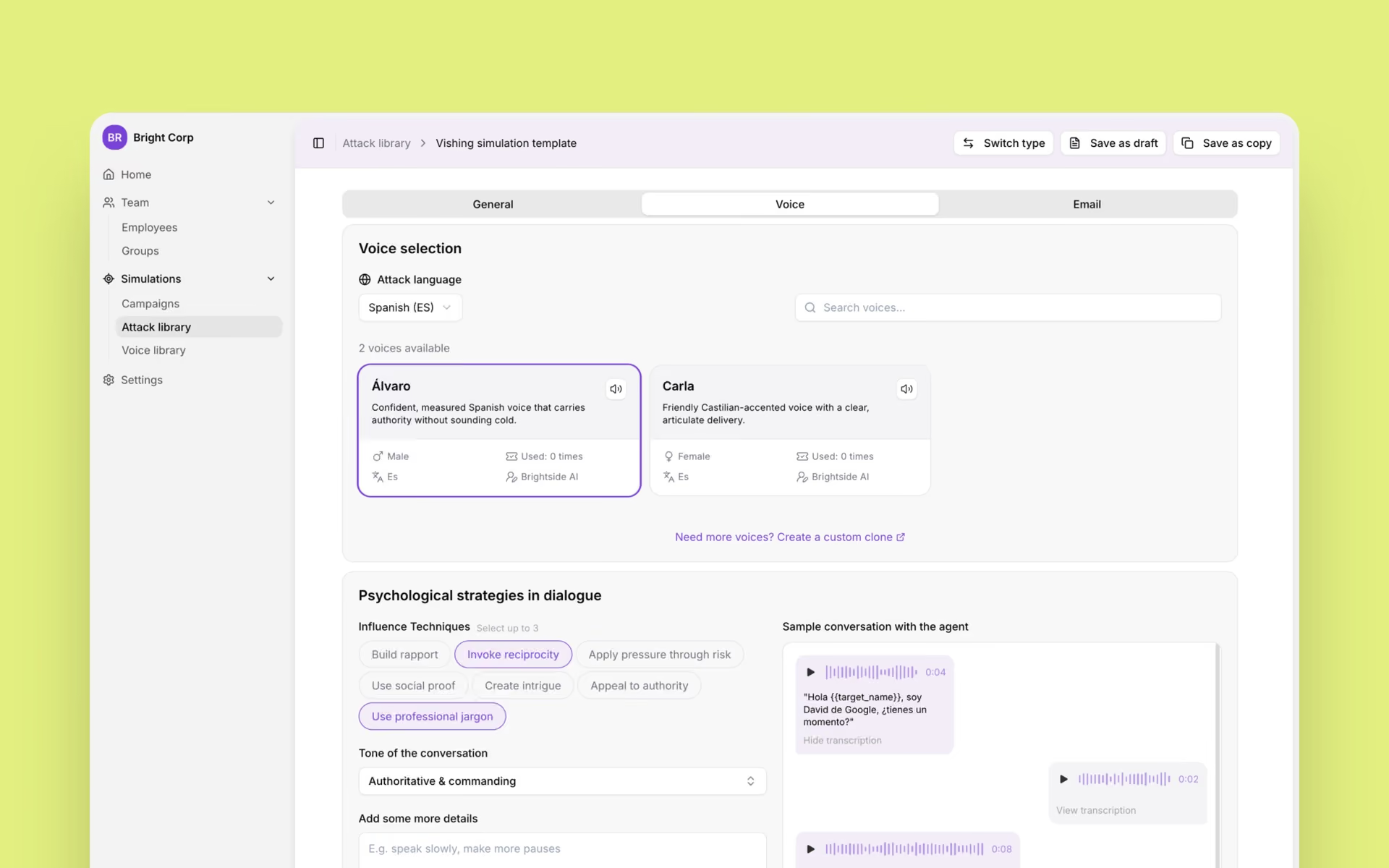
Brightside fits teams that want voice phishing practice tied to broader AI-era attack simulation. Its vishing simulator supports live AI-powered calls, voice-only and hybrid voice-plus-email attacks, custom or cloned voices, admin-defined caller personas, generated opening messages, social engineering tactic and tone selection, a test launch the admin can hear, and vishing metrics such as answer rate, failed rate, and median call duration.
That makes it useful for financial services scenarios where the attack is not just an email click. A team can model a fake IT support call asking for a reset link, an executive impersonation attempt against finance, or a hybrid call-and-email sequence that pressures an employee through multiple channels. Brightside also supports broader awareness coverage across phishing, vishing, and deepfake simulations, so it fits organizations comparing vishing simulation software by realism and attack-channel coverage rather than content-library size alone.
Hoxhunt
Hoxhunt suits organizations that want adaptive security behavior training and simulations with less manual administration. Its public positioning includes phishing and deepfake-style simulation capabilities, and it is often evaluated by teams that want training to adjust to employee behavior over time instead of relying on one-off annual modules.
For voice phishing specifically, buyers should confirm whether the available experience matches their needs for live calls, synthetic voice, phone-based testing, or browser-based deepfake scenarios. The competitor matrix indicates vishing and deepfake-related capabilities, but also suggests some experiences may be browser-based rather than true outbound phone calls. That makes Hoxhunt more compelling as a behavior-change and adaptive training platform than as a dedicated vishing simulator for contact-center or treasury-team testing.
Jericho
Jericho is relevant for financial institutions looking at AI-native social engineering simulation, including voice and deepfake-style scenarios. It is often grouped with vendors focused on realistic multi-channel attacks rather than traditional compliance-only awareness, and the available competitor research indicates support for voice simulation, deepfake video simulation, voice cloning, and live adaptive conversations.
That breadth makes Jericho worth evaluating for teams that want to pressure-test executive impersonation, video-call trust, or multi-channel deception. The due-diligence work is in the details: how much control admins get over caller persona, attack objective, voice behavior, reporting, safety boundaries, and remediation after failures. For regulated financial workflows, buyers should also ask how simulations are logged, how employee impact is managed, and whether results can support audit or operational-risk reporting.
Keepnet Labs
Keepnet Labs offers a broader human-risk and awareness platform with phishing and vishing-related capabilities. It can make sense for organizations that want awareness, simulation, reporting, and response workflows in one environment rather than a standalone voice simulation tool. The available matrix indicates voice/vishing simulation, custom voice capability, automatic follow-up training, admin audit logging, and vishing-specific metrics.
For AI-era voice phishing readiness, buyers should confirm the realism of the vishing module, whether scenarios are live and adaptive or more template-based, and how results map into follow-up training. Keepnet Labs is worth shortlisting when operational reporting, auditability, and broader awareness management matter alongside voice simulation. Financial institutions should still test whether its vishing scenarios are realistic enough for contact-center, executive impersonation, and payment-pressure use cases.
Financial cybersecurity needs controls that do not depend on perfect human detection
AI makes financial cybersecurity harder because it weakens the signals people used to trust. A clean email, a familiar voice, a convincing video call, a plausible support interaction, or a confident AI assistant output can still be hostile.
High-risk workflows need verifiable controls instead of media-based trust. That means stronger authentication, stricter payment procedures, safer AI-agent design, faster vulnerability response, realistic social engineering practice, and tighter coordination between security, fraud, compliance, operations, and customer support.
Get a complete live walkthrough
Book a call with our team for a full overview of the platform, and bring any questions you want answered. No obligation exploration call.
Try our vishing simulator
Experience the most advanced voice phishing simulator built for security teams. Create scenarios, test voice cloning, and explore automation features.
Latest articles

Live Vishing Simulation vs Pre-Recorded Calls: What the Difference Actually Trains

The Help Desk Callback Verification Script: What to Say and When

AI Vishing Simulations: How to Run Voice Phishing Drills That Actually Change Behavior