Deepfake Awareness Training: Defend Your Organization
Prepare your workforce for advanced AI threats. Read our guide on deepfake awareness training to build secure verification workflows for your company.

Picture this. A finance manager at a global firm gets a video call from the CFO. The video looks normal. The voice sounds right. The CFO says there’s an urgent acquisition happening, the deal must close today, and a wire transfer needs to go out before end of business. The manager processes the payment. The CFO is later told about the transfer and has no idea what anyone is talking about.
That’s not a hypothetical. A variation of it happened to Arup, a multinational engineering firm based in the UK, in early 2024. The finance employee attended a video conference call with what appeared to be multiple senior executives. Every person on the call was an AI-generated deepfake built from publicly available video footage. The employee transferred approximately HK$200 million, roughly $25 million USD. Nobody caught it until the real executives noticed the transaction.
The reason that attack worked isn’t that the employee was careless or poorly trained. It’s that they used the exact tools we’d expect any employee to use: they looked, they listened, and they verified by asking questions on the call. None of those checks helped, because the call itself was the attack.
Companies need to understand this shift. Deepfakes are no longer just a media or political problem. They’re a business process problem. They target the workflows your teams use every day, including payment approvals, onboarding calls, IT requests, and hiring decisions. And the standard advice, “teach employees to spot fakes,” doesn’t address the problem at its source.
This article explains why impersonation attacks work so well, where employees are most exposed, and what “deepfake-proofing” actually looks like in practice.
Why AI Impersonation Works Inside Real Companies
Deepfakes don’t succeed because employees are gullible. They succeed because they’re designed to look and sound exactly like the people and processes employees already trust.
Think about how your team communicates day-to-day. An executive sends a message over Teams asking someone to take urgent action. IT calls to reset a password before a critical system goes down. HR sends a DocuSign link to finalize a new hire’s contract. All of these are normal. All of them can now be convincingly faked.
Cloned voices are the fastest-moving threat. A convincing voice clone can now be created from as little as three to five seconds of publicly available audio. An earnings call, a conference presentation, a short clip on the company website — any of it works. Once an attacker has that audio, they can simulate a phone call where “the CEO” asks for something urgent.
The same logic applies to video. The Arup case showed that even a full video conference call, with multiple apparent executives on screen, can be entirely synthetic. The technology to build those faces and voices is freely available online.
Multi-channel attacks are the hardest to question. When an attack moves across channels, it becomes much harder for employees to push back. A fake email arrives from “IT Security” warning about a suspicious login. Then a follow-up call comes confirming the incident and asking the employee to reset their credentials using a link. Then a Teams message arrives from what appears to be the IT director, confirming the process. Each step reinforces the others. The employee isn’t being naive. They’re looking at three separate signals that all point in the same direction.
Why impersonated executives are so effective. Most employees are conditioned to act quickly when a senior leader asks for something. They don’t want to seem obstructive or incompetent. Attackers know this, and they use it. They don’t just clone a voice or face. They clone the urgency, the tone, and the authority that makes employees feel they shouldn’t push back.
Why Employee Intuition Fails Under Pressure
Most security awareness training assumes employees have time and space to think carefully. Real attacks don’t give them that.
When an employee gets a call from “the CFO” saying a wire transfer must go out in the next 45 minutes or the deal falls through, they’re not sitting at a desk calmly reviewing a training module. They’re under pressure. They’re worried about the deal, their performance, and whether they’re going to be the person who held everything up. Their brain isn’t asking “Is this a deepfake?” It’s asking “How fast can I get this done?”
Authority bias works exactly like this. And it doesn’t only affect less experienced employees. Experienced, senior professionals fall for it too, because the social dynamics of hierarchy don’t disappear just because someone’s been through security training.
Visual tells don’t save people in real conditions. Training programs often teach employees to look for lip-sync delays, unnatural blinking, or slight audio distortion. Those cues are sometimes visible in controlled classroom examples. On a compressed video call on a mobile phone with background noise in a busy office, they’re almost impossible to catch. Attackers calibrate their attacks for exactly those conditions.
The most dangerous gap isn’t knowledge. It’s behavior under stress. The research firm IRONSCALES found that 99% of security leaders described themselves as confident in their organization’s deepfake defenses. The same organizations averaged a 44% detection rate when tested with simulated attacks. Only 8.4% of organizations scored above 80% in detection drills. People know what deepfakes are. They just don’t catch them when it counts.
Policy protects where intuition fails. The strongest protection isn’t a more alert employee. It’s a company-wide rule that removes the judgment call entirely. If the policy says that no payment over $10,000 can be authorized on the basis of a phone or video call alone, the employee doesn’t need to decide whether the CFO’s voice sounds slightly off. They just follow the process.
Stop asking employees to detect the attack. Build a company where detecting it doesn’t matter.
What a Deepfake-Proof Company Actually Looks Like
Deepfake-proofing a company means redesigning the workflows that attackers target, so that a successful impersonation still can’t achieve its goal. Most of these changes are procedural, not technical. You don’t need expensive tools to start. You need clear rules, consistent enforcement, and roles that understand their specific exposure.
Finance workflows that a cloned executive can’t hijack. The most targeted workflow in any organization is the wire transfer or vendor payment approval. Finance teams should operate under a rule that no high-value payment can be authorized based solely on a call or video message, even if the voice or face appears to be from a known executive. Every large transfer needs a second verification step through a separate, pre-confirmed channel. The callback number must come from an internal verified directory, not from the contact who initiated the request.
Time delays are worth building in here too. An artificial urgency claim is one of the most reliable tools in a deepfake attack. A 30-minute waiting period on any large payment request that arrived through an unusual channel removes the urgency entirely, which is often enough to break the attack.
HR and recruiting controls for synthetic candidate fraud. Deepfakes aren’t only used to impersonate existing employees. They’re increasingly used to create entirely fake job candidates. GetReal Security research found that 41% of organizations surveyed had hired and onboarded a fraudulent candidate. A fake hire can end up with legitimate access credentials, internal email accounts, and procurement authority.
HR teams should require a secondary video verification step for remote candidates that uses a separate platform from the original interview. They should also ask candidates to complete a task that requires interaction with a real person during onboarding, separate from any automated process. Thin employment histories, overly polished interview performances, and rapid requests for system access or unusual role scope are all worth flagging.
IT help desk controls for impersonation and reset scams. IT support teams are a high-value target because their job is to help people solve problems quickly. Attackers use that against them by impersonating either an employee in distress or a senior person demanding a fast fix. No password reset, access grant, or software installation should happen solely because someone on a call asked for it. Every reset request should be validated through a registered secondary channel or confirmed via a supervisor before it’s processed.
Executive communication rules that reduce impersonation risk. A simple but underused defense is the pre-agreed codeword. Leadership teams can establish rotating phrases that authenticate sensitive verbal requests. These codewords are shared only through internal secure channels and can’t be replicated by a voice clone that doesn’t have access to them. Even a brief shared phrase breaks the attack entirely if the caller can’t provide it.
Defining which channels are trusted for which types of requests also matters. If company policy says payment instructions coming via WhatsApp or a personal mobile number are never valid, employees can decline those requests with confidence and without looking obstructive.
How to Train Employees for Deepfake Attacks Without Creating Paranoia
Simulation-based training works best when it’s realistic, role-specific, and repeated regularly. A once-a-year phishing test won’t build the habits that a deepfake attack will eventually test.
Training should make certain behaviors automatic: pausing before acting on an unusual request, verifying through a trusted channel, and escalating without embarrassment. It shouldn’t make employees distrust everyone. That would slow down legitimate work and erode the internal trust organizations depend on.
Finance teams should practice scenarios involving voice-cloned calls from apparent executives requesting urgent payments. The simulation should include all the features of a real attack: urgency, authority, and a plausible business reason. Follow-up training should reinforce the verification procedure, not just highlight the detection failure.
HR and recruiting teams should practice scenarios involving video interviews with candidates who show subtle inconsistencies, multi-stage onboarding flows that request escalating access, and reference checks that don’t hold up. These teams don’t see themselves as security targets, and that awareness gap is exactly what attackers exploit.
Executives and their assistants should practice scenarios involving impersonated leadership across WhatsApp, Teams, and phone calls. Assistants, in particular, sit at a high-risk position. They have access to calendars, confidential communications, and payment workflows, and their role is to make things happen for senior people without questioning every instruction. In the wrong scenario, that combination is a real problem.
What makes a simulation useful rather than just stressful. The simulation itself isn’t the training. The conversation that follows it is. Employees who fail a simulation should receive immediate, constructive feedback explaining what happened, why it was effective, and exactly what to do differently. Scoring employees publicly or shaming people who were caught doesn’t make teams more secure. It makes people less likely to report real incidents they’re uncertain about.
How often to run simulations. Short, focused drills run quarterly outperform long annual compliance modules. Frequency matters. So does realism. If your finance team has never received a voice call that sounds like the CFO asking for money, running that simulation before a real attack happens is a concrete advantage.
Give employees the language to push back. A standing permission to say no to an unusual request is one of the most underused tools in security awareness. If employees know that saying “I need to verify this by process before I act on it” is not only allowed but required, the social pressure attackers exploit loses most of its power. Make it easy to pause, make it expected to verify, and make it safe to escalate.
Top 5 Security Awareness Platforms to Prepare Teams for Deepfake Attacks
This ranking focuses on platforms that help teams rehearse modern impersonation attacks across voice, video, SMS, and phishing workflows. It’s a focused list for organizations that take AI-enabled social engineering seriously, not a general comparison of the largest awareness vendors.
Here are the five rewritten descriptions with all recommended corrections applied:
1. Adaptive Security
Adaptive Security covers email, voice, video, and SMS in one simulation program and explicitly positions deepfake and AI threat training as core to its offering. The platform uses AI-generated voice calls and custom executive personas to simulate vishing scenarios, and it includes OSINT-shaped spearphishing that personalizes attacks based on what’s publicly known about a target. It also pairs simulation delivery with phishing triage and risk monitoring, giving teams both practice and measurement in one place.
Pros:
- Multi-channel simulations span email, voice, video, and SMS.
- AI-generated voice calls and executive personas are part of the core product.
- OSINT-shaped spearphishing personalizes attacks by role and public profile.
- Phishing triage and risk monitoring are built in alongside simulation delivery.
- Designed for modern AI and deepfake-enabled threats, not legacy email compliance.
Cons:
- The executive persona and OSINT approach requires internal governance review and leadership buy-in before rollout.
- Better suited for organizations building a full multi-channel program than for buyers who only need basic email awareness modules.
2. Brightside
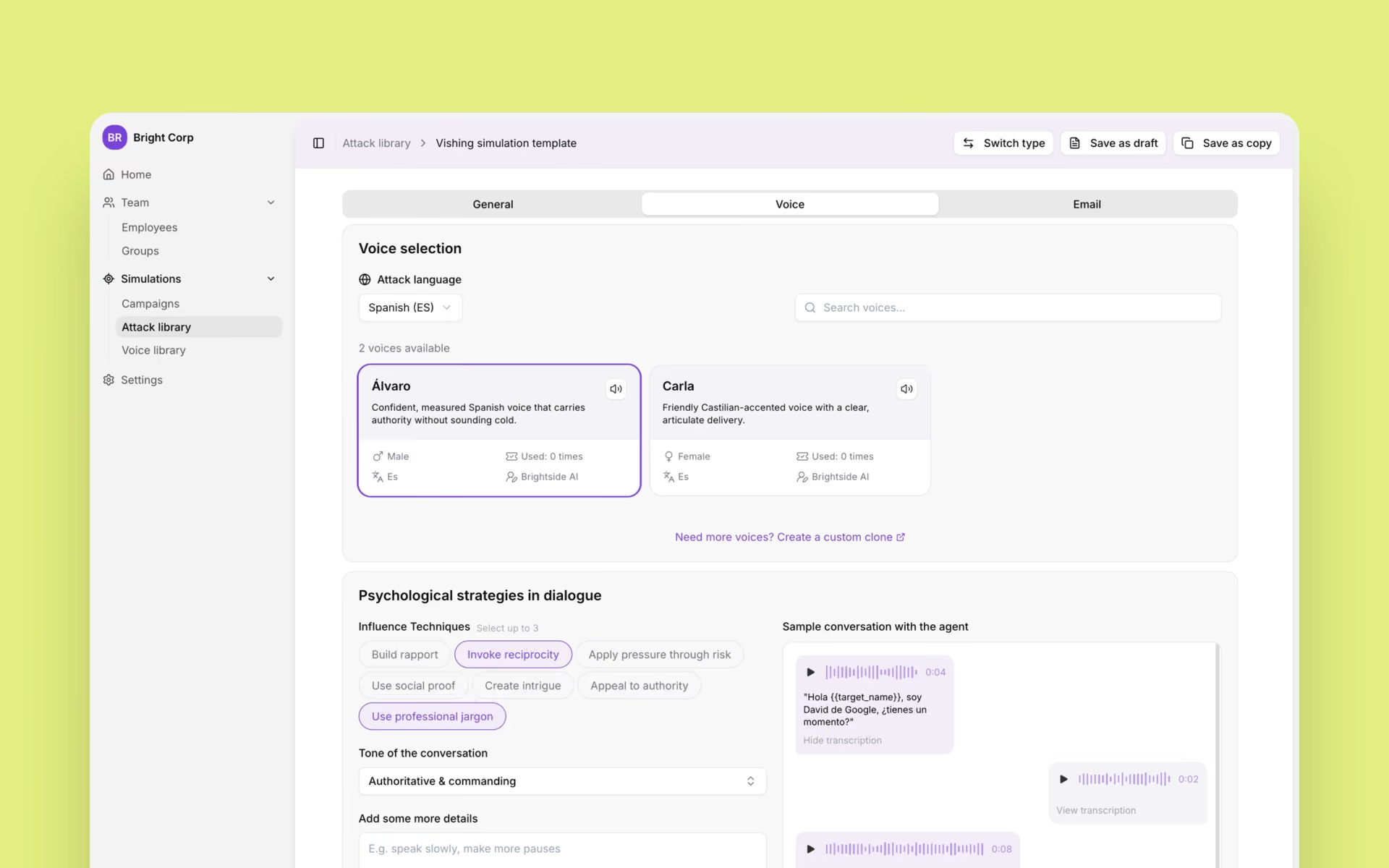
Brightside is a Swiss security awareness platform that combines structured cybersecurity courses with phishing, vishing, and deepfake simulations in one admin environment. Its vishing simulator supports both voice-only and hybrid attacks that combine a live AI phone call with a phishing email. Admins can build simulation templates in five steps, selecting tactics, tone, and voice, and can clone executive voices from a short audio upload. Courses cover topics from deepfake identification and CEO fraud to password management and social engineering, delivered in a chat-based format with gamification elements.
Pros:
- Phishing, vishing, and deepfake simulations are all available in one platform.
- Interactive courses cover deepfake identification, vishing, CEO fraud, and social engineering.
- The vishing simulator supports both voice-only and hybrid voice-plus-email attack formats.
- Custom voice cloning is available using a 1 to 2 minute uploaded audio recording.
- Admins get structured curricula, detailed reporting, and CSV export options.
Cons:
- Brightside does not provide OSINT scanning, real-time breach detection or response, or real-time employee communications monitoring.
- The platform does not offer live adaptive replay coaching or real-time behavioral feedback after simulations complete.
3. Jericho Security
Jericho Security is built for organizations that want attack simulations that go beyond standard phishing templates. The platform covers email, SMS, voice, and video calls and adapts scenarios based on employee roles, behavior patterns, and prior simulation responses. Outside coverage notes that Jericho uses AI-generated, personalized attack scenarios rather than fixed templates, and that its reporting is designed to identify who fails at what and guide targeted follow-up training. The company raised $15 million in a Series A round announced in 2025, following a U.S. Department of Defense contract win, with deepfake fraud defense as a stated strategic priority.
Pros:
- Public positioning covers email, SMS, voice, and video-call simulation.
- Scenarios adapt by role, behavior patterns, and previous simulation responses.
- AI-generated simulations rather than fixed template libraries.
- Reporting focuses on identifying where specific employees fail and guiding remediation.
- Raised $15 million in Series A funding in 2025 with a specific focus on combating deepfake fraud.
Cons:
- Public materials emphasize outcomes and concept more than specific scenario-builder workflows, so buyers should press for a live demo to see admin depth.
- Organizations that want detailed governance controls and transparent data handling should verify those specifics before committing.
4. Hoxhunt
Hoxhunt describes itself as an adaptive learning system that combines phishing, smishing, vishing, and AI impersonation in one program. Its deepfake simulation delivers a multi-step attack flow: a phishing email routes the target to a fake video meeting page where a cloned-voice executive avatar creates urgency, and a failed response triggers instant micro-training. The platform frames ongoing behavioral feedback loops as a way to improve response quality over time rather than just measuring failure rates. For organizations that want continuous learning rather than periodic one-off tests, it is a strong option.
Pros:
- Covers phishing, smishing, vishing, and AI impersonation in a single system.
- Deepfake simulation combines a voice-cloned executive avatar with a fake video meeting environment, not just email-based training content.
- Positioned as an adaptive learning system rather than a compliance test engine.
- Strong framing around continuous behavioral improvement for high-value targets.
Cons:
- Deepfake campaigns are described as customizable but require building an executive persona, which may involve internal approval steps before rollout.
- Organizations wanting role-specific finance or HR playbooks should verify how granular the simulation templates actually are.
5. KnowBe4
KnowBe4 is the largest security awareness vendor in the market and launched dedicated deepfake training in December 2025 to address AI-powered social engineering. Its deepfake capability is a training video module: admins upload a short clip of a company leader, the platform generates a realistic deepfake video, and employees watch it as part of a training campaign to experience how convincing AI impersonation can be. This is distinct from live vishing simulations where AI calls employees in real time. KnowBe4’s value is content breadth, compliance program maturity, and simplified rollout at scale. It belongs in this list for organizations that want a strong awareness foundation across many content areas and are beginning to add deepfake-specific content.
Pros:
- Launched custom deepfake training in December 2025, allowing admins to generate a training video featuring their own executives.
- Strong content breadth, compliance coverage, and ability to deploy at scale.
- Well established in large enterprises that already run awareness programs.
- Useful for organizations that want a broad foundation and are adding deepfake content gradually.
- Easier to get procurement approval for in large organizations with established vendor relationships.
Cons:
- The deepfake feature is a training video module, not a live simulation where AI actively calls or messages employees. Organizations seeking immersive, real-time voice or video attack simulations should validate whether that capability exists before assuming it matches the content library’s breadth.
- Simulations remain more email-centric overall, and buyers focused specifically on active voice-clone vishing or cross-channel deception flows should evaluate simulation depth directly during a demo.
Deepfake-Proofing Starts With Behavior
None of the controls in this article require employees to become experts at spotting AI-generated media. Most attacks won’t be stopped by a savvier set of eyes. They’ll be stopped by a process that says: this type of request requires a second verification step, full stop, regardless of who appears to be asking.
The organizations that handle these attacks best don’t leave the decision to the employee in the moment. They design the workflow so that a convincing fake still can’t get through. They rehearse the scenarios that finance, HR, and IT teams will actually face. And they tell employees clearly that slowing down to verify is not obstructing business. It is the job.
Start with one question: could someone on your team authorize a significant payment, give system access, or hand over credentials based solely on a phone call or video from a senior leader? If the answer isn’t a hard no, that’s the gap to close first.
Get a complete live walkthrough
Book a call with our team for a full overview of the platform, and bring any questions you want answered. No obligation exploration call.
Try our vishing simulator
Experience the most advanced voice phishing simulator built for security teams. Create scenarios, test voice cloning, and explore automation features.
Latest articles

Live Vishing Simulation vs Pre-Recorded Calls: What the Difference Actually Trains
The Help Desk Callback Verification Script: What to Say and When

AI Vishing Simulations: How to Run Voice Phishing Drills That Actually Change Behavior