What's the Best Tool for Simulating Deepfake Attacks to Train Employees? (2026 Buyer's Guide)
Compare the best deepfake attack simulation tools for 2026. Learn which platforms run real, self-serve voice and video deepfake simulations — and which only offer awareness videos.
Let’s deal with the obvious objection first. Some of this is vendor hype, and there’s plenty of fear-selling in the space, so a little skepticism is healthy. But the data is hard to wave away.
Deepfake incidents jumped roughly 680% year over year, with 179 separate incidents recorded in the first quarter of 2025 alone. AI-generated phishing now lands a click-through rate near 54%, compared to about 12% for the old-school stuff. And 78% of CISOs say AI-powered threats are having a real, measurable impact on their organizations.
The Arup case isn’t a lonely outlier either. The CEO of advertising giant WPP was targeted by a voice-clone scam built around a fake WhatsApp account and AI audio. The FBI’s Internet Crime Complaint Center has issued public warnings that criminals are generating short audio clips of a loved one’s or executive’s voice to fake emergencies and authorize fraudulent payments.
Volume is only half the story. The trajectory is what should worry you. Security leaders at Infosec Institute describe deepfakes moving “from proof-of-concept to front-and-center threat.” Analysts at Intel 471 expect “selective escalation,” meaning attackers won’t spray these at everyone. They’ll aim carefully at executives, finance teams, and the assistants who can move money. If your organization handles wire transfers, password resets, or sensitive data over the phone, you’re in scope.
What a Deepfake Attack Simulation Actually Is (and What It Isn’t)
A deepfake attack simulation is a safe, controlled exercise that uses AI-cloned voice or video to impersonate a real person, usually an executive, and tests how your employees respond to a fraudulent request. The point is to rehearse the moment of pressure so people build the instinct to verify before they act, not to embarrass anyone.
That sounds simple, but it’s exactly where buyers get tripped up. Three very different things get sold under the same “deepfake training” label, and most people don’t notice the difference until after they’ve signed.
The first is awareness content. This is a polished video, sometimes featuring a clone of your own CEO, that explains what deepfakes are and warns people to stay alert. It’s educational, it’s passive, and it’s genuinely useful as a starting point. But nobody is actually tested.
The second is a live attack simulation. Here, an AI-cloned voice or video impersonates a specific person and calls or messages real employees with a real-looking request. The employee has to decide, in the moment, whether to comply or push back. This is the version that changes behavior, because it puts people in the actual situation.
The third is a managed-service simulation. The capability is real, but you can’t run it yourself. The vendor’s team builds the scenario, clones the voice, and launches the campaign on your behalf. That’s fine for a one-off showpiece, but it’s slow and expensive to repeat.
Knowing which of these three you’re buying determines your price, your control, and whether you’ll see any lasting change in how your people behave.
Why Awareness Videos Alone Don’t Build Deepfake Resistance
You might be wondering why a well-made training video isn’t enough. After all, if people know deepfakes exist, won’t they be more careful?
A bit more careful, maybe. But information isn’t the bottleneck. Employees rarely fail because they’ve never heard of voice cloning. They fail because a confident voice that sounds exactly like their boss calls during a busy afternoon, says something is urgent, and leans on authority to short-circuit their judgment. Knowing about deepfakes in the abstract does almost nothing in that specific, high-pressure moment, but rehearsal is what actually moves the needle.
When someone has already taken a simulated call from a cloned executive, felt the pull to comply, and then learned they were being tested, the lesson sticks in a way no slideshow can match. They’ve practiced the reflex of pausing and verifying, not just read about it.
The practitioners who’ve tried this internally back it up. In cybersecurity community discussions, security teams who cloned an executive’s voice and ran it against their own finance and helpdesk staff reported failure rates around 50%. Half their people fell for it, even in organizations that took security seriously. You don’t fix a 50% failure rate with a video. You fix it with repetition.
7 Criteria for Choosing a Deepfake Simulation Tool
Once you accept that you need real simulations, the next question is how to tell good tools apart. Here are the seven things that actually matter.
- Live, adaptive AI calls. The simulated call should respond to what the employee says in real time, not just play a scripted recording or voicemail. Real attackers improvise. Your simulations should too.
- Voice cloning from a short recording. Look for the ability to clone a specific executive’s voice from a one to two minute clip. Impersonating “a manager” in the abstract is far less convincing than impersonating their manager.
- Deepfake video simulation. This is the rarest capability on the market. Plenty of tools do voice. Very few can stage a fake video call, which is exactly what hit Arup.
- Self-serve versus managed-service. Can your team build, preview, and launch simulations whenever you want? Or do you have to file a request and wait for the vendor to do it for you? Self-serve lets you run frequent, varied campaigns. Managed-service caps you at occasional set pieces.
- Hybrid attacks. The strongest modern scams combine channels: a phishing email that primes the target, followed by a confirming phone call. A good tool can orchestrate voice plus email in one coordinated workflow.
- Automatic remediation. When an employee fails, the right training should fire automatically and be tied to the exact scenario they fell for. No manual follow-up, no gap between mistake and lesson.
- Vishing-specific metrics. Generic open rates don’t cut it for voice. You want answer rate, fail rate, and call duration, plus difficulty mapped to a recognized standard like the NIST Phish Scale and coverage in the languages your people actually speak.
The Best Deepfake Attack Simulation Tools for 2026, Compared
No tool wins on every axis. This is an honest read on where the main players land against those seven criteria.
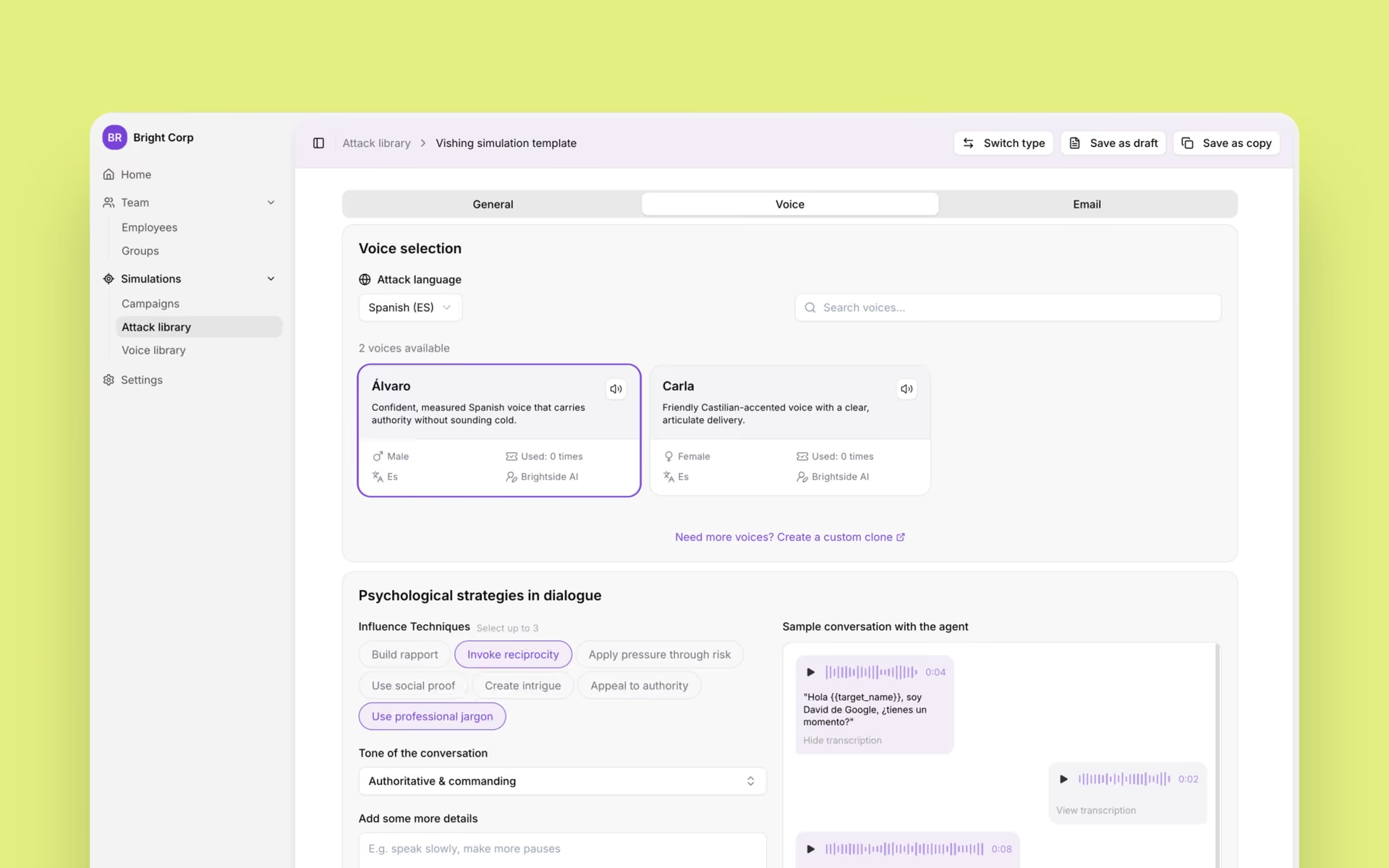
Brightside AI is built simulation-first. It runs live, adaptive AI voice calls, clones executive voices from a short recording, and runs email phishing from the same self-serve admin portal, with deepfake video available as a managed engagement. A test launch lets you hear the call before you launch it, and it works across English, French, German, Italian and other languages. The hybrid attack workflow, combining a live call with a trackable phishing email, is a standout.
Hoxhunt does genuine deepfake video simulation, delivering a phishing email that leads to a mock video call featuring an AI likeness of an executive. The catch is that it’s a managed service. Hoxhunt’s team builds and runs it for you, so your security staff can’t spin up campaigns on demand.
KnowBe4 (AIDA) is the one most often mistaken for an attack simulator. Its December 2025 deepfake feature generates awareness content starring a trusted leader from your org. It’s good content, but it doesn’t test anyone with a live attack, and its phone simulations rely on scripted outbound calls rather than adaptive AI.
Jericho Security uses agentic AI for live voice and video deepfake simulations with voice cloning, and points to a US Department of Defense deployment as a trust signal.
Adaptive Security treats phishing, vishing, and deepfakes as one connected problem, using AI personas that call, email, and text in coordination across channels.
Callstrike is a newer, purpose-built entrant focused squarely on simulating deepfake attacks across voice, video, and messaging, with remediation auto-assigned based on how each person fails.
Keepnet Labs and Arsen both offer voice cloning and broad attack-surface coverage, though their voice simulations lean on text-to-speech and template-based scenarios rather than fully unscripted conversations.
How to Run Your First Deepfake Simulation Campaign
Running one is more straightforward than it sounds. This sequence works whether you’re piloting or rolling out at scale.
Start with the scenario and the target group. Don’t simulate everyone at once. Begin with the people criminals actually go after: finance staff who move money, IT helpdesk who reset passwords, and the executive assistants who field “urgent” requests.
Define the attack goal. Be specific about what the fake caller is trying to get. A wire transfer to a new account, a password reset, a credential handed over to “verify identity.” The clearer the goal, the more realistic the call.
Build the persona and clone the voice. Create the caller identity, then clone the voice you want to impersonate. A quick but important note here: get written consent before cloning a real executive’s voice, and check your local rules on biometric and voice data. Cloning your own CEO with their sign-off is one thing. Doing it without permission is a legal headache you don’t need.
Choose your tactics and tone. Pick the social engineering levers the simulation will pull, things like authority, urgency, or pretexting, and set the tone, from friendly to commanding. Mixing tactics makes the test more lifelike.
Preview, launch, measure, and remediate. Run a test launch first, taking the call yourself, so you know how it sounds and how the AI adapts. Then launch, watch your answer and fail rates, and let follow-up training fire automatically for anyone who slips. Repeat with fresh scenarios so people can’t pattern-match their way to a passing grade.
Why Simulation Must Be Paired With Out-of-Band Verification
The best practitioners keep hammering one point, and it’s worth taking seriously even though we’re talking about simulation tools. Training alone won’t save you. Neither will technical detection.
The reason is blunt: the usual checks are already broken. Caller ID gets spoofed for free, so a call that looks like your CEO’s mobile number means nothing. And video verification, the “I can see their face, so it’s really them” instinct, was definitively shattered by the Arup case and the copycats that followed. Investigators who’ve worked real deepfake fraud cases land on the same answer again and again. The single most effective control is a pre-agreed, out-of-band verification step: a passphrase or callback method, agreed face to face and never shared digitally, that a voice clone simply can’t produce.
A passphrase only helps if people actually remember to use it, and that habit comes from rehearsal. People reach for the verification step when they’ve built the reflex to pause under pressure, and you build that reflex by practicing it. So simulation and process work together: the simulation is what gets the process used when it counts. Pair it with multi-stage approval for large payments and solid helpdesk identity checks, and you’ve got real defense in depth.
Matching the Right Tool to Your Organization’s Risk Profile
The honest answer to which tool is best depends on who you are.
Smaller companies and any organization that moves money on informal, trust-based say-so are arguably the most exposed, because they often lack the layered approvals that slow an attacker down. For them, a self-serve, easy-to-run voice and video simulator that builds verification habits fast is worth more than enterprise breadth they’ll never use. Larger enterprises with mature controls may already blunt the financial impact, but they still need to rehearse their people and document that they did, which makes metrics and language coverage matter more.
The fork that trips up most buyers is self-serve versus managed-service, and content versus real simulation. If you only ever want one showpiece deepfake video for a town hall, a managed service or an awareness-content tool will do. If you want to build genuine, lasting resistance, you need a platform that lets your own team run real, multi-vector, self-serve simulations across voice, video, and email, again and again.
If that’s where you’ve landed, it’s worth seeing one in action. Run a vishing or deepfake simulation against a pilot group, watch your fail rate, and decide based on what your own people do, not what a vendor promises.
Deepfake Simulation FAQ
Can you legally clone an executive’s voice for training?
Yes, with their explicit consent. Cloning your own executive’s voice for an internal simulation is generally fine when you’ve got written sign-off and you follow local biometric and data-protection rules. Cloning anyone’s voice without permission is where you run into legal trouble, so always document consent first.
Is deepfake simulation different from phishing simulation?
They overlap but aren’t the same. Phishing simulation usually tests email. Deepfake simulation adds AI-cloned voice and video, impersonating a specific person on a call. The strongest programs combine both, often in a single hybrid attack that pairs an email with a confirming phone call.
How often should you run deepfake simulations?
Frequently enough that people can’t predict them, but not so often you cause fatigue. A quarterly cadence with rotating scenarios works well for most teams, with extra rounds for high-risk groups like finance and IT helpdesk. Self-serve tools make this rhythm far easier to maintain.
Does deepfake awareness training actually work?
On its own, only a little. Passive awareness content raises baseline knowledge but rarely changes behavior under pressure. What works is pairing that content with live simulations and automatic, scenario-specific remediation, so people practice the response instead of just reading about it.
What’s the difference between vishing and deepfake simulation?
Vishing simulation tests how employees handle voice phishing calls. Deepfake simulation is a more advanced form that uses AI to clone a specific, recognizable voice or face, so the employee believes they’re talking to a real, trusted colleague. Deepfake adds the impersonation layer on top of vishing.
Get a complete live walkthrough
Book a call with our team for a full overview of the platform, and bring any questions you want answered. No obligation exploration call.
Try our vishing simulator
Experience the most advanced voice phishing simulator built for security teams. Create scenarios, test voice cloning, and explore automation features.
Latest articles

Live Vishing Simulation vs Pre-Recorded Calls: What the Difference Actually Trains
The Help Desk Callback Verification Script: What to Say and When

AI Vishing Simulations: How to Run Voice Phishing Drills That Actually Change Behavior