Shadow AI Risk: A Security Leader's Practical Playbook
Shadow AI is your biggest ungoverned attack surface in 2026. Discover why your security stack misses it and what a people-first AI governance strategy looks like.

Shadow AI is what shadow IT was a decade ago, except it’s moving faster, the data exposure is deeper, and your existing security stack wasn’t built to catch it. If you’re a CISO, CTO, or information security officer trying to figure out where your organization actually stands, this guide covers what shadow AI is, how it infiltrates organizations, why your current tools miss it, and what a practical response looks like.
What You’re Already Dealing With, Whether You Know It or Not
A finance team member pastes a quarterly earnings summary into ChatGPT to draft a board presentation. A developer uploads proprietary source code to an AI code assistant to speed up a debugging session. A salesperson feeds a full CRM export into a free AI summarizer to prep for a pitch call. None of them told IT. None of them meant any harm. And none of them stopped to think about what they just shared, with whom, or under what terms.
This is shadow AI: the unsanctioned use of consumer-grade or unvetted AI tools, browser extensions, and AI-assisted applications by employees, without the knowledge or approval of IT or security teams. According to the 2025 State of Shadow AI Report, 98% of organizations already have employees using unsanctioned AI apps. Nearly 90% of enterprise AI activity is invisible to IT. Salesforce’s 2026 Workforce AI Survey found that 67% of employees now use AI tools at work, but only 18% of organizations have formal AI security policies in place. The gap between adoption and governance isn’t closing. It’s widening.
By the end of this article, you’ll understand exactly what shadow AI is, how data actually exits your organization through it, why your existing security tools can’t see it, and what a proven people-first approach to containing it looks like, including a comparison of the platforms built to train employees against AI-specific threats.
Shadow IT Left Files in the Wrong Place. Shadow AI Sends Intelligence Outside Your Organization.
Shadow IT was manageable, in hindsight. An employee signed up for a personal Dropbox account. A team started using Slack before IT approved it. The data was mostly static: files sitting somewhere they shouldn’t be. You could find it, contain it, and write a policy.
Shadow AI is a different problem entirely. When an employee pastes data into an AI tool, that data doesn’t just sit somewhere. It enters a processing pipeline. It gets transformed, analyzed, and potentially stored on external servers. Depending on the tool’s terms of service, which almost no one reads, it may be used to train future models. The employee isn’t moving a file to an unauthorized location. They’re sharing live organizational intelligence with an external system they have no visibility into and no control over.
The most common shadow AI entry points aren’t exotic or obscure. Research shows the top categories are code generation tools used by 72% of shadow AI adopters, documentation tools used by 64%, and data analysis applications used by 58%. These are productivity tasks. Normal tasks. The kind employees do dozens of times a day.
The scale of what gets shared is what makes this serious. A Cybernews survey found that 75% of employees using unapproved AI tools admitted to sharing potentially sensitive information with them, most commonly employee data, customer data, and internal documents. IBM has calculated that shadow AI increases the average cost of a data breach by $670K. Samsung learned this in 2023 when engineers leaked semiconductor designs through ChatGPT, prompting a company-wide ban. In 2025, a major pharmaceutical company discovered employees had uploaded clinical trial data to multiple AI tools, a potential FDA and EMA regulatory violation worth tens of millions in penalties. These aren’t edge cases anymore.
How Data Actually Leaves Your Organization Through AI Tools
Understanding the mechanism matters, because the way shadow AI creates exposure is counterintuitive to how most security teams think about data loss.
Here’s the actual sequence:
- An employee identifies a workflow friction point. A repetitive task, a report to write, a code block to debug. They search for an AI tool to speed it up, often in under thirty seconds.
- The tool is installed or accessed via browser. It’s usually a Chrome extension, a SaaS web app, or a free-tier AI assistant that requires no corporate login, no IT review, and no procurement approval.
- Sensitive data enters the AI input. The employee pastes, uploads, or types content that includes PII, financial data, intellectual property, or confidential client information. They don’t register this as a security event. It feels like using a search engine.
- Data leaves the organizational perimeter. The prompt is processed on external servers. Depending on the tool’s pricing tier and terms, it may be stored, retained for a period, used for model fine-tuning, or accessible via the vendor’s data pipeline.
- Zero detection occurs. The traffic looks like normal HTTPS web browsing. Your DLP sees clean traffic to a known domain. Your EDR logs nothing unusual. Your SIEM has nothing to alert on.
- Risk accumulates silently. Multiply this across hundreds of employees over months and you have a chronic, unmonitored data exfiltration problem with no incident record and no trail to follow.
The Productiv 2026 SaaS Intelligence Report found that the average enterprise has 14 distinct AI tools in use, but IT is typically aware of only 4 to 5 of them. The invisible majority is where the exposure lives.
Why Your Security Stack Has a Blind Spot Here
This isn’t a failure of vigilance. It’s a structural visibility gap, and it’s worth understanding precisely why.
DLP tools were built to monitor file transfers and email attachments. They weren’t designed to inspect the content of browser-based AI prompt sessions. When an employee types a paragraph of confidential strategic planning into a chat interface, no file moves. No attachment is sent. The DLP has nothing to catch.
VPN and network monitoring tools see encrypted HTTPS traffic to recognized AI service endpoints and classify it as clean. There’s nothing anomalous in the pattern. It looks identical to an employee reading documentation or using a SaaS product the organization actually approved.
EDR focuses on endpoint process behavior: malware execution, privilege escalation, lateral movement. It has no mechanism to evaluate the content an employee is deliberately typing into a browser window.
Most organizations don’t have AI-specific usage policies at all. The Gartner 2026 AI Governance Survey found that only 12% of organizations can identify all AI tools in use. A BlackFog survey of 2,000 workers at enterprises with over 500 employees found that 99% of companies have no way to measure what is actually happening in their AI environments. Gartner predicts that 40% of enterprises will experience a shadow AI breach by 2030.
Technical controls reach the network perimeter. They don’t reach the moment an employee decides to paste a client contract into an AI tool. That decision happens in the browser, and closing that gap requires training employees to recognize the risk before they act, not monitoring them after the fact.
The Real Problem Is Behavior
The most important data point in this entire discussion is also the most counterintuitive: 89% of employees understand the risks associated with AI tools, yet they continue to use unapproved ones anyway.
This isn’t ignorance. It’s a behavioral gap, and it’s one of the most documented phenomena in cybersecurity research. The Uchendu et al. systematic review of 58 peer-reviewed studies on organizational security culture found that employees act outside policy most often not because they’ve decided to break the rules, but because policies haven’t been meaningfully communicated, aren’t understood, or haven’t been translated into behavioral expectations they can act on in the moment.
The BlackFog data adds another layer that security teams often underestimate: shadow AI isn’t just a problem among junior employees. It’s happening at the top. Cybernews found that 93% of executives and senior managers admitted to using unapproved AI tools at work, the highest rate of any group. BlackFog’s survey found that 69% of C-suite members and 66% of directors actively put speed ahead of security, with most of them aware that their teams are using shadow tools and choosing to tolerate it.
The Balzano PESTEL review of cybersecurity strategies across business environments confirms that turning awareness into actual secure behavior remains one of the most stubborn unsolved problems in organizational security, because individuals frequently express concern about risks while acting in ways that contradict those concerns.
Two additional statistics explain why conventional training approaches fail to close this gap. Approximately 90% of information from training sessions is forgotten within one week when delivered as one-time awareness modules. And only 32% of employees have received any formal AI training at work at all.
A policy document about AI tool usage, sitting in a wiki no one reads, isn’t a defense strategy. Behavioral change at scale requires training that employees engage with, retain, and can actually apply at the moment of decision.
5 Steps Security Leaders Should Take Right Now
1. Conduct an AI tool usage audit before setting policy.
You can’t govern what you can’t see. Survey teams directly and analyze browser telemetry to map which AI tools are already in use, sanctioned or not. User interviews with department heads will typically surface two to three times more tools than technical monitoring alone reveals. Start with that honest inventory.
2. Establish a clear, communicated AI usage policy, not a blanket ban.
Blanket bans don’t work. BlackFog’s research found that employees who can’t find a corporate-approved option will simply use whatever tool they prefer, often the free version. The data shows only one third of employees using company-approved tools say those tools actually meet their needs, which is exactly why shadow alternatives thrive. Build a tiered framework that classifies tools as approved, conditional, or prohibited based on data sensitivity, and communicate the reasoning behind every restriction. Employees comply with policies they understand.
3. Deploy browser-level telemetry or an AI gateway.
Enforce routing policies that prevent sensitive data categories from being submitted to unvetted AI endpoints. Stream AI usage signals to your SIEM or SOAR for visibility. This is the technical control layer that closes the blind spot your existing DLP, VPN, and EDR stack can’t cover.
4. Train employees on AI-specific threat scenarios, not just general phishing.
Role-based, scenario-driven training that shows employees exactly what shadow AI data exposure looks like in their specific job context produces substantially higher behavioral retention than generic awareness modules. This layer also needs to cover the AI-powered attacks that bad actors are now using to manipulate employees directly: AI-generated phishing emails, voice cloning and vishing calls, and deepfake impersonations of executives or colleagues. Employees who understand how AI is being used against them take the governance side of AI much more seriously.
5. Build a continuous culture program, not a one-time campaign.
The research is consistent: single-session training produces near-zero lasting behavior change. Security culture requires reinforcement spread across months, not concentrated into a single annual session that employees forget within a week. It also requires visible commitment from leadership, which is especially important given that senior leaders are statistically the most likely to be using shadow tools themselves. Organizations with structured continuous training programs see 40% fewer security incidents than those relying on periodic campaigns.
5 Best Platforms to Train Employees Against AI-Generated Threats and Shadow AI Risks
If you’ve decided that employee training is the missing layer, the next question is which platform was actually designed for the threats your employees are facing today, where AI-generated attacks, shadow tool adoption, and multi-channel social engineering are colliding at the same time.
Brightside AI was built for the threat environment security leaders are dealing with in 2026. Where most platforms simulate phishing emails and stop there, Brightside covers every attack vector that employees actually encounter. It runs live AI-powered voice simulations with real-time adaptive conversation, deepfake attack scenarios, and AI-powered spear-phishing personalized to each employee’s role, department, and context.
The learning companion Brighty guides employees through structured, chat-based micro-learning on topics including phishing, vishing, CEO fraud, deepfake identification, ransomware, and AI tool threats. Courses are delivered in configurable curricula with adjustable intervals, so training runs continuously across the year rather than hitting employees once and disappearing.
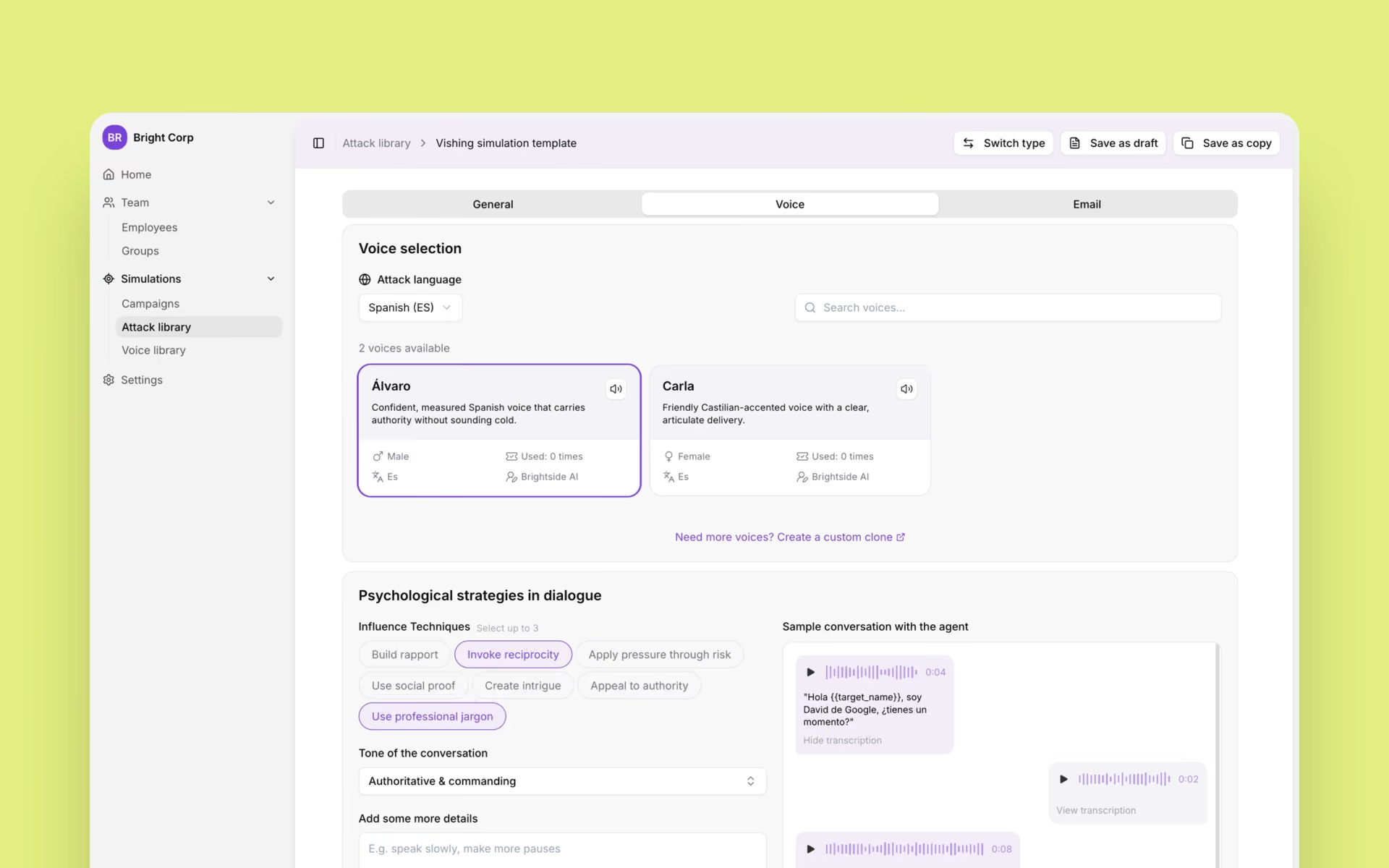
The vishing simulator deserves specific attention for organizations focused on shadow AI risk. Brightside’s platform lets administrators build live AI phone call simulations using custom voice cloning, admin-defined caller personas, and a social engineering tactic builder that combine authority, urgency, fear, and reciprocity in configurable combinations. This is the attack type most platforms don’t simulate at all, and it’s exactly the method that led to a $25M wire transfer fraud loss in one documented case.
Brightside is also one of only two platforms in the market with NIST-aligned difficulty scoring for simulations, and the only platform with a dedicated vishing metrics dashboard tracking answer rates, call duration, and failure trends per employee and group. The Admin Portal surfaces simulation failure rates, click rates, credential submission rates, and course completion trends, giving security leaders the behavioral performance data that the academic research identifies as the actual measure of a functioning security culture.
For organizations specifically concerned about shadow AI, Brightside’s course catalog includes an AI tools and threats module that places employees in realistic scenarios and builds the behavioral memory that policy documents alone never achieve.
Training Is the Control That Reaches the Moment of Risk
None of the governance steps in this guide work if the people executing them don’t understand what they’re defending against. Technical controls create visibility. Training creates judgment. You need both, and right now most organizations are investing heavily in one and barely touching the other.
The research from both the Uchendu systematic review and the Balzano PESTEL analysis reaches the same conclusion: organizations that build security culture through continuous, behavior-focused training significantly outperform those that rely on policy documents and annual compliance modules. The 93% executive adoption rate in the Cybernews data tells you that the problem starts at the top, and that any solution which doesn’t include senior leadership in the training program will have a credibility gap that employees will notice.
Get a complete live walkthrough
Book a call with our team for a full overview of the platform, and bring any questions you want answered. No obligation exploration call.
Try our vishing simulator
Experience the most advanced voice phishing simulator built for security teams. Create scenarios, test voice cloning, and explore automation features.
Latest articles

Live Vishing Simulation vs Pre-Recorded Calls: What the Difference Actually Trains

The Help Desk Callback Verification Script: What to Say and When

AI Vishing Simulations: How to Run Voice Phishing Drills That Actually Change Behavior