Back to blog
What’s the Best AI-Powered Cybersecurity Training Platform for Employees

Written by
Brightside Team
Published on
Your employees are your biggest security risk and your most underinvested defense. What are you actually doing about it?
That's not a rhetorical question. Most organizations spend millions on firewalls, endpoint detection, and threat intelligence, then allocate a fraction of that budget to the one layer attackers exploit most consistently: people. And the people problem is getting worse, not better.
Attackers now use the same AI tools your vendors are selling you. They generate convincing phishing emails in seconds, clone executive voices to run live phone scams, and produce deepfake video to authorize fraudulent wire transfers. The annual compliance module your employees clicked through in January isn't going to stop any of that.
This article helps you understand what modern platforms actually do differently and which features to demand before signing a contract. It also shows you how to measure whether your investment is changing behavior.
Why AI Has Changed How Cybersecurity Training Works
AI has moved from a marketing buzzword to a technical differentiator in how security training is built, personalized, and delivered. Platforms that use AI well don't just serve up the same video to every employee. They adapt to individual risk profiles, generate realistic simulations that mirror current attacker tactics, and track behavioral change over time rather than just recording who clicked "complete."
The market data backs up the urgency here.
Did you know?
Human error accounts for over 68% of data breaches, according to Verizon's 2024 Data Breach Investigations Report
The global security awareness training market is projected to surpass $10 billion by 2027, driven by escalating threat complexity and regulatory pressure
Organizations using adaptive, AI-driven training report significantly higher rates of measurable behavior change compared to organizations using static annual programs
Goldman Sachs estimates generative AI could affect up to 50% of tasks in exposed occupations, making AI literacy functionally inseparable from security literacy for the modern workforce
The CISO's dilemma is clear: threats are more sophisticated, budgets are tighter, and a workforce that isn't engaged with training is a workforce that isn't protected. AI-powered platforms are the practical response to that equation.
From Compliance Checkbox to Continuous Behavior Change
Traditional security awareness training was designed to satisfy auditors, not to change how people behave under pressure. Understanding why it failed is the first step toward buying something better.
The Old Model: Annual Modules and Pass/Fail Quizzes
Most organizations still recognize this pattern. Once a year, employees get assigned a 45-minute training module. The content is generic, the scenarios are obviously fake, and the passing threshold is 70% on a multiple-choice quiz. The employee clicks through, earns the completion certificate, and the security team files the report for the next audit.
Three months later, that same employee clicks a phishing link because the simulation doesn't look anything like the real attack they received. The training covered phishing in theory. It didn't train them to recognize a convincing, personalized email from what appeared to be their company's IT team referencing an actual internal project.
Behavior science is clear on why this approach fails. Information delivered without context, repetition, or real-world application doesn't change behavior. It creates awareness without developing a conditioned response. That gap is where breaches happen.
The New Model: AI-Driven, Adaptive, and Multi-Vector
Modern platforms work differently at every layer. Training arrives in short, targeted bursts triggered by actual employee behavior, such as a near-miss click on a simulation. Content adapts to each person's role, risk level, and previous performance rather than serving everyone the same material. And threat themes update continuously to reflect what attackers are actually doing right now, not what they were doing when the content library was built two years ago.
Email phishing is no longer the only channel. Attackers run AI-powered voice calls that conduct live, adaptive conversations to extract credentials or authorize actions. They produce deepfake video to impersonate executives. Platforms that only simulate email phishing are training employees for yesterday's attacks. The best platforms cover all three vectors natively, and they generate a human risk score for each employee that gives security leaders a measurable, trackable posture metric to bring to the board.
Why Demand for AI Security Training Platforms Is Surging Right Now
This isn't a gradual category shift. Three specific factors are driving rapid adoption right now.
Generative AI is accelerating attacks across every channel: Attackers use LLMs to write flawless, personalized phishing emails at scale, clone executive voices for vishing calls, and produce deepfake video to authorize fraudulent transfers. The attacks your employees face today are more convincing than anything in a static template library. AI-powered platforms can generate and update simulations continuously to keep pace with current attacker techniques, rather than relying on a fixed content set that grows stale within months.
Regulatory and compliance pressure is intensifying: NIS2 in Europe, SEC cybersecurity disclosure rules in the United States, and recent ISO 27001 updates all place explicit requirements on documented, measurable employee security training. Passing an audit with a completion rate spreadsheet is getting harder. CISOs need platforms that produce structured reporting on behavioral outcomes, not just who watched a video.
The cybersecurity skills gap is pushing risk down to every employee: The global shortage of cybersecurity professionals now exceeds 4 million, according to the ISC2 2024 Workforce Study. Organizations can't hire their way out of human risk exposure. Every employee, from the receptionist to the CFO, needs to function as a first line of defense. Achieving that at scale requires intelligent, automated training infrastructure that doesn't depend on a large internal security team to manage.
Must-Have Features in AI-Powered Cybersecurity Training Platforms
Before you look at a single vendor, you need a clear set of evaluation criteria. The phrase "AI-powered" appears in almost every platform's marketing. What separates genuinely intelligent platforms from legacy tools with a new coat of paint is how deeply AI is embedded in three specific capabilities.
Adaptive Learning and Personalization Engine
Adaptive learning means the platform adjusts what each employee sees based on who they are and how they've behaved, not on a fixed schedule applied to everyone equally.
In practice, this means a finance team member who repeatedly fails invoice-themed phishing simulations gets more frequent, more targeted training on business email compromise and wire transfer fraud. A developer gets content focused on credential theft, API key exposure, and supply chain attacks. A new hire in their first 30 days gets foundational content before more advanced scenarios are introduced.
Why it matters: generic training wastes time for employees who are already performing well, while leaving high-risk individuals under-trained in the exact areas where they're most vulnerable. Personalization closes that gap systematically, without requiring manual intervention from your security team for every employee.
Multi-Vector AI Simulations: Phishing, Vishing, and Deepfake
Email phishing simulations have been standard for years. What distinguishes the leading platforms in 2026 is coverage of the full attack surface: email, voice, and video.
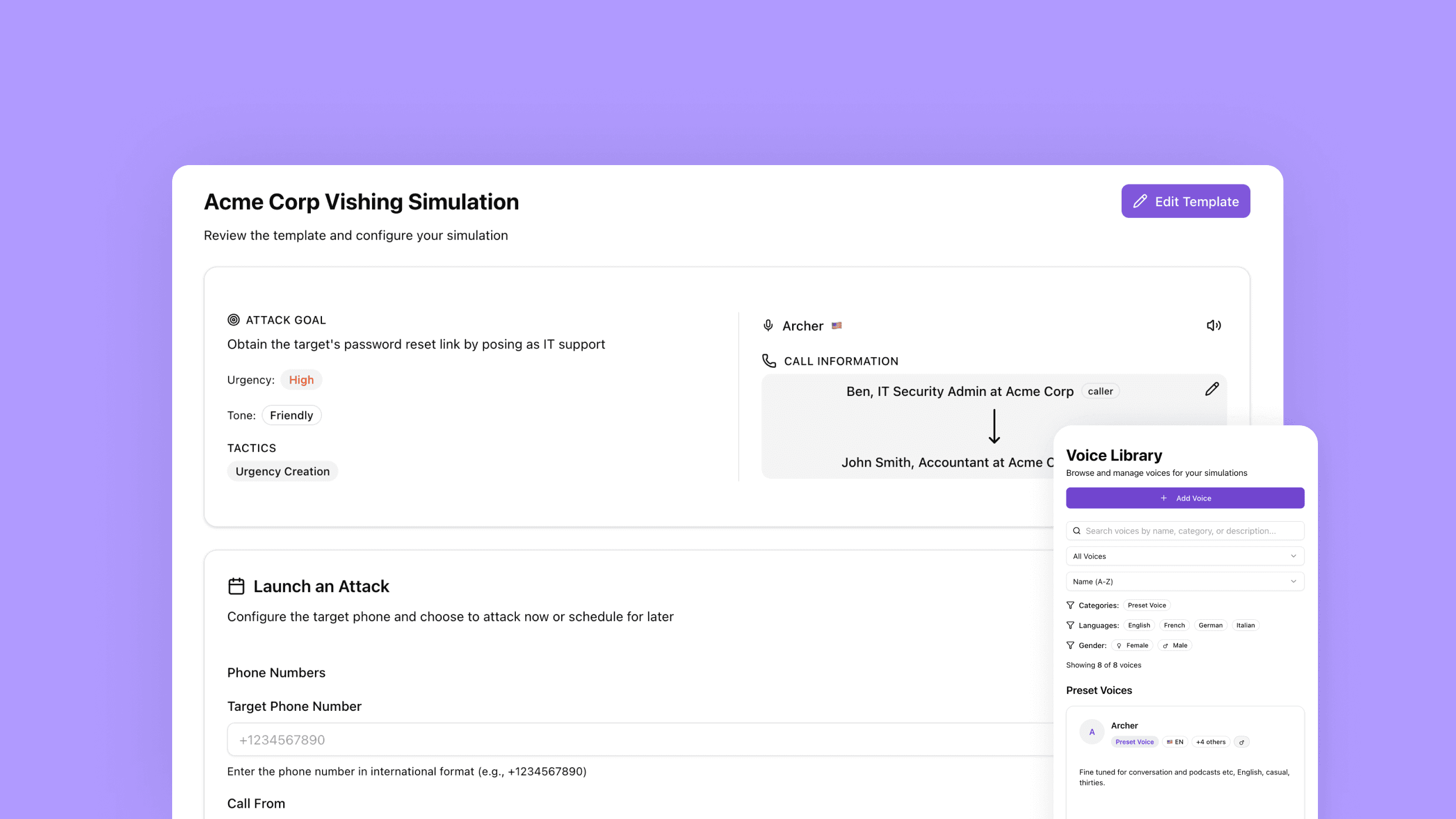
AI-powered vishing simulations place actual phone calls to employees and conduct live, adaptive conversations using generative AI. The AI agent adjusts its responses in real time based on what the employee says, mimicking the behavior of a skilled social engineer. Some platforms allow you to clone an executive's voice to make the call even more convincing and to test whether employees verify identity before complying with unusual requests.
Deepfake simulations prepare employees for video-based manipulation, the type of attack where a "CFO" on a video call instructs a finance employee to transfer funds urgently. This attack category is growing fast, and most employees have never been trained to question what they see on a screen.
Covering all three vectors isn't a nice-to-have. It's the baseline for any platform calling itself modern.
Behavioral Analytics and Human Risk Scoring
A human risk score aggregates each employee's simulation performance, training completion, and time-to-report behavior into a single, trackable metric. Good platforms surface this at the individual level, the team level, and the organization level, with trend data over time.
This capability matters for two reasons. First, it tells your security team where to focus intervention efforts before an incident occurs, not after. Second, it gives you something to show the board. Click rates and completion percentages don't communicate business risk. A risk score that moved from red to green over a 90-day campaign, with a phishing failure rate dropping from 34% to 8% in the accounts payable team, communicates something a non-technical executive can act on.
Look for platforms that weight their risk scores against recognized benchmarks such as the NIST Phish Scale, so your metrics carry external credibility in audit conversations.
Top AI-Powered Cybersecurity Training Platforms for Employees in 2026
The security awareness training market has matured considerably. The platforms below represent the leading options across different organization sizes, use cases, and threat models. Each has been evaluated on AI depth, simulation breadth, analytics quality, and real-world usability for security teams.
Platform | Core Strength(s) | Ideal Audience | Notable Feature |
|---|---|---|---|
KnowBe4 | Phishing simulation scale | Mid-market to enterprise | AI-powered phishing template generation |
Brightside AI | Multi-vector AI simulations | SMBs to enterprise | Vishing + deepfake + phishing in one platform |
Proofpoint Security Awareness | Threat-intelligence integration | Enterprise, regulated industries | Risk scoring tied to live email threat data |
Hoxhunt | Gamified adaptive simulations | Enterprise, global workforces | Employee-reported threat pipeline |
Adaptive Security | AI-generated deepfake simulations | Enterprise, high-risk sectors | Voice and video social engineering sim |
KnowBe4
KnowBe4 is the largest security awareness training platform by install base, with a library of thousands of phishing templates and a long track record in enterprise and mid-market organizations. Its strength is scale: broad content coverage, extensive compliance modules, and a mature reporting infrastructure that most IT teams already know how to use.
Key capabilities:
AIDA (AI-Driven Intelligent Agent) for generating personalized phishing emails based on employee data
SecurityCoach, which delivers real-time micro-training nudges when an employee triggers a risky behavior
A deep compliance content library covering frameworks including GDPR, HIPAA, PCI DSS, and ISO 27001
Gamified learning paths with leaderboards and progress tracking
CISO-level reporting dashboards with department-level drill-down and trend analysis
Brightside AI
Brightside AI is an award-winning Swiss cybersecurity awareness training platform that prepares organizations for modern cyber threats through full-coverage simulations and interactive courses, with AI-assisted automation to simplify training management. It's the only platform in this comparison that covers email phishing, AI-powered vishing, and deepfake simulations natively within a single unified interface, making it the most complete option for organizations that need to train employees across the full attack surface rather than just email.
Key capabilities:
AI-powered vishing simulations that conduct real-time adaptive phone calls using generative AI, with support for custom voice cloning to impersonate specific executives. The AI agent adjusts its responses dynamically during each live call, and supports English, French, German, and Italian
Deepfake simulations covering video and audio manipulation attacks, completing the training picture alongside email phishing and voice-based social engineering
AI-powered OSINT spear phishing that personalizes each simulation to the target employee using their role, department, tools, tenure, and location, pulling data from HR integrations with Google Workspace, Microsoft Active Directory, Okta, and Vanta
Brighty, a chat-based learning companion with gamification elements including mini-games, achievement badges, and challenges. Course topics range from phishing recognition and CEO fraud to deepfake identification, ransomware awareness, and AI tools as threats
Behavioral risk scoring with NIST Phish Scale weighting, month-over-month trend tracking, and color-coded thresholds (green below 0.5% simulation failure, yellow at 0.5 to 4%, red above 4%) for per-employee, per-group, and company-wide visibility
Flexible simulation campaigns that support one-time, quarterly, yearly, or continuous evergreen programs, with follow-up training triggered automatically when an employee fails a simulation
Proofpoint Security Awareness Training
Proofpoint's platform stands out for its direct integration with live threat intelligence, which means the phishing simulations your employees receive reflect actual campaigns targeting your industry right now, not a static template library. This makes it particularly well-suited to regulated industries with high threat exposure.
Key capabilities:
Threat-intelligence-fed simulation content updated from Proofpoint's global threat detection network
Very Attacked People (VAP) identification to surface the specific employees most targeted by real attackers, enabling prioritized training investment
Integration with Proofpoint's Targeted Attack Protection layer for a unified view of email risk and training gaps
Granular reporting segmented by department, role, and risk tier
Compliance-focused content libraries for financial services, healthcare, and government sectors
Hoxhunt
Hoxhunt takes a distinctly different approach from the rest of this list: it builds security culture through gamification and turns employees into active participants in threat detection, rather than passive recipients of training content.
Key capabilities:
Gamified phishing simulations with a reward mechanism that reinforces correct behavior rather than just penalizing failure
An employee threat-reporting pipeline that aggregates real suspicious emails reported by staff into a usable threat intelligence feed for the security team
Multilingual content with localization across a wide range of languages, making it strong for global organizations
Adaptive simulation paths based on each employee's individual performance history
Culture metrics dashboard that tracks security behavior change at the organizational level over time
Adaptive Security
Adaptive Security positions itself as one of the most technically advanced platforms in the market, with a focus on organizations that face elevated social engineering risk. It's particularly well-suited to financial services, crypto, and tech companies where targeted attacks against specific individuals are a primary threat.
Key capabilities:
AI-generated spear phishing, vishing, and smishing simulations built using the same generative AI techniques real attackers use
A deep personalization engine that builds attack scenarios from employee-specific data to maximize simulation realism
Deepfake video simulation capability for training employees to question visual identity verification
Real-time risk scoring that updates as employees interact with simulations
Enterprise integrations with SIEM and HRIS systems for a unified view of human risk alongside technical security signals
" height="5000.014289657591px" id="KrZEL4sI2" stroke-dasharray="" stroke-linecap="round" stroke-linejoin="bevel" stroke-width="50" stroke="rgb(165, 140, 255)" transform="translate(50 50)" width="5000px"/></svg>)
Try our vishing simulator
Experience the most advanced voice phishing simulator built for security teams. Create scenarios, test voice cloning, and explore automation features.
Implementation Plan and ROI Measurement
Picking the right platform is step one. Getting measurable results requires treating deployment as a behavior-change program, with clear scope, defined metrics, and a process for continuous improvement.
Designing and Scoping a Pilot Program
Don't start with a full organization rollout. Start where the risk is highest.
Identify your highest-risk cohort. Finance, HR, executive assistants, and senior leadership are typically the primary targets for phishing, vishing, and social engineering attacks. Begin the pilot with these groups.
Set a defined pilot window of 60 to 90 days. This gives you enough cycles to see behavioral change without committing to a multi-year program before you have evidence.
Establish a baseline before you launch anything. Run a silent phishing simulation in week one to capture your starting click rate, vishing answer rate, and reporting rate. Without a baseline, you can't measure improvement.
Get HR and legal aligned before simulations go live. Employees need to understand that simulations are part of their training program. The communication framing matters significantly for engagement and for avoiding morale issues.
Choose 2 to 3 simulation types for the pilot. A phishing campaign and at least one vishing simulation is a reasonable starting point. Adding deepfake coverage in the second cycle is a natural progression.
The research is consistent on this point: training programs without defined scoping and outcome metrics slide into checkbox territory. Employees notice when there's no apparent purpose, and engagement drops accordingly.
KPIs and Metrics to Track
The metrics you track in your internal dashboard and the metrics you bring to the board are not the same list. You need both.
For the security team:
Phishing simulation click rate, tracked per department and risk tier, with comparison to your pre-pilot baseline
Vishing simulation failure rate (call answered and attacker goal achieved before employee reported or terminated the call)
Time to report a suspicious email or call, as a proxy for how alert employees are in the moment
Training completion rate and course coverage rate by department
Human risk score per employee, per team, and company-wide, tracked as a trend over time
For the board:
Reduction in simulation failure rate from baseline to current period
Human risk score movement from red/yellow to green across high-risk cohorts
Correlation between training completion and reduction in actual phishing incidents or near-misses reported to the security team
Boards and auditors are increasingly asking for outcome metrics, not activity metrics. "85% of employees completed the training" is an activity metric. "Our phishing failure rate dropped from 28% to 6% over 90 days" is an outcome metric. Build your reporting around the latter.
Running Continuous Improvement Cycles
A quarterly review cadence keeps your program from stagnating.
Review simulation results across all vectors and identify any teams or individuals who remain persistently high-risk despite training. Increase simulation frequency and adjust content for these groups.
Update threat themes to reflect what attackers are doing right now. If a new ransomware variant is making headlines or a high-profile CEO fraud case is in the news, that's content your employees should be trained on immediately, not at the next annual refresh.
Gather employee feedback, not just performance data. Employees who find training annoying or pointless disengage quickly. Short pulse surveys after training cycles reveal friction points you can address before they erode participation.
Align content updates with any new regulatory requirements that emerged during the quarter.
Bring updated metrics to your board or risk committee with a clear narrative: what changed, why, and what you're adjusting next.
The goal isn't a training program that runs on autopilot. It's a training program that adapts at the same pace as the threats it's preparing your workforce to handle.
Frequently Asked Questions
What is the difference between AI-powered and traditional cybersecurity training?
Traditional training delivers generic, scheduled content to all employees regardless of their individual risk level or behavior history. AI-powered platforms personalize content delivery to each employee's role and performance, generate realistic simulations across multiple attack channels including email phishing, vishing, and deepfakes, and track behavioral change over time to reduce actual risk. The goal is measurable behavior change, not a completion certificate.
How do I measure the ROI of a cybersecurity training platform?
Track ROI through a combination of output metrics and business metrics. Output metrics include phishing and vishing simulation failure rates, time-to-report suspicious contacts, and training completion rates. Business metrics include reduction in successful phishing incidents, avoided incident response costs, and improved audit outcomes. Establishing a pre-training baseline for all metrics is essential. Without it, you can't demonstrate the delta that justifies the investment.
Which AI cybersecurity training platform is best for large enterprises?
Enterprises with complex, global workforces typically need platforms with strong personalization engines, multilingual content, deep SIEM and HRIS integrations, and board-level reporting capabilities. KnowBe4, Proofpoint, and Hoxhunt are strong contenders at enterprise scale. Brightside AI is well-suited for organizations that need full multi-vector simulation coverage including vishing and deepfakes across international teams, with support for four languages in voice simulations and enterprise-grade HR integrations.
Can AI-generated phishing simulations replace red team exercises?
No. AI-generated phishing and vishing simulations are effective for training general employee populations at scale, but they don't replace adversarial red team exercises. Red team engagements test technical infrastructure, privilege escalation paths, incident response procedures, and how your security team performs under pressure. Employee simulation programs and red team exercises serve different purposes and work best when they run in parallel.
The threat picture has changed permanently. AI-generated voice calls, deepfake video fraud, and hyper-personalized spear phishing have made the old annual training model not just ineffective but actively misleading: it gives organizations a false sense of coverage while leaving employees unprepared for the actual attacks they'll face. These platforms are built for the attacks your employees actually face today, not the ones from two years ago.
If you're evaluating options, start with a pilot in your highest-risk cohort, establish a behavioral baseline before you launch, and hold your chosen platform accountable to outcome metrics from day one. You can request a demo from Brightside AI directly at brside.com to see the multi-vector simulation framework in action, or compare the full vendor list above against your specific use case before shortlisting.