How to Train Employees Against AI-Generated Phishing Attacks (2026 Guide)
AI-generated phishing achieves the same click rates as human experts. Annual training won't fix that. Here's how to redesign your employee security program. Plus a list of best platforms to train employees against AI-powered phishing.

In 2024, researchers tested whether AI-generated spear phishing emails could match the performance of ones written by human social engineering experts. They could. In a peer-reviewed human-subject study published at Cornell (arXiv 2412.00586), AI-generated phishing emails achieved a 54% click-through rate, identical to emails crafted by professional attackers and 350% higher than the control group. The cost to generate each email was roughly $0.04.
That finding matters because most employee phishing training is still built on the assumption that phishing looks suspicious. The old tells (poor grammar, generic greetings, implausible pretexts) were real signals for a long time. Large language models have eliminated them. A well-prompted model can produce a spear phishing email that references a real internal project, mirrors your CEO’s writing style, and arrives timed to something actually happening at your organization.
This guide covers what to do about it. Not a list of new red flags to add to your annual training slides, but a practical framework for rebuilding a phishing training program that prepares employees for the attacks they’ll actually face: AI-generated email, live AI phone calls, deepfake audio and video, and coordinated multi-channel campaigns.
Why the Threat Changed, and Why Most Training Programs Haven’t
Three developments have converged to make the current phishing threat qualitatively different from what most programs simulate.
AI-generated email at scale. Large language models can produce personalized spear phishing emails from publicly available OSINT in seconds. A model given an employee’s job title, company, and LinkedIn activity can write a phishing email from an apparently legitimate sender that references the real tools they use, the real people they work with, and real events in their organization’s calendar. The cost is negligible. The output, for a significant share of targets, is indistinguishable from a legitimate message.
Live AI voice calls. Vishing attacks rose 28% in 2024 (APWG Q3 Phishing Trends Report), and the attacks themselves have changed. Today’s AI vishing tools don’t leave voicemails or play recorded scripts. They conduct live phone conversations, adapting in real time to whatever the target says. A caller can maintain a convincing impersonation of an IT helpdesk employee, a bank fraud team, or a company executive through an entire interaction. Voice cloning from short recordings makes it possible to reproduce a specific person’s voice, not just a generic caller persona.
Deepfake fraud. Deepfake audio and video used in fraud increased substantially in 2025, with CEO impersonation via video call now documented at enterprise scale. In the Arup case, a Hong Kong finance employee authorized a £20 million transfer after a video call featuring deepfake versions of company executives. The employee had no reason to be suspicious. The people on the call looked and sounded like colleagues they recognized.
What connects all three is that they defeat detection-based training. Employees were taught to spot bad signals: awkward phrasing, mismatched sender domains, unusual urgency. AI-generated attacks often carry none of those signals. Training that teaches pattern recognition against yesterday’s phishing doesn’t prepare employees for attacks that contain no detectable patterns.
The financial stakes reinforce the urgency. The FBI’s Internet Crime Complaint Center has documented more than $55.5 billion in losses from business email compromise across 305,000 incidents over a decade. IBM’s 2024 Cost of a Data Breach Report puts the average breach cost at $4.88 million, with phishing remaining the primary initial access method. Those numbers largely predate the widespread adoption of AI in attacker toolchains.
Annual Training Doesn’t Protect Against This
Most organizations run annual security awareness training because compliance frameworks and cyber insurance policies require it. The problem is that annual training doesn’t work, and there’s now peer-reviewed research to confirm it.
A study conducted at UC San Diego Health and published by researchers at the University of Chicago tracked employee phishing susceptibility over eight months. The finding: no significant correlation existed between how recently employees had completed their annual training and their ability to avoid phishing attacks in simulations. Employees who had just finished the annual course performed no better than employees who hadn’t trained in over a year.
The underlying mechanism is well-established. Without reinforcement, trained behavior decays. Studies tracking click rates after training show a consistent pattern: rates drop to around 3.5% immediately after a training event, then climb back above 15% within 90 days (UCSD/Beauceron research). Annual training produces a temporary improvement that largely disappears before the next session.
What actually reduces susceptibility, across the research literature, is training delivered at the moment of failure. A meta-analysis of 42 studies found that point-of-error training, educational content triggered immediately when an employee fails a simulation, reduces susceptibility by roughly 40% on average. That’s the best-supported intervention in the field. The mechanism is straightforward: employees are most receptive to security feedback immediately after making a mistake, before the moment passes and the lesson becomes abstract.
Interactive training also outperforms passive content. Employees who work through scenario-based exercises perform better on subsequent simulations than those who received the same information as slides or video. But even well-designed interactive training needs to be paired with realistic simulations at adequate frequency to sustain the effect.
The broader picture is consistent with this. Fortinet’s 2025 Security Awareness and Training Report, covering 1,850 respondents, found that 94% of organizations run regular training but only 6% achieve full completion. Meanwhile, 69% of IT and security leaders still report that employees lack adequate security awareness, a figure that hasn’t improved year-over-year. More training volume isn’t the answer. Better training design is.
What a Redesigned Training Program Looks Like
The framework below is a program structure, not a vendor checklist. It applies to any platform that supports continuous simulation, multi-channel attack types, and triggered follow-up training.
Step 1: Baseline your current exposure
Before changing anything, measure where you are. Run a baseline phishing simulation across your employee population and record the phish-prone percentage, the share of employees who click a simulated link or submit credentials. Industry benchmark data puts the average at around 33% before any structured program is in place (KnowBe4 2025 Phishing Benchmark; vendor-reported).
More importantly, identify your channel gaps. Most organizations have email simulation in place. Almost none run regular vishing simulations against real employees. Fewer still include deepfake or video-based scenarios for high-risk roles. A baseline assessment should surface not just click rates, but which attack channels your program currently leaves untested, because those gaps are exactly what sophisticated attackers exploit.
Step 2: Set simulation frequency by risk level
Monthly simulations are the minimum for most employees. High-risk roles like finance teams, HR, executives, and IT administrators warrant more frequent testing, typically biweekly. These roles are disproportionately targeted because they have access to financial systems, sensitive data, or the authority to approve unusual requests.
Quarterly is too infrequent. Given the 90-day decay in training effectiveness, a quarterly schedule means the majority of employees are operating near their pre-training baseline for most of the year. New hires compound the problem: anyone who joins between simulation cycles may go months without any practical exposure to a simulated attack.
The point isn’t to catch employees failing. It’s to create enough repeated exposure that recognizing and reporting suspicious contact becomes a habitual response rather than something that requires deliberate effort.
Step 3: Trigger training at the moment of failure
Every failed simulation should automatically trigger a short, specific follow-up training module, not manager escalation or a note in a personnel file. The follow-up should appear immediately, explain exactly what signals the simulation contained, and take no more than five minutes. Brevity matters: research on follow-up training pages shows that employees who reach training after clicking a simulated phishing link spend less than a minute on it on average. Content that demands more attention doesn’t get it.
The framing matters too. Programs that treat simulation failures as disciplinary events suppress the behavior you most need: employees reporting real suspicious contact without fear of consequences. The goal is to make reporting feel like a win, not a confession.
Step 4: Add channel coverage progressively
Start with email if you haven’t already. Then add vishing simulations.
Vishing is the channel most organizations currently skip, and it has the fastest-growing attack volume. Employees who’ve never experienced a live social engineering phone call, even a simulated one, have no practical reference for what one sounds like. The goal of vishing simulation isn’t just to measure failures. It’s to give employees direct experience of a live caller using urgency, authority impersonation, or pretexting so they can recognize those patterns when a real call arrives.
For high-risk roles like executives, finance, and legal, add deepfake awareness scenarios. Not necessarily full video call simulations for every employee, but people who are plausible targets for CEO fraud should have direct exposure to what a deepfake audio or video request looks like before one arrives in a real context.
Step 5: Progress difficulty over time
A new employee who clicked a basic branded email simulation needs different training than someone who’s been in the program for two years and hasn’t clicked in six months. Effective programs adjust simulation difficulty as employees improve.
The NIST Phish Scale provides a defensible framework for calibrating difficulty: it scores phishing emails on the plausibility of the pretext and the relevance to the target, mapping to a range from least difficult to very difficult. Running employees through progressively harder simulations maintains the training effect as their baseline awareness improves, and prevents the habituation that comes from repeatedly receiving the same difficulty of test.
Step 6: Train the process
The most important shift in a modern phishing training program isn’t technical. It’s behavioral.
Detection-based training asks employees to identify suspicious signals in messages or calls. That worked when phishing had consistent tells. It doesn’t work reliably against AI-generated content that often has none.
Process-based training teaches a different behavior: any unusual request involving credentials, payments, access, or sensitive data requires verification through a separate channel before acting on it. The question shifts from “does this look suspicious?” to “did this arrive through a channel that could be spoofed?” If a caller claims to be from IT and asks for a password reset, the response is a callback to a known IT number, regardless of how convincing the caller sounds. That behavior doesn’t degrade as AI-generated attacks improve.
This is also why framing matters in how you communicate the program to employees. A workplace where the default response to an unusual urgent request is a quick verification step will hold up far better than one that depends on each person spotting each attack.
The Metrics That Actually Reflect Training Progress
Training completion rates measure compliance. They don’t measure security improvement. An organization where every employee completed their annual module but 35% clicked a simulated phishing link the following month has a compliance program, not a security awareness program.
The metrics worth tracking:
Phish-prone percentage trend. Not a single data point, but a direction over time. What matters is whether click rates are declining across your employee population and whether improvements hold between simulation cycles rather than resetting each time.
Simulation report rate. The share of employees who actively report a suspicious simulation, rather than just deleting it, is a stronger signal than the click rate alone. Reporting behavior indicates employees are engaging with the program and developing the habit of flagging suspicious contact, which is the behavior that matters most against real attacks.
Time-to-report. How quickly employees flag a suspicious simulation after receiving it. Fast reporting times indicate that security awareness has become an active concern rather than a background one.
Multi-channel coverage rate. If your metrics only cover email click rates, you’re measuring one channel and leaving two others untested. Tracking what percentage of employees have been exposed to vishing and deepfake simulations in the past 90 days gives a fuller picture of program coverage.
For vishing programs: answer rate (what share of simulation calls employees pick up) and vishing failure rate (what share of answered calls result in successful social engineering). Call duration trends can also indicate whether employees are engaging long enough for a real attacker to succeed.
KnowBe4’s benchmark data shows phish-prone percentages dropping from a 33.1% average to around 4.1% after 12 months of continuous training in their customer base (vendor-reported). That’s a useful directional target, but it’s platform-specific data. Use it as a reference range, not a universal benchmark.
Best Platforms to Train Employees Against AI-Powered Phishing Attacks
The program framework above requires specific capabilities: continuous simulation scheduling, multi-channel attack types, point-of-error training triggers, and difficulty calibration. The five platforms below cover this space. All support email phishing simulation as a baseline; they differ significantly on vishing, deepfake, and AI-era threat coverage.
Adaptive Security
Adaptive Security is built for AI-era threat simulation. It uses conversational AI agents to run simulations across email, phone, SMS, and video, and covers attack surfaces that most platforms don’t address, including OWASP LLM Top 10 scenarios, prompt injection, and indirect prompt injection via shared documents. This makes it relevant for organizations where employees use AI tools and face risks beyond conventional phishing vectors. The platform includes enterprise exposure monitoring and posture automation for executive-level risk visibility. Public documentation on the specifics of its vishing workflow and voice cloning capabilities is less detailed than some competitors in this list. Best for organizations that need broad AI threat coverage including AI-tool-related attack surfaces, not just phishing and voice.
Brightside
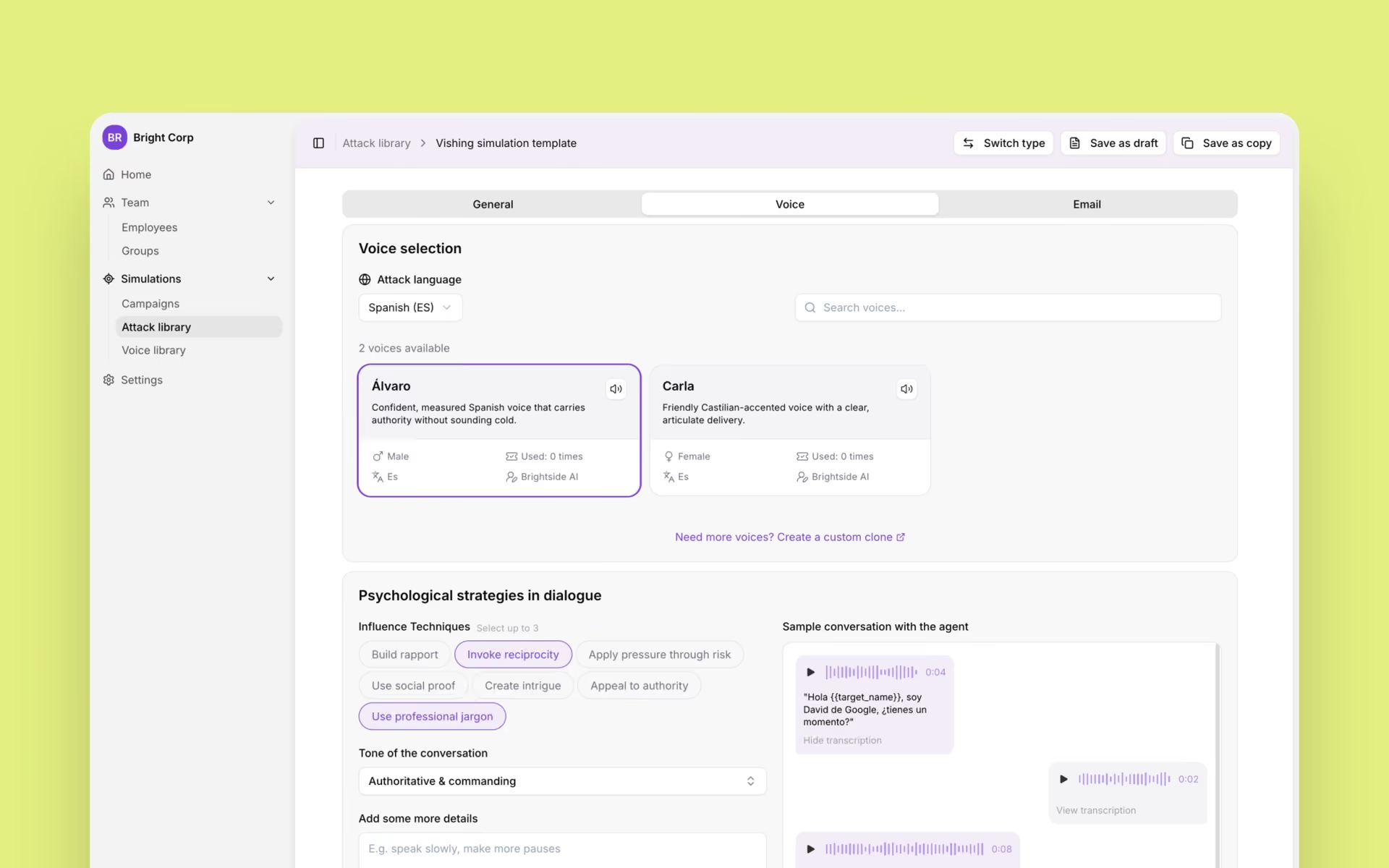
Brightside covers email phishing, live outbound AI vishing, deepfake simulations, and hybrid voice-plus-email attacks from a single platform. Its vishing product runs actual outbound AI phone calls that adapt in real time to the employee’s responses, not voicemails or scripted callback flows. Admins configure a caller persona, social engineering tactics (pretexting, authority impersonation, fear, commitment escalation, social proof), and conversation tone, with optional delivery notes. Custom voice cloning from a one-to-two minute recording enables executive impersonation scenarios, and a test launch lets admins take the live call themselves before deploying it to employees. Email simulations are aligned to the NIST Phish Scale for difficulty calibration. Automatic follow-up training triggers on simulation failure. The platform is Swiss-based with support for English, French, German, and Italian, which is relevant for EU organizations with NIS2 or DORA obligations. Integrations include Google Workspace, Microsoft Active Directory, Okta, and Vanta. Brightside is a simulation-first specialist: it doesn’t include SIEM/EDR integration or a live threat intelligence feed. Best for organizations that need phishing, live AI vishing, and deepfake simulation in one platform, particularly those building programs that match the multi-channel attack patterns now documented in the wild.
Hoxhunt
Hoxhunt’s primary differentiator is its adaptive difficulty engine, which adjusts simulation complexity per employee without admin configuration. Employees who consistently report simulations receive harder ones; those who struggle start with simpler scenarios. The platform uses a positive reinforcement model, rewarding employees for reporting rather than penalizing failures, which tends to produce higher report rates than shame-based approaches. Hoxhunt reported a 63% reduction in repeat phishing victims within six months in its 2025 customer data (vendor-reported). Its video meeting simulation combines a fake Teams or Meet call with a phishing email in a single scenario, though the call component is browser-based rather than a live outbound AI call. Best for enterprises where long-term behavioral change and minimal admin overhead are the primary goals, and where programs have plateaued after initial-year improvements.
KnowBe4
KnowBe4 is the market’s largest platform by customer count, with the most extensive content library and the most widely cited phishing benchmark data. Its AIDA agent autonomously selects phishing templates based on each employee’s click history, reducing the admin work of keeping simulations fresh. KnowBe4’s 2025 Phishing Benchmark Report shows phish-prone percentages dropping from a 33.1% baseline to 4.1% after 12 months of continuous training in its customer base (vendor-reported). The platform offers strong compliance reporting, broad language support, and enterprise scale. Its vishing options are limited to scripted, keypad-driven test calls on the SAT Advanced or Diamond tier and a callback phishing flow at Diamond tier, and neither is a live adaptive AI conversation. Best for organizations that need scale, content breadth, and compliance-ready reporting, with email phishing as the primary simulation channel.
Proofpoint Security Awareness
Proofpoint’s differentiator is threat-intelligence integration. Its Satori agent deploys training simulations based on the phishing attacks actively targeting the organization through the Proofpoint email security stack, so employees practice against threats that are literally arriving in their environment, not generic templates from a library. This produces more operationally relevant simulations for organizations already using Proofpoint’s email security. The platform also offers strong risk modeling and suspicious-message reporting for Outlook and Gmail. Its value scales with the depth of Proofpoint ecosystem investment; as a standalone awareness platform, it is less distinctive. There is no documented live outbound vishing capability. Best for organizations already running Proofpoint email security who want awareness training directly informed by their live threat intelligence.
Get a complete live walkthrough
Book a call with our team for a full overview of the platform, and bring any questions you want answered. No obligation exploration call.
Try our vishing simulator
Experience the most advanced voice phishing simulator built for security teams. Create scenarios, test voice cloning, and explore automation features.
Latest articles

Live Vishing Simulation vs Pre-Recorded Calls: What the Difference Actually Trains
The Help Desk Callback Verification Script: What to Say and When

AI Vishing Simulations: How to Run Voice Phishing Drills That Actually Change Behavior