Multi-Channel Phishing Test Tools (2026): Which Ones Run the Call and the Email as One Attack
Most multi-channel phishing tools are several single-channel tools sharing a target list. We ranked 10 platforms on one question: can the email and the phone call run as one attack, with one result?

Key Takeaways
- The FBI’s Internet Crime Complaint Center defines the crime type as “the use of unsolicited email, text messages, and telephone calls,” and logged 191,561 Phishing/Spoofing complaints in 2025, the largest single crime type by complaint count. Most simulation programs test the first third of that definition.
- IBM’s 2026 Cost of a Data Breach Report found vishing and smishing produced the highest average breach cost of any initial vector, $5.29 million, against a global average of $4.99 million.
- The 2026 Verizon DBIR found 62% of breaches involved the human element, and calls mobile devices “the new favorite target” on 40% higher click rates.
- Channel count is not coordination. Keepnet Labs sells six channels and more than 30,000 templates to over 4,000 organizations, and states on its own product page that “each channel has its own campaign manager.”
- Three of the ten platforms we compared build the call and the email as one attack with one result record: Brightside AI, Adaptive Security, and Arsen.
- Brightside’s Voice + BEC is a single template that produces a single result, and the admin sets whether the BEC email arrives before the call, so it’s already sitting in the inbox when the AI agent mentions it, or after the call ends.
- Six different products answer yes to “do you do vishing” and they are not substitutes: a live self-serve agent, a tier-gated live agent, a keypad-driven IVR, a managed human engagement, a browser audio session, and nothing at all.
IBM’s 2026 Cost of a Data Breach Report found that vishing and smishing attacks produced the highest average breach cost of any initial vector, at $5.29 million, against a global average of $4.99 million. The same report found phishing was the most common initial attack vector for the fourth consecutive year. So the cheapest way in is email, and the most expensive way in is the phone. Most security teams test the cheap one.
That’s not because anyone thinks email is the whole problem. It’s because the tooling made email easy and everything else hard, and because “multi-channel” on a vendor website usually means the vendor sells more than one product without the products talking to each other. Buy it and you get a phishing simulator, and a voice simulator, and maybe an SMS simulator, each with its own campaign screen, each pointed at the same list of employees, each reporting separately.
The 2026 Verizon DBIR points the same way, calling mobile devices “the new favorite target” on 40% higher click rates. This guide compares ten platforms on eight criteria, and the first three are all about one thing: can a single attack cross channels? Not can you run two campaigns in the same week. Can the email and the phone call be one exercise, with one timeline and one result for the person who ignored the email and then approved the invoice on the phone? By the end you’ll know which three platforms do that, what the other seven do instead, and the questions that separate them on a demo.
What is a multi-channel phishing test?
The FBI’s Internet Crime Complaint Center, in its 2025 Internet Crime Report, defines Phishing/Spoofing as “the use of unsolicited email, text messages, and telephone calls purportedly from a legitimate company requesting personal, financial, and/or login credentials.” Three channels, one crime type, one definition. IC3 logged 191,561 Phishing/Spoofing complaints in 2025, the largest single crime type by complaint count.
A multi-channel phishing test is an exercise that covers more than one of those channels. That’s the floor. The interesting question is what “covers” means, and there are three answers in this market.
Separate campaigns. The platform sells an email simulator and a voice simulator. You build a phishing campaign, you build a vishing campaign, you point both at the same group, and you look at two sets of results. This is the most common shape by a wide margin.
Joined reporting. Same as above, except the results meet afterwards in one dashboard. Keepnet describes this precisely on its phishing simulator page: “Each channel has its own campaign manager, and you can run email, SMS, voice, QR code and callback campaigns against the same target group,” with reporting bringing the results together. It’s genuinely useful and it is not a coordinated attack. The attacks never met. Only the numbers did.
One attack. The email and the call sit inside a single campaign object, on one timeline, producing one result record. The admin decides whether the email arrives before the call or after it. Brightside’s Voice + BEC works this way: one template, one result, with the BEC email timed to land before the call so it’s already in the inbox when the agent refers to it, or after the call ends.
Why does the distinction matter? Because real attacks are built the third way. An employee who deletes a suspicious invoice email and then, twenty minutes later, takes a call from someone who already knows about that invoice is in a very different position than one who gets two unrelated tests a month apart. The pretext carries across. That’s the thing being rehearsed, and a program running channels separately never rehearses it.
The compliance frameworks are quieter on this than you’d hope. PCI DSS v4.0 Requirement 12.6.3.1, mandatory since 31 March 2025, requires awareness training covering threats to the cardholder data environment, explicitly including phishing and related attacks and social engineering. ISO/IEC 27001:2022 Annex A control 6.3 says personnel “should receive appropriate information security awareness, education and training and regular updates of the organisation’s information security policy, topic-specific policies and procedures, as relevant for their job function.” NIS2 Article 21(2)(g) lists “basic cyber hygiene practices and cybersecurity training” among its minimum measures for essential and important entities. None of them names a channel. So compliance won’t force this decision for you, which means it’s a risk decision, and the risk numbers point at the phone.
If what you want is the wider view of which platform covers which channel, we’ve written that comparison separately: the full channel-by-channel roundup and our guide to multi-vector simulations. This one is about whether the channels work together.
What to look for in a multi-channel phishing test tool
Eight questions. The first three take the coordination claim apart, because it’s the one most often asserted and least often demonstrated.
Can one attack cross channels?
A good answer is one campaign object, one timeline, one result record per employee. Not two campaigns aimed at the same list, and not two dashboards that a report stitches together afterwards.
So ask to see the single campaign that sends an email and places a call, then ask for the one result row it produced for one person. If that means opening a second screen, you’re looking at two products.
Does the second channel reference the first?
Coordination isn’t just simultaneity. The email has to be able to arrive before the call so the agent can mention it, or after the call as the follow-up the caller promised. Both orders are real attack patterns and the admin should choose per template.
Ask them to move the email from before the call to after it, inside the same template, while you watch. Brightside puts that control in the BEC email step of the template builder, where delivery timing is the first thing you set.
Does one employee produce one result, or several?
The valuable data point in a coordinated test is the person who passed one channel and failed the other. That only exists if both channels write to one record.
Ask for the result row of somebody who ignored the email and then failed on the phone. Adaptive Security rolls both into one enrollment record per user. Brightside’s Voice + BEC produces one result for the attack rather than one per channel.
What actually happens when the phone rings?
This is where the word vishing stops being informative. Six different mechanisms are sold under it, and they train completely different things:
- A live self-serve agent. A real outbound call with a two-way AI agent that adapts to what the employee says, configured by you.
- A tier-gated live agent. The same mechanism, sold as a paid add-on, often undocumented.
- A keypad IVR. A real call, but stepped text-to-speech or recorded audio advanced by pressing digits. No speech recognition.
- A managed human engagement. The vendor’s staff make the calls. It’s a service rather than a product you run.
- A browser audio session. An AI voice conversation inside a browser tab. No phone call, no phone number.
- Nothing at all, behind a page that talks about vishing.
We’ve broken down what each call mechanism actually trains elsewhere. On a demo, the test takes ten seconds: ask them to dial your mobile and then interrupt the agent mid-sentence. A live agent handles it. A keypad IVR keeps reading.
How much of the attack do you get to write?
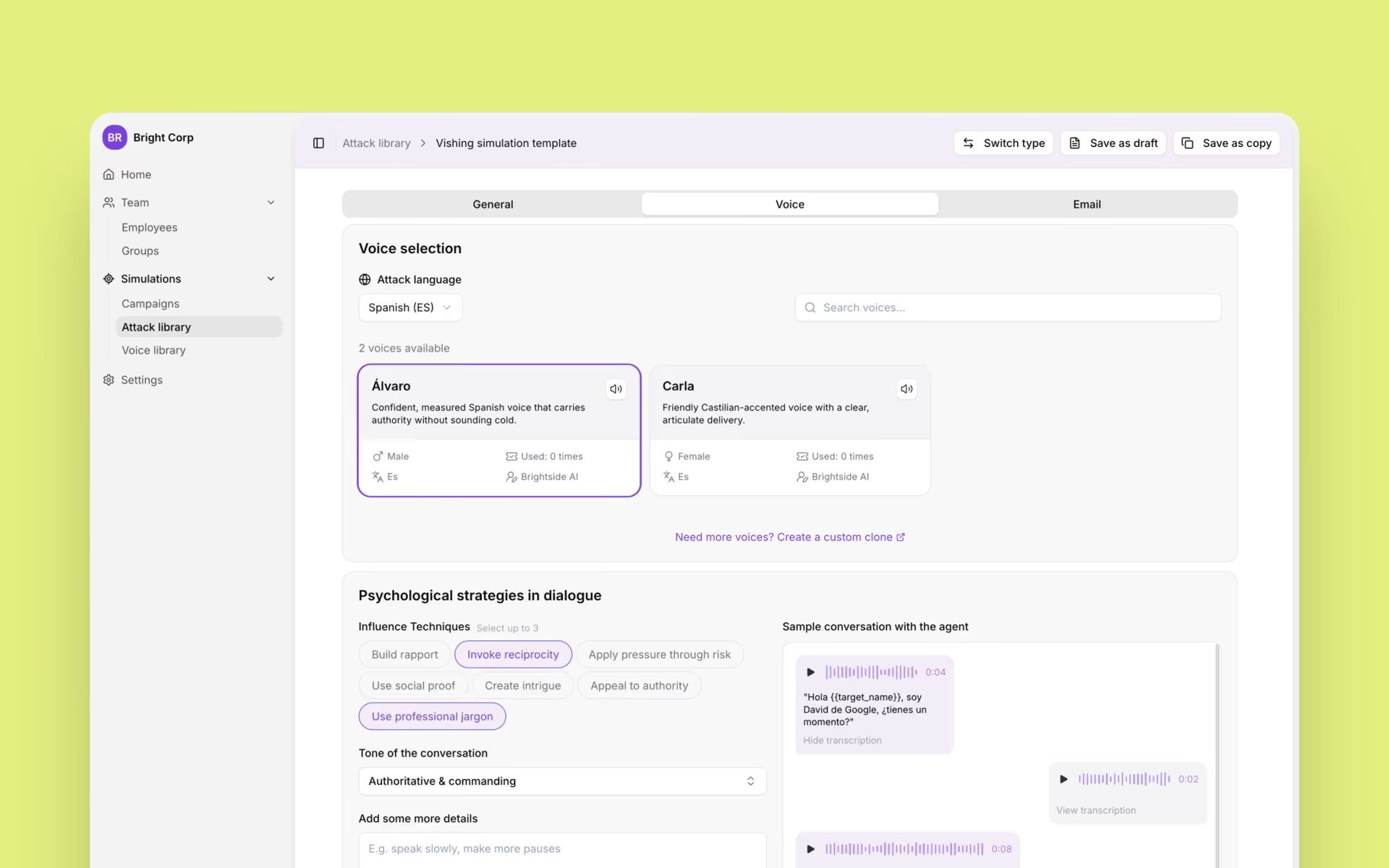
Some platforms give you a difficulty dropdown and a persona category. Some give you one free-text box. Brightside gives admins discrete controls: an attack goal with presets for things like a 2FA phishing link or a fraudulent invoice approval, a caller name, position and organization plus a context field for ticket numbers and recent account activity, up to three influence techniques chosen from Build rapport, Invoke reciprocity, Apply pressure through risk, Use social proof, Create intrigue, Appeal to authority and Use professional jargon, a tone dropdown, and a free-text field for delivery notes.
Build a template live on the call and count the controls, and ask specifically how you’d tell the caller to appeal to authority while sounding helpful.
Can you hear it before your employees do?
Two different things hide behind “preview”. One is hearing the agent before you commit. The other is receiving the actual exercise yourself, exactly as the employee will. Several vendors have one. One documents having neither.
What does the voice channel measure?
Click rate doesn’t describe a phone call. A voice channel needs its own metrics: answer rate, call duration, failed rate, with a trend window to measure against. If the platform reports voice results inside the email dashboard, it probably bolted voice on. We’ve written about how to read the four vishing metrics in more detail.
How difficult was it, on whose scale?
A failure rate without a difficulty rating is uninterpretable. The good answer is a published scale, ideally the NIST Phish Scale, which grades on observable cues and premise alignment rather than on how hard the template felt to the person who wrote it.
Ask which scale, and whether difficulty is computed or hand-assigned. “Easy, medium, hard” with nothing behind it is a label pretending to be a scale.
How we evaluated
Each platform is scored on the eight criteria above, weighted toward the first four, because coordination and call mechanism are what separate a multi-channel program from a set of single-channel ones. What counts as evidence is how deeply a vendor documents the mechanism behind a channel rather than its existence, how much of the campaign workflow is published rather than asserted in marketing, and the review scores.
On ratings, Arsen is 4.8/5 on G2, Hoxhunt 4.8/5, KnowBe4 4.6/5 on G2, SoSafe 4.5/5 on G2, Proofpoint ZenGuide 4.5/5 on G2, Infosec IQ 4.5/5 on G2, and Brightside 4.4/5 on G2. Adaptive Security holds 4.9/5 on Gartner Peer Insights.
Several platforms here sell a channel that no public page explains: no campaign flow, no configuration surface, no metric. Nobody outside the vendor can judge whether it works, and on a security purchase that silence is its own kind of answer.
1. Brightside AI
Brightside AI is a Swiss security awareness platform built around attack simulation rather than content volume, covering email phishing, live AI voice calls and audio deepfakes in one product, alongside 14 interactive courses in English, French, German, Italian and Spanish. It rates 4.4/5 on G2. It takes slot one for a specific reason: it’s the platform here where the call and the email are written in the same template builder and come back as one result.
What does Brightside AI do well?
- Voice + BEC is one attack rather than two campaigns. Brightside runs three attack types on a vishing campaign, Voice, Voice + BEC and BEC, and the Voice + BEC template covers both channels and produces a single result per employee.
- The admin controls the order. Brightside lets the admin set the BEC email to arrive before the call, so it’s already in the inbox when the agent mentions it, or after the call ends, which is the “I’ll send that over now” pattern. That control sits inside the template, where the attack is designed.
- The agent is live and steerable control by control. Brightside’s AI agent holds a real-time conversation and adapts to what the employee says, driven by an attack goal, a caller persona with a free-text context field, up to three influence techniques from a fixed set of seven, a tone dropdown and delivery notes. That’s the most granular attack-design surface in this comparison.
- Voice cloning is self-service from a 1 to 2 minute recording, with no service engagement.
- Three separate checkpoints before anyone is called. Brightside generates a sample conversation in the template builder, playable turn by turn with a transcription; lets the admin take the call in the browser from the campaign’s Attacks step; and runs a test launch at step five delivering the real exercise exactly as the target will get it.
- The voice channel has its own dashboard: failed rate, answer rate, median call duration and total simulations, with a failed-rate trend over 7, 30 or 90 days and a baseline option that treats the first round as the before-training benchmark.
- Email difficulty runs on the NIST Phish Scale, from Least Difficult to Very Difficult.
One reviewer on G2 put the practical version plainly: “I like that Brightside AI makes it easy to clone voices and create templates. The engine seems to work well and is effective, which makes it a great starting point.”
What to know before you buy
- Vishing sits in the Pro tier or the Voice add-on, and the Voice add-on requires at least 10 seats. AI spear-phishing is Pro only.
- Audio deepfakes are self-service through voice cloning. Video deepfakes are a managed service the Brightside team produces and runs, scoped per engagement and priced outside the standard packages.
- The published walkthrough of the campaign path and template builder shows the workflow, so it can be checked before a demo.
Best for
Security teams that want the call and the phishing email rehearsed as one attack, with fine-grained control over what the caller says and why.
2. Adaptive Security
Adaptive Security is an AI-native human risk platform positioned around deepfake and multi-channel social engineering, and it’s the closest true peer in this field on voice. It rates 4.9/5 on Gartner Peer Insights as of 19 June 2026. The one published price point is on AWS Marketplace, where the Elite Package for organizations under 100 employees runs $5,988 for 12 months.
What does Adaptive Security do well?
- Adaptive chains channels inside one scenario. Its Preview screen shows an
Email › Phone Callbreadcrumb, and results roll up to one enrollment record per user, which puts it in the small group that genuinely coordinates rather than co-locates. - The agent navigates IVR phone trees to reach a human, works outbound and inbound, and can be pointed at shared numbers, help desks and call centres rather than only at individual employees. That’s a real capability gap in its favour, and it matters if your exposure is a service desk.
- Adaptive clones voices self-serve and generates deepfake video self-serve through AI Personas, currently in beta, which takes an image, a short audio clip and a script.
- Reporting is the deepest in this comparison: more than 50 pre-built reports, Report Boards with AI-written narrative summaries, PowerPoint export, and Campaign Insights covering pickup rates, callback rates, call durations and AI-generated summaries of each call.
- Preview Scenario is thorough, offering a Send Preview, an in-browser Simulate Call, and a dial-in number so you can take the call on your own device.
Where does Adaptive Security fall short?
- The attack-design surface is thin next to the reporting. Adaptive exposes a persona category and a difficulty setting, and that’s the steering. If you want to specify that the caller appeals to authority while staying warm and using procurement jargon, there’s nowhere to say so.
- Difficulty is Easy, Medium and Hard with no published scale behind it, so a failure rate can’t be compared against an external benchmark.
- No public source outside Adaptive’s own materials documents an end-to-end vishing campaign, which makes independent verification harder than it should be for a platform this prominent.
- Adaptive markets itself as the only platform unifying email, vishing, smishing and deepfake video in a single admin interface, and it has publicly asserted that KnowBe4 lacks native vishing, which is not the case. Treat the marketing claims as claims.
Brightside gives the admin discrete influence-technique toggles, a tone control and a delivery-notes field where Adaptive exposes a persona category and a difficulty setting. We’ve laid out the full comparison between the two platforms separately.
Best for
Enterprises that want the widest coordinated channel set and board-ready reporting, and that don’t need to hand-write the caller’s tactics.
3. Arsen
Arsen is a Paris-based simulation platform covering phishing, smishing and vishing, and it’s the closest European peer on live voice. It holds 4.8/5 on G2, the highest score of any platform here. Arsen launched its smishing module in summer 2025 and opened it to all customers on 24 October 2025.
What does Arsen do well?
- “Phone to phish” is a named, documented chained attack. Arsen runs it as one campaign on one timeline,
Calling… → Answered Call → Delivered → Click → Compromised, with the phishing email firing after the answered-call event. That’s coordination with a published state machine behind it, which almost nobody else offers. - The agent is live and two-way, steered by a free-text Call Pretext plus a First Phrase with a Generate button and an End Phrase.
- Preview Call places a real test call to a number you type in, so you hear the agent on a handset rather than through a browser.
- Arsen’s public documentation is excellent: a six-article vishing help-centre collection that names actual UI fields, which is more than most vendors in this field publish, ours included.
- Voice-only and hybrid modes are separate and named, Extraction for voice alone and Phone to phish for the chained version, so you know which one you’re configuring.
Where does Arsen fall short?
- Attack steering is one free-text box. Arsen’s marketing line about customizing voice, tone, urgency and tactics refers to the single Call Pretext field rather than to discrete controls. It works, and it puts the burden of prompt-writing on the admin.
- Voice cloning is managed rather than self-serve. You supply 30 to 60 seconds of audio plus consent proof, Arsen’s team processes it, and the voice then appears in Caller Profiles. That’s a turnaround time in the middle of your campaign build.
- The difficulty field has no published scale behind it, same problem as Adaptive.
- Rule-based dynamic group membership isn’t documented. Arsen documents Entra ID and Google Workspace sync, which is not the same thing.
Brightside clones a voice self-serve from a 1 to 2 minute recording, with no consent file to submit and no vendor team in the loop.
Best for
European buyers who want a documented, chained call-and-email attack and are happy writing the pretext themselves.
4. KnowBe4
KnowBe4 is the largest security awareness platform by install base, with a template library in the thousands, mature automation through its AIDA agents, and a proprietary Risk Score engine. It rates 4.6/5 on G2. Its voice product is new: the Vishing Security Test shipped on 10 September 2026.
What does KnowBe4 do well?
- Callback Phishing genuinely chains two channels. KnowBe4 sends an email whose lure is a phone number and then handles the inbound call, which is one scenario spanning email and voice. It’s the real thing, in one direction.
- The simulated-test catalogue is the broadest here, covering link tests, attachment tests, data-entry tests, spear phishing, reply-to tests, QR code tests and callback tests.
- Content scale and language coverage are unmatched in this comparison, and for a program whose main constraint is breadth of training material, that matters more than mechanism depth.
- Automation maturity is real. KnowBe4 has had years to work out remediation triggers, smart grouping and reporting workflows.
Where does KnowBe4 fall short?
- The outbound vishing product is a scripted robocall. KnowBe4’s Vishing Security Test is built from
Say(text-to-speech),Play(an MP3 under 1 MB) andPausesteps, plus a mandatory Failure Step that requires the employee to enter 4 to 20 keypad digits. There’s no speech recognition and no branching, so the employee’s words are never the thing being measured. - Voice results aren’t wired into the platform yet. As of September 2026, KnowBe4’s report catalog contains no vishing report, and the Risk Score engine’s seven security types contain no voice type.
- There’s no voice cloning, so executive impersonation over the phone isn’t available.
- Voice is gated to SAT Advanced or Diamond, and Advanced runs 1.7 to 1.9 times Foundation pricing at every seat band.
Brightside’s agent holds a live two-way conversation and adapts to what the employee says, with no keypad step anywhere in the flow. For teams weighing the broader trade-off, we maintain a breakdown of KnowBe4 alternatives.
Best for
Large organizations that need maximum content breadth and mature automation, and that can wait for the voice product to be wired into reporting.
5. Hoxhunt
Hoxhunt is an enterprise human risk platform built around adaptive, gamified phishing training with SOC-connected remediation, and it holds 4.8/5 on G2 with a vendor-stated review count. Its personalization engine adjusts difficulty per employee based on past performance.
What does Hoxhunt do well?
- The deepfake video product is genuine and end to end. Hoxhunt runs a phishing email into a browser page skinned as Teams, Meet or Zoom, where a cloned executive appears on video and asks for a link click, ending in a failure page. Two channels, one workflow. It’s vendor-built rather than self-serve, and it’s a real attack chain.
- Hoxhunt sends real SMS to real phones. Its own description: “Hoxhunt sends realistic SMS simulations that mimic bank, delivery, IT and HR scams, tailored to local regions,” with employees reporting suspicious texts through an iOS app.
- Consent handling is documented rather than assumed. Hoxhunt requires documented opt-in consent before smishing campaigns ship in regulated regions, which is the kind of operational detail most vendors leave you to discover during rollout.
- Adaptive difficulty and gamification have behaviour-change evidence behind them at enterprise scale, and the engagement model is the strongest in this comparison.
Where does Hoxhunt fall short?
- The voice product never places a phone call. Hoxhunt’s AI voice agents hold adaptive audio conversations inside a browser or app session. No Hoxhunt page mentions telephony, phone numbers, dialling or caller ID, and Hoxhunt itself calls the feature Training rather than simulation.
- No voice-specific metric is published, so there’s no answer rate or call duration to trend.
- Smishing coverage has geographic holes. Hoxhunt states it’s “currently available in the US, Canada and most EU countries, but not everywhere (e.g. UK, China, Singapore)”, which is a planning constraint for anyone with a London office.
Brightside places a real outbound call to the employee’s phone, which is the device the attack actually arrives on. We’ve published a fuller comparison of the two approaches.
Best for
Enterprises that want sustained engagement and behaviour change across a large workforce, and that treat voice as an awareness topic rather than a test.
6. Keepnet Labs
Keepnet Labs is a broad human risk platform spanning simulation, training, phishing response and incident workflow, claiming more than 30,000 phishing simulation campaign templates and over 4,000 organizations. It runs the widest channel list in this comparison, and it publishes the best product documentation in the field.
What does Keepnet Labs do well?
- Six channels, all documented. Keepnet covers email, SMS, voice, QR code, callback and MFA, each with its own simulator and its own documentation pages, and the docs are current rather than stale.
- The MSP story is the deepest here by a distance: reseller-only tenancy, white-labeling, per-tenant content scoping, an
Available Forcontrol on templates, and a Reseller API with a dedicated billing endpoint family. - Reporting joins results across channels, so you can see how one person responded on each channel even though the attacks ran separately.
- The Agentic AI Vishing Call Agent, released 04 March 2026, is a genuine two-way agent with transcripts, call summaries, and Strict versus Adaptive script modes.
Where does Keepnet Labs fall short?
- Keepnet sells three different vishing products and blends them in marketing. The documented self-serve Vishing Simulator is a five-step text-to-speech or MP3 sequence advanced by keypad digits, where “vished” means reaching a step flagged “fail at this step” rather than anything the employee says. The live agent is a paid add-on with no documentation page. Voice cloning and caller-ID spoofing exist only inside Vishing as a Service, a managed human-delivered engagement.
- Channels don’t coordinate. Keepnet’s own page states that “each channel has its own campaign manager, and you can run email, SMS, voice, QR code and callback campaigns against the same target group.” Joined reporting after the fact is not a coordinated attack.
- There’s no send-test-now option. Keepnet’s documentation states it outright, which means no preview of the exercise before employees receive it.
- Several headline figures have no methodology behind them. The “up to 89% success”, “92% improvement” and “12 times faster” claims are unsupported, and the last two are customer testimonial quotes.
Brightside runs the call and the email as one template and one result, rather than as two campaign managers pointed at the same group.
Best for
MSPs and MSSPs that need per-tenant separation and white-labeling, and buyers who want the longest channel list on one invoice.
7. SoSafe
SoSafe is a behavior-science-driven awareness platform with strong European scale and the most complete public admin documentation in this comparison. It holds 4.5/5 on G2. It’s also the only vendor here shipping named standards modules: ISO Simulation Analytics and ISO E-Learning Analytics.
What does SoSafe do well?
- The compliance story is the strongest in the field. SoSafe’s named ISO analytics modules produce the evidence an auditor asks for against controls like ISO/IEC 27001:2022 Annex A 6.3, rather than leaving you to assemble it from raw campaign exports.
- Public admin documentation is complete, which means you can evaluate the campaign builders before you talk to sales. That’s rarer than it should be.
- SoSafe’s smishing simulation runs from a straightforward builder: pick templates with preview, pick user groups, set start and end dates, review a recap.
- Consent and disclosure are handled carefully. In SoSafe’s vishing exercise, the learner supplies context first and the use of AI is disclosed before the call begins.
Where does SoSafe fall short?
- The vishing feature isn’t a simulation. In SoSafe’s own words, it takes place “entirely within the browser at the end of an e-learning lesson.” No phone numbers are collected, the learner knows it’s coming, and the AI is disclosed up front. That’s a rehearsal, and a decent one, and it doesn’t test whether somebody would take the call cold.
- Channels are separate by construction. SMS Simulation is its own section in the admin docs, and the voice exercise lives inside a lesson rather than in a campaign at all, so there’s no campaign object for an attack to cross.
- There’s no voice cloning and no voice-specific metric, so executive impersonation and call-level measurement are both out.
- The Multi Chain Attack Orchestrator is roadmap, not shipped, so it shouldn’t factor into a purchase decision this year.
Brightside runs the call as an unannounced simulation launched from a campaign, not as a disclosed exercise at the end of a lesson. Our comparison of the two platforms covers the EU buyer case in more depth.
Best for
European organizations whose priority is auditable compliance evidence and behavior-science content across large multilingual workforces.
8. Jericho Security
Jericho Security is an AI-first training vendor centered on personalized multi-channel phishing, selling email across all tiers, SMS on Plus, and voice on Premium.
What does Jericho Security do well?
- The self-serve on-ramp is the best in this comparison. Jericho offers a 7-day free trial at Premium level with voice included, no credit card and no sales call, which no other vendor in the top half of this list matches.
- Jericho generates phishing pretexts quickly, and the AI-first positioning shows in how fast a campaign goes from idea to send.
- Channel pricing is transparent by tier, so you know what voice costs before you book a demo.
- Smishing coverage is broad by country, which matters for distributed teams.
Where does Jericho Security fall short?
- The voice capability is undocumented. Zero of Jericho’s 12 support articles cover voice. There’s no published campaign flow, no steering surface, no voice library, no cloning mechanics, and no metric. We’re not saying the capability is absent. We’re saying nobody outside Jericho can evaluate it, and on a security purchase that’s a problem in itself.
- Nothing published describes a campaign that spans channels, so the coordination story can’t be assessed at all.
- The circulating per-seat prices exist only on third-party listings, one of which contradicts itself. Jericho doesn’t publish them.
- Marketing outruns documentation consistently, which is the pattern to watch for during the trial.
Brightside publishes the campaign path and the template builder field by field, so the workflow can be checked before a demo rather than during one.
Best for
Teams that want to try multi-channel simulation this afternoon without talking to a salesperson, and that will do their own evaluation of the voice channel during the trial.
9. Proofpoint (ZenGuide)
Proofpoint’s ZenGuide is an enterprise human risk platform tied to Proofpoint’s broader threat intelligence, and it rates 4.5/5 on G2. Its simulation library is built from lures Proofpoint sees across tens of billions of messages a day, which is a genuine advantage nobody else here has.
What does Proofpoint do well?
- The difficulty methodology is the best in this comparison. Proofpoint’s
Machine-Learning Leveled Phishingis explicitly built on the NIST Phish Scale, covering both observable cues and premise alignment, and difficulty is computed rather than hand-assigned. For email, that’s ahead of everyone here, us included. - Proofpoint runs email, SMS and USB campaigns. Its own product page: “You can set up phishing simulations and tests, USB, SMS, and SMShing campaigns in minutes”, drawing on thousands of templates.
- Template realism is threat-intelligence-fed rather than hand-invented, so the lures track what’s actually landing in inboxes.
- Integration with the rest of the Proofpoint stack is deep if you already run its email security, and the risk modeling and suspicious-message reporting are mature.
Where does Proofpoint fall short?
- ZenGuide has no voice capability at all. Its vishing story is a TOAD template: an email whose call-to-action is a phone number. The employee may well dial it, and the failure event is still an email interaction. No call is ever placed by the platform.
- The multi-channel claim covers email, SMS and USB, all of which are message-delivery channels. There’s no live conversation anywhere in the product.
- No voice metrics exist, because there’s no voice.
- The USB channel, while distinctive, is a declining attack surface relative to the phone.
Brightside places the call that a TOAD email is asking the employee to make, and measures what happens on it. Our comparison with Proofpoint covers that trade-off.
Best for
Organizations already running Proofpoint that want the most rigorous email difficulty methodology available and can cover voice elsewhere.
10. Infosec IQ
Infosec IQ is a mature awareness and phishing simulation platform with role-based training, LMS interoperability and a newer human risk management layer. It rates 4.5/5 on G2 and offers more than 2,000 phishing templates categorized by attack type, industry and difficulty.
What does Infosec IQ do well?
- The email template library is large and well-organized, with a drag-and-drop editor for building your own.
- Micro-training fires at the moment of failure. The instant an employee clicks a link, opens an attachment or enters credentials on a spoofed page, Infosec IQ records it and delivers training based on what they clicked.
- LMS compatibility and phishing-report integrations for Outlook and Gmail make it easy to fold into an existing awareness workflow.
- The human risk management layer ingests signals from SIEM, EDR, SOAR and DLP environments, which is a different and legitimate approach to risk scoring.
Where does Infosec IQ fall short?
- There’s no voice channel. Infosec’s own knowledge base returns zero results for “vishing”, “voice” and “phone”. Voice exists only in Infosec HRM, a separately sold resale of Right-Hand Cybersecurity that publishes no documentation.
- No SMS simulation is documented, so the channel set is email plus training.
- Difficulty is admin-set and documented as “subjective and can be set to whatever you feel is appropriate”, which is honest and also means the ratings aren’t comparable across campaigns.
- There’s nothing to coordinate, which is why it sits last in a ranking built on coordination.
Brightside covers the voice channel that Infosec IQ’s own knowledge base returns no results for.
Best for
Organizations running a traditional email awareness program with LMS delivery, where template breadth matters more than channel coverage.
Which multi-channel phishing test tool is best for your team?
| If your priority is | Choose | Why |
|---|---|---|
| The call and the email as one attack | Brightside AI | Voice + BEC is one template and one result, with admin control over whether the email lands before or after the call |
| Widest coordinated channel set with board-ready reporting | Adaptive Security | Channels chain in one scenario, 50+ pre-built reports, AI-written narrative summaries |
| A documented chained attack, European vendor | Arsen | “Phone to phish” runs as one campaign on a published timeline |
| Per-tenant delivery as an MSP or MSSP | Keepnet Labs | Reseller-only tenancy, white-labeling, per-tenant content scoping, Reseller API |
| Maximum content breadth and install base | KnowBe4 | Thousands of templates, mature automation, the broadest simulated-test catalogue |
| Sustained engagement and behaviour change at scale | Hoxhunt | Adaptive gamified training, SOC-connected remediation, a real deepfake video chain |
| Auditable ISO compliance evidence | SoSafe | ISO Simulation Analytics and ISO E-Learning Analytics, complete public admin docs |
| Trying it today without a sales call | Jericho Security | 7-day Premium trial with voice included, no credit card |
| The most rigorous email difficulty scoring | Proofpoint ZenGuide | Machine-Learning Leveled Phishing, computed on the NIST Phish Scale |
| A traditional email awareness program with LMS delivery | Infosec IQ | 2,000+ templates, micro-training at the moment of failure, LMS compatibility |
How Brightside differs from a stack of single-channel simulators
The design decision underneath Brightside is that the attack is the unit, not the channel. Once you accept that, a lot of the product follows: the email and the call belong in the same template because the attacker treats them as one move, and the result belongs in one row because the employee experienced one event.
The call and the email are one attack
Brightside’s Voice + BEC attack type produces a single template covering both channels and a single result. The BEC email’s delivery timing is set inside that template, so the email can arrive before the call and sit in the inbox while the agent refers to it, or arrive after the call as the document the caller promised to send. Both are attack patterns we see in the wild, and both are a checkbox rather than a project.
A live agent you steer control by control
Brightside’s AI agent runs the whole call, using the goal, caller persona, influence techniques, tone and voice that the admin set to hold a conversation and adapt in real time. The attack goal takes free text with presets for common objectives like a 2FA phishing link or approval of a fraudulent invoice. The persona takes a caller name, position and organization, plus a context field for the ticket numbers and account details that make a call sound like it belongs inside your company. Then up to three influence techniques from a fixed set of seven, a tone dropdown, and a delivery-notes field for asking the agent to use filler words or keep its sentences short. That’s a lot of dials, and they’re the difference between “a call happened” and “we tested whether authority plus time pressure works on our finance team.”
Three checkpoints before anyone is called
Brightside generates a sample conversation inside the template builder, playable turn by turn with a transcription for each turn and regenerable until the pretext sounds right. From the campaign’s Attacks step, clicking a template card opens it so the admin can take the call in the browser. Then test launch, the last step before anything reaches employees, delivers the real email and the real call to the admin exactly as the target will receive them. Three different questions get answered at three different moments, which is more useful than one preview at the end.
Voice cloning without a service engagement
Brightside clones a voice from a 1 to 2 minute recording, self-service, and that cloned voice then runs inside a live adaptive call. Library voices are built for phone calls, so they sound like a person on a handset rather than a studio recording, which is exactly right for the channel. Executive impersonation goes from a proposal to a template in an afternoon.
A voice dashboard with its own metrics
Brightside reports failed rate, answer rate, median call duration and total simulations as first-class voice metrics, with a failed-rate trend across 7, 30 or 90 days and a baseline option that treats the first round as the pre-training benchmark. Answer rate tells you about reachability, duration tells you how long people stayed on the line with a stranger, and failed rate tells you what you actually wanted to know.
Difficulty on a scale somebody else published
Brightside grades email difficulty on the NIST Phish Scale, from Least Difficult to Very Difficult. Using an external scale means a 14% failure rate on a Very Difficult template and a 14% failure rate on a Least Difficult one are two different findings, and the board can be told which is which.
Frequently Asked Questions
What is a multi-channel phishing test?
Brightside’s Voice + BEC attack type is the clearest example of one: a single template covering a live AI phone call and a BEC email, producing one result per employee. More generally, a multi-channel phishing test is a simulated attack that reaches employees on more than one channel, typically email plus voice, and sometimes SMS or QR codes. The FBI’s Internet Crime Complaint Center defines the underlying crime as covering “unsolicited email, text messages, and telephone calls,” so a test limited to email covers roughly a third of it. The stronger version is a coordinated test, where the channels form a single attack instead of two exercises.
Which tools run the phishing email and the vishing call as one campaign?
Three platforms in this comparison. Brightside AI runs Voice + BEC as one template producing one result, with the email timed before or after the call. Adaptive Security chains channels inside a single scenario, showing an Email › Phone Call breadcrumb on its Preview screen and rolling results into one enrollment record per user. Arsen runs “Phone to phish” as one campaign on one timeline, with the email firing after the answered-call event. Every other platform here runs its channels as separate campaigns, joined at most in reporting.
Is a browser-based voice exercise the same as a vishing simulation?
No, and two well-known vendors ship the browser version. Hoxhunt runs AI voice agents inside a browser or app session and calls the feature Training rather than simulation. SoSafe states its vishing lesson happens “entirely within the browser at the end of an e-learning lesson,” with no phone numbers collected and the AI disclosed before the call begins. Both are reasonable learning experiences. Neither tests whether an employee would take an unexpected call from a stranger and do what they asked.
Does PCI DSS or NIS2 require testing channels other than email?
Neither names a channel. PCI DSS v4.0 Requirement 12.6.3.1 requires awareness training covering phishing and related attacks and social engineering, mandatory since 31 March 2025. NIS2 Article 21(2)(g) lists “basic cyber hygiene practices and cybersecurity training” among the minimum measures for essential and important entities. ISO/IEC 27001:2022 Annex A 6.3 requires “regular updates,” ruling out a one-off annual session while saying nothing about voice. So multi-channel testing is a risk decision rather than a compliance one, and IBM’s 2026 report puts vishing and smishing at the highest average breach cost of any initial vector.
How do you measure a multi-channel phishing test?
Brightside reports failed rate, answer rate, median call duration and total simulations as voice metrics in their own right, with a 7, 30 or 90-day failed-rate trend and a baseline option that treats the first campaign as the pre-training benchmark. That’s the shape to look for, because click rate alone doesn’t describe a phone call. Answer rate tells you about reachability, duration tells you how long someone stayed on the line with a stranger, and failed rate tells you what you wanted to know. The measure only a coordinated test produces is the cross-channel one: the same employee’s behaviour on the email and on the call, in one record.
Book a demo and ask us to call your mobile during it. That’s the whole test.
Get a complete live walkthrough
Book a call with our team for a full overview of the platform, and bring any questions you want answered. No obligation exploration call.
Try our vishing simulator
Experience the most advanced voice phishing simulator built for security teams. Create scenarios, test voice cloning, and explore automation features.
Latest articles

Live Vishing Simulation vs Pre-Recorded Calls: What the Difference Actually Trains
The Help Desk Callback Verification Script: What to Say and When

AI Vishing Simulations: How to Run Voice Phishing Drills That Actually Change Behavior