AI Voice Cloning: Is 3 Seconds of Audio Enough?
How much audio is needed to clone a voice? Separate the three-second research result from real attack requirements, detection limits, and practical defenses.

Yes, three seconds of audio can be enough to clone a voice.
Microsoft’s VALL-E system generated personalized speech from a three-second recording of a speaker it had not encountered before. The research showed how little target-specific audio a modern speech model may need to imitate recognizable vocal characteristics.
The result was bounded to a particular research system and evaluation. It gave no universal quality guarantee or standard criminal workflow. VALL-E had already been trained on 60,000 hours of English speech, so those three seconds guided a model that already understood a vast range of speech.
Security teams can misread the number in opposite directions. Treating it as a magic formula exaggerates what any arbitrary clip can produce. Focusing only on the caveats understates how far the target-audio barrier has fallen.
An attacker rarely needs a voice that survives careful forensic examination or reads an audiobook without slipping. The voice only needs to remain believable long enough to support a request. That request also needs the right identity, context, timing, delivery channel, and target. Most importantly, it needs a process that allows familiar sound to stand in for authorization.
Three seconds proves the audio barrier can be very low. Building a usable attack still requires much more than the clip.
Key Takeaways
- Microsoft demonstrated personalized speech from a three-second acoustic prompt, but that is a research capability rather than a universal sample requirement.
- Audio cleanliness, consistency, language, emotional range, target script, and cloning method all affect how much source material is useful.
- A short prepared message demands less from a clone than a long or fully interactive conversation.
- Attackers need more than audio. Credible context, delivery, timing, a persuasive request, and a verification gap often decide whether the attempt works.
- The durable defense is to verify high-risk actions through an independent channel and rehearse that behavior before a real call creates pressure.
The Three-Second Claim Is Real. The Shortcut Is the Problem.
The source of the three-second claim is Microsoft’s 2023 paper, Neural Codec Language Models are Zero-Shot Text to Speech Synthesizers. The system described in the paper is called VALL-E.
Traditional text-to-speech systems often depend on a defined voice, a dedicated training process, or a substantial set of recordings from the person being imitated. VALL-E demonstrated a different capability. It could take a short recording from an unseen speaker as an acoustic prompt, combine that voice information with new text, and synthesize speech that resembled the speaker.
An acoustic prompt is a reference. It gives the model clues about vocal identity and delivery: timbre, pace, accent, recording environment, and some elements of emotion. The text prompt tells the system what words to produce. VALL-E then generates new audio conditioned on both.
The target-specific prompt lasted three seconds, which became the headline.
The part that usually disappears is what happened before those three seconds entered the system. Microsoft’s researchers pretrained VALL-E on 60,000 hours of English speech. That large corpus taught the model broad patterns of speech, speakers, rhythm, pronunciation, and acoustic variation. The target sample then steered that existing knowledge toward a new voice.
Many generative systems now follow the same pattern. A model learns general structure at scale, then adapts its output from limited context at inference time. The prompt can be short because the model carries a large amount of prior knowledge.
The VALL-E paper demonstrated what a particular research system could do under defined evaluation conditions. A random clip pulled from a noisy room is not the same as an enrolled research recording. A three-second laugh, shouted phrase, or sentence covered by music may contain far less useful speaker information than three seconds of clean, steady speech. A familiar accent in a well-represented language may behave differently from a voice or language the model handles poorly.
Even the phrase “clone a voice” hides several different goals. Does the output need to resemble the person for one sentence? Maintain their cadence across ten minutes? Express panic convincingly? Switch languages? Answer unexpected questions in real time? Each task asks the system to generalize beyond the reference in a different way.
The useful question is simple: enough audio for what?
Four Voice-Cloning Myths That Hide the Real Risk
The three-second headline survives because it is simple. Real attacks are not. Four common shortcuts obscure where the risk actually sits.
Myth 1: Any three seconds of speech will work.
Reality: Duration is only one property of a recording.
A clean sample of one person speaking at a steady volume gives a model more usable information than a longer clip with several speakers, background music, heavy echo, clipping, or aggressive noise reduction. A sample also needs to represent the voice the attacker wants to generate. Whispered audio says little about how a person sounds while giving a firm instruction. A highly emotional outburst may not represent their normal cadence.
The words inside the sample matter too. Speech contains different consonants, vowels, transitions, and rhythms. Three seconds cannot cover all of them. A capable model can infer missing characteristics from its prior training, but inference introduces uncertainty. The better the model’s prior knowledge fits the target voice, accent, and language, the more it may accomplish with limited evidence.
Why it matters: “Three seconds is enough” should change your threat model without becoming a quality guarantee. The claim establishes a low target-audio threshold under demonstrated conditions. Exposed audio still varies widely in usefulness.
Myth 2: More audio always produces a better clone.
Reality: More useful audio can help. More inconsistent audio can confuse an instant clone.
Current ElevenLabs guidance for Instant Voice Cloning recommends at least one minute and approximately one to two minutes of clean audio. It also warns that going beyond two or three minutes may yield little improvement and can reduce stability in some cases. The company emphasizes capture quality and consistency over the number of files.
That makes sense for a system using the sample as a conditioning reference. If one recording is close, dry, and calm while another is distant, reverberant, and excited, the system has to reconcile two different acoustic pictures. Extra duration has added conflicting evidence.
Professional cloning uses a different process. Rather than conditioning generation on a short reference, a provider may fine-tune model parameters on a larger set of target-speaker recordings. ElevenLabs recommends roughly 30 minutes of high-quality audio for that workflow. Fine-tuning uses the larger dataset to learn a more durable representation.
Why it matters: Sample-length numbers only make sense when you know the method. Three seconds, one to two minutes, and 30 minutes can all be accurate recommendations for different systems and quality goals.
Myth 3: The clone has to be flawless to fool someone.
Reality: A target judges attack quality inside a situation.
A target rarely compares a suspicious call with a clean reference recording while wearing studio headphones. They hear a voice attached to an identity and a request. They may already expect the caller. They may be dealing with an urgent deadline, an upset relative, a senior executive, or a frustrated colleague locked out of an account.
A ten-second clip saying, “I can’t talk now. Please deal with this and call me afterward,” has a smaller performance surface than an open conversation. Carrying one believable moment may be enough; unusual names, a sustained emotional arc, and follow-up questions never enter the exchange.
Context can fill gaps in the audio. If a message refers to the right meeting, vendor, employee, or account issue, the listener receives several cues pointing toward legitimacy. The voice becomes corroboration for a story that already feels plausible.
Why it matters: Defenders should assess the minimum quality needed for the requested action. A clone can be imperfect as audio and still be effective social engineering.
Myth 4: Attackers need a live cloned conversation.
Reality: Prepared clips, generated speech, converted speech, and conversational systems support different attack designs.
A prerecorded message is the least demanding. The attacker can generate or select a short segment and deliver it through voicemail, a messaging app, or another channel that does not invite immediate dialogue. Text-to-speech can create prepared lines in a target voice. Speech-to-speech systems transform a source performance, preserving more of the operator’s timing and emotion while changing vocal identity. Conversational voice systems add live responses, but they also add latency, consistency, and control challenges.
Technical sophistication can work against the scam. A live call gives the target a chance to ask an unexpected question, notice a strange response, or insist on a second channel. A short message can create pressure while denying that opportunity.
The FBI’s guidance on generative AI fraud specifically warns about criminals generating short audio clips in the voice of a loved one during crisis scenarios. Short clips are a distinct delivery format with fewer ways to break.
Why it matters: A defense built around catching awkward live dialogue will miss attacks designed to avoid dialogue entirely.
How Much Audio Is Enough Depends on the Job
If you want a practical answer to how much audio is needed to clone a voice, start by defining the output. “A voice clone” is too broad to produce one honest threshold.
| What the clone must do | What the listener is judging | Why sample needs change |
|---|---|---|
| Sound recognizable in one short line | Basic vocal identity and timbre | A strong model may infer enough from a very short, clean prompt |
| Deliver several prepared sentences naturally | Identity, pronunciation, pacing, and stability | Broader speech coverage helps reduce inconsistent words and cadence |
| Sustain long-form speech | Consistency across many sounds, phrases, and transitions | Limited references leave more characteristics for the model to guess |
| Reproduce a specific emotion or speaking style | Identity plus performance | The reference needs to represent the desired tone, or the model must generalize beyond it |
| Handle an interactive conversation | Identity, timing, relevance, emotion, and continuity | The system must solve both voice generation and real-time dialogue under unpredictable input |
Several factors move the threshold up or down.
Clean capture
Voice-cloning systems learn from everything they receive. Room echo, background speech, music, mouth clicks, microphone distortion, and compression artifacts can become part of the reference or obscure the speaker characteristics the model needs. A shorter clean recording may provide a stronger signal than a longer recording collected from a chaotic environment.
Clean does not necessarily mean lossless or studio-grade. ElevenLabs notes that capture quality matters more than whether a file uses MP3 or WAV. The useful distinction is whether the target voice is clear, isolated, and represented without distracting acoustic changes.
Consistency
A short-sample system needs to decide what belongs to the speaker and what belongs to the moment. If volume, microphone distance, mood, pace, or accent changes sharply across the reference, the model receives several possible answers.
Consistency creates a narrower target. That can improve stability, though it may also limit what the clone can do outside that style. A calm narration sample may support calm generated speech but perform less reliably when asked to sound panicked or commanding.
Phonetic coverage
Every voice has characteristic ways of producing different sounds. A longer and more varied sample can expose more of those patterns. Very short prompts force the system to infer how the speaker would pronounce sounds, words, or names that never appeared in the reference.
Large pretrained models can make strong guesses because they have learned relationships across many speakers. A guess is still a guess. Unusual names, regional pronunciations, code-switching, industry vocabulary, and idiosyncratic speech habits create more chances for the output to drift.
Language and accent
Model coverage matters. A system trained heavily on a speaker’s language and accent has more relevant patterns to draw from. If the target voice falls outside the training distribution, a short prompt may not give the model enough evidence to preserve the right characteristics.
Cross-language cloning raises another issue. The system may preserve timbre while changing accent or pronunciation. Whether that matters depends on the attack. A short confirmation in the speaker’s usual language sets a lower bar than a long request in a language the target rarely speaks.
Emotional range and delivery
Vocal identity is only part of what listeners recognize. People also know how a colleague pauses, emphasizes a demand, laughs, hesitates, or sounds under stress. A sample that contains none of the required emotional range gives the system less to work with.
Some models can control style from text or a separate performance. That reduces dependence on the original recording, but it creates another point where the result may feel wrong. The words may sound like the target while the emotional behavior does not.
The target script
Short, ordinary sentences are easier than long passages containing names, numbers, acronyms, or unfamiliar terms. A tightly constrained message also lets the attacker choose wording that the clone handles well. Interactive conversation removes that control because the response must fit whatever the target says next.
Sample length cannot be separated from attack design. A three-second reference that supports one convincing sentence has met the need for a one-sentence attack. The same clone may still fail during five minutes of unscripted conversation.
The cloning method
ElevenLabs describes Instant Voice Cloning as few-shot adaptation. The reference conditions generation without updating the underlying model weights. It is immediate and works from short samples, but its ceiling depends heavily on that reference. The company’s Professional Voice Cloning fine-tunes a model on much more target audio. That takes longer and aims for greater consistency across styles.
Speech-to-speech adds another path. Instead of asking a text-to-speech model to invent the whole performance, it can transform a human operator’s speech toward the target identity. That may improve timing and emotional delivery, while introducing different artifacts and operational demands.
There is no single “correct” number across these methods. A useful security assessment should ask four questions:
- What type of output is plausible against this role?
- How long must the impersonation remain credible?
- Which decisions could the message influence?
- What independent control should stop that decision even if the voice sounds right?
The fourth question is the one that keeps working when the first three change.
A Voice Clip Is Only One Part of the Attack
Voice cloning attracts attention because it is novel and easy to demonstrate. The attack around it looks familiar. It is deepfake social engineering with a stronger identity cue.
For a cloned voice to create harm, several parts have to align. Thinking in terms of those parts gives defenders more opportunities to intervene.
| Attack component | What the attacker needs from it | Defensive interruption point |
|---|---|---|
| Source material | Enough usable speech to imitate the target for the intended task | Reduce unnecessary exposure for sensitive roles, govern recordings, and assume some public audio will remain available |
| Generation method | Output suited to a short message, prepared script, converted performance, or live exchange | Use provider safeguards where available, but do not make them the organization’s only control |
| Identity and context | A believable relationship, role, event, or business reason for contact | Limit unnecessary disclosure, teach staff to notice contextual pressure, and protect internal details |
| Delivery | A channel and timing that make the contact feel expected | Treat caller ID and familiar accounts as claims, not proof; monitor unusual communication patterns |
| Requested action | A payment, disclosure, reset, code, approval, or other outcome | Define which actions always require additional verification and approval |
| Verification gap | A process that accepts voice resemblance or urgency as authorization | Require an independent channel, known contact record, and separation of duties |
Source material
Executives, public officials, creators, sales leaders, recruiters, and subject-matter experts often have substantial public audio. Earnings calls, interviews, conference talks, webinars, podcasts, social videos, and recorded presentations all expose speech. Less public employees may still leave voicemail greetings, appear in internal recordings, or speak in content shared beyond its intended audience.
Reducing unnecessary exposure can add friction, especially for sensitive roles. It cannot eliminate the threat. Much of this audio exists for legitimate business reasons, and copies may persist after the original is removed. A workable security plan assumes that a motivated attacker can obtain some target audio.
A generation method suited to the message
The attacker needs a method that fits the communication, not the most advanced system available. A short prepared clip may only require stable output for one line. A voicemail can be generated and reviewed before delivery. A live service-desk call demands timely responses and enough continuity to handle questions.
This choice changes the amount and quality of target audio required. It also changes where the attack can fail. Prepared messages reduce spontaneity but increase control. Live systems gain flexibility while exposing latency, incorrect responses, emotional mismatch, and conversational drift.
Commercial safeguards can raise the barrier. Voice verification, consent statements, account controls, traceability, and content restrictions can discourage or block some misuse. They are uneven, and attackers may turn to products with weaker controls or use open systems.
Consumer Reports tested six voice-cloning products in 2025 and reported that researchers could easily create a clone from public audio in four of them. Those four lacked a meaningful technical mechanism to confirm the speaker had consented. The test assessed product safeguards; criminal prevalence was outside its scope. Organizations should not assume provider controls remove the threat.
Identity and relationship context
A synthetic voice becomes more persuasive when the target understands who is supposedly calling and why.
An executive voice may be paired with a confidential transaction. A service-desk caller may reference a plausible access problem. A relative-in-distress message may include a familiar relationship and an emotionally charged emergency. The facts do not all have to be private. Public job titles, company news, travel, event schedules, and social connections can provide enough structure to make a story feel timely.
Context carries two kinds of value. First, it helps the target interpret an imperfect voice as the person they expect. Second, it gives the request a reason. “Send this now” sounds suspicious in isolation. The same instruction placed inside a known deadline or incident can feel routine.
Audio quality and pretext quality can compensate for each other. A stronger story can carry a weaker clone. A highly accurate voice can make a thin story feel stronger than it is.
Delivery and timing
The channel shapes expectations. A voicemail does not require a back-and-forth. A voice note can be replayed but may feel normal for someone who sends them often. A phone call creates urgency and interaction. A hybrid sequence can use an email or message to establish context before the voice appears to confirm it.
Timing can make the contact feel ordinary. A request that aligns with a scheduled meeting, known trip, finance deadline, or active IT issue gets a free credibility boost. Pressure also reduces the time available for checking.
Caller ID, display names, profile photos, and familiar messaging accounts can support the deception, but none proves who controls the communication. The cloned voice is often one signal among several attacker-controlled signals.
A requested action
An impersonation without an outcome is a demonstration. An attack asks the target to do something.
For consumers, the request may involve money, gift cards, cryptocurrency, account access, or personal information. For organizations, common high-risk actions include approving a payment, changing vendor bank details, disclosing sensitive data, resetting credentials, registering a new authentication factor, sharing a one-time code, or bypassing a standard review.
The FBI’s 2025 IC3 Annual Report recorded 22,364 complaints and $893,346,472 in losses carrying an AI-related descriptor. That total spans complaints referencing AI in many forms, including generated text, images, video, profiles, and voice cloning. The number cannot be attributed to voice cloning alone.
The report’s more tightly scoped example is distress scams within its confidence and romance category. IC3 says voice cloning is used to imitate loved ones in emergency scenarios and reports more than $5 million in 2025 losses to distress scams. Even that number belongs to a defined complaint category and should not be treated as the total cost of cloned-voice fraud.
Attackers use synthetic identity cues to move a person toward an action. Defenders need to identify the actions that create irreversible harm.
A verification gap
The final requirement is often the least technical. The target’s process must allow the request to proceed.
If a finance employee can authorize an exceptional payment because a voice sounds like the CFO, the voice has become an authentication factor. If a help desk can reset access after an urgent call and a few discoverable facts, urgency has become an authentication factor. If a family member sends money because the caller sounds distressed, emotional recognition has become an authentication factor.
Defenders have the most control at the verification gap. Organizations cannot choose what models will do next year or retrieve every recording already online. They can decide that no voice, however familiar, completes a high-risk authorization.
Every link in the attack chain matters. The verification gap decides whether the chain reaches its objective.
Why an Imperfect Voice Clone Can Still Pass
Voice-cloning stories often use the word “indistinguishable.” It is dramatic and usually too broad.
Any claim of indistinguishability needs conditions: who is listening, what reference they have, how long the clip lasts, and what the voice must say. Human-perception research shows that people can detect some synthetic speech, but their judgments are unreliable and strongly shaped by the test.
A 2023 PLOS ONE study of 529 English and Mandarin listeners found that participants correctly identified speech deepfakes 73% of the time. Participants beat chance yet still missed roughly one in four. Giving them examples of deepfakes beforehand improved results only slightly.
The 73% result is bounded to the models, speakers, languages, samples, and tasks in the experiment. Real calls add different pressures and cues. Even within those boundaries, the finding undermines any control that depends on consistent human detection.
A 2025 PLOS ONE study on voice-clone realism adds another layer. In one experiment, voice clones were labelled human at a rate statistically similar to real human recordings. Generic AI voices were easier to distinguish. The result suggests that a voice built to resemble a specific person can be more persuasive than a synthetic voice chosen from a generic library.
The finding applies to the tested voices rather than every clone. It also shows that voice category matters and perceived realism is contextual. Attackers exploit that context deliberately.
Expectation narrows interpretation. If you believe your manager is about to call, a voice that sounds close is more likely to be heard as your manager. The brain explains small inconsistencies through the channel, the speaker’s mood, illness, stress, or a poor connection.
Authority changes the cost of challenging the request. Employees may hesitate to question a senior leader, especially when the task falls near their normal responsibilities. The attacker benefits from the target’s desire to be helpful and responsive.
Urgency shortens the test. A call framed as a security incident, confidential transaction, or family emergency shifts attention toward consequences. The target spends less time judging acoustic detail and more time solving the apparent problem.
Emotion supplies an explanation for unusual speech. Panic, anger, exhaustion, and whispering all change how a real person sounds. They also provide cover for a clone that does not match the target’s normal delivery.
Other signals corroborate the identity. A preceding message, spoofed caller name, accurate job detail, or reference to a real event can make the voice feel like confirmation. The target is no longer asking, “Is this voice perfect?” They are asking, “Does this fit the situation I think I am in?”
Audible tells are therefore a weak primary defense. Robotic cadence, odd pauses, flattened emotion, strange breathing, or pronunciation errors may expose a poor clone. Better systems can reduce those artifacts. Real people also sound strange on bad calls, when nervous, or when using unfamiliar equipment.
Employees should notice suspicious audio, but normal-sounding audio must never authorize an action.
Make High-Risk Requests Pass Verification
The most durable policy fits in one sentence: a familiar voice cannot authorize a high-risk action.
The rule shifts the employee’s task away from judging whether audio is real. They identify the type of request and follow its verification process.
Verify through an independent channel
End or pause the original interaction, then contact the supposed requester through a channel the organization established before the request arrived.
For a phone call, that may mean calling a number from the corporate directory, customer record, or another trusted system. Never call a number supplied by the caller or copied from the suspicious message. For a messaging request, move to a pre-registered phone number or an authenticated internal workflow.
The verification channel must be independent in two ways. The attacker should not choose it, and compromise of the original channel should not automatically compromise the second.
The FBI gives consumers similar advice: hang up, find the bank or organization’s contact information independently, and call that number directly. The enterprise version should be written into payment, identity, and data-handling procedures.
Define actions that voice can never approve alone
Ambiguous policies fail under pressure. Name the actions that always require additional verification.
At minimum, review:
- new or changed payment instructions
- vendor bank-detail changes
- exceptional or confidential transfers
- release of sensitive employee, customer, or company data
- password and account-recovery requests
- registration or reset of multi-factor authentication
- sharing of one-time codes or recovery credentials
- requests to bypass a security or approval control
The policy should apply regardless of who appears to ask. An urgent request from the CEO should trigger more discipline, not less.
Separate request, verification, and approval
One person should not be able to receive an unusual request, verify it through a weak channel, and complete an irreversible action without review.
Two-person approval, segregation of duties, transaction limits, and documented exception handling reduce the chance that one convincing interaction becomes a loss. These controls also help against ordinary account compromise, business email compromise, insider pressure, and mistakes. They do not depend on correctly classifying the media as synthetic.
For service desks, identity proof should rely on strong, documented factors rather than biographical details or vocal familiarity. A caller who knows an employee’s manager, recent travel, phone number, and job title has demonstrated research, not identity.
Give employees permission to slow down
Procedures fail if culture punishes people for using them.
Employees need explicit permission to pause a senior leader, refuse an unsafe request, and escalate without being treated as obstructive. Leaders should model this by following the same process and supporting staff who challenge them.
A useful policy states what to say: “I need to verify this through the approved channel before I act.” The neutral phrase gives the employee a practiced exit from pressure without accusing the caller of being fake.
Safe escalation also needs a destination. Employees should know who receives a suspicious-call report, what details to preserve, and which urgent financial or identity teams must be contacted if they already acted.
Treat detectors and audible cues as signals
Voice-clone and deepfake detectors, liveness systems, provenance mechanisms, call analytics, and provider safeguards can all reduce risk. They can flag suspicious content, raise friction, or support investigation. The FTC’s analysis of voice-cloning defenses divides interventions across upstream prevention and authentication, real-time detection, and post-use evaluation. It also concludes there is no single solution.
A detector result can influence scrutiny. Other controls must still govern payment approval and identity resets. Generation systems evolve, calls are transformed by real channels, and false positives can make genuine speech look suspicious.
Likewise, train people to notice odd audio without teaching them that normal audio is safe. “It sounded real” should never close the investigation.
Use safe words for the narrow problem they solve
A private family word or phrase can help with emergency impersonation when relatives can keep it secret and remember it under stress. The FBI recommends establishing one for identity verification.
Safe words solve a narrow problem. In an enterprise, shared code words can leak, get reused, or become informal substitutes for strong approval. High-risk business actions need authenticated workflows, independent callback, and separation of duties. A word can add friction, but it must never carry the transaction.
Rehearse the decision under pressure
People often understand verification rules in a calm training module and abandon them when a familiar voice creates urgency. Rehearsal closes that gap.
Effective training against AI voice scams tests more than whether someone labels audio as fake. It tests whether they pause, refuse the unsafe action, use the approved channel, notify the right team, and preserve useful details. The scenario should reflect the participant’s role. Finance should face payment pressure. Service desks should face recovery and MFA requests. Executive assistants should face authority, confidentiality, and scheduling context.
Measure the behavior that matters: answer rate, unsafe disclosure or action, successful verification, reporting, and time to report. The objective is a response that still works when the voice becomes better.
Rehearse the Voice-Clone Attack With Brightside
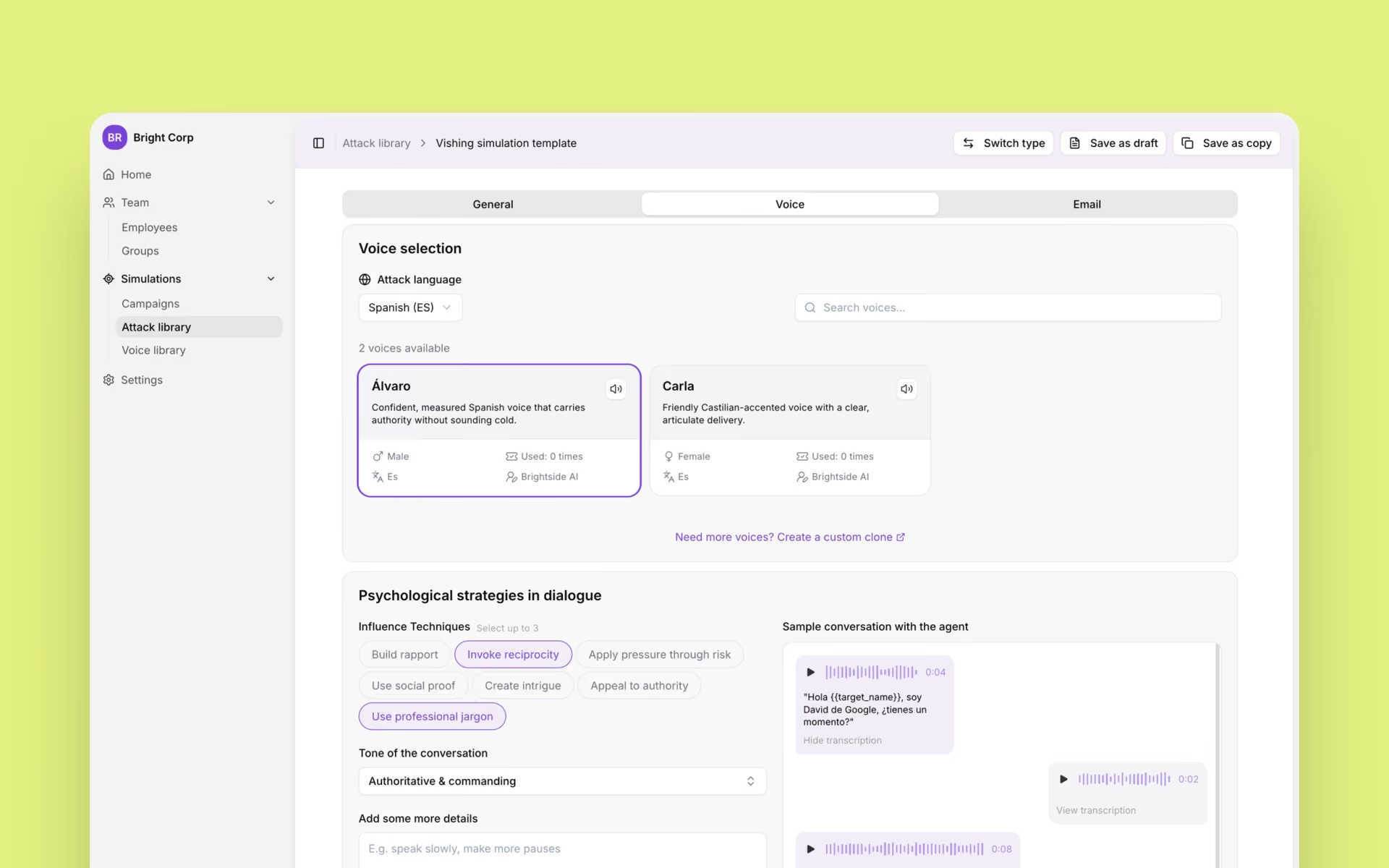
Brightside’s AI vishing simulator is designed to rehearse the whole pressured decision, including the voice, pretext, request, and employee response.
Administrators can upload an authorized one-to-two-minute recording to create a custom voice for a simulation. Brightside chose that product input for consistent defensive rehearsal; attacker requirements vary by tool and task. Admins can also select a preset voice when cloning a specific person is unnecessary.
The scenario builder covers more than audio. Administrators choose a voice-only attack or a hybrid attack that combines a call with a trackable phishing email. They define the attack goal, caller persona, target context, opening message, social-engineering tactics, and tone. Available tactics include pretexting, authority impersonation, fear or threat, commitment, social proof, and reciprocity.
Before launch, an administrator can take the call themselves in a test launch. That gives the security team a chance to hear the voice, check response speed, and assess whether the scenario reflects the policy or behavior being tested.
The vishing dashboard reports failed rate, answer rate, median call duration, and total simulations. Teams can inspect simulation details and export results. Those measurements help separate several questions that a generic completion score cannot answer: Did the employee take the call? Did the scenario move them toward the goal? Did they hold the boundary? Where did the response process break?
Brightside focuses on training and simulation. Real-call monitoring, blocking, authentication, and approval remain separate controls. The platform lets employees practice using those controls while the request feels credible and urgent. The simulator walkthrough shows how the voice, context, tactics, preview, and campaign workflow fit together.
AI Voice Cloning FAQs
Can someone really clone a voice from three seconds of audio?
Yes, under demonstrated conditions. Microsoft’s VALL-E research synthesized personalized speech from a three-second recording of an unseen speaker. Results still vary with audio cleanliness, speech content, language, accent, model coverage, target script, and desired output. Three seconds proves that the target-audio barrier can be very low; it is no universal recipe.
Does more audio always make a voice clone better?
No. More clean and representative audio can improve coverage, but inconsistent recordings can reduce stability in an instant-cloning workflow. ElevenLabs currently recommends approximately one to two minutes of clean, consistent audio for Instant Voice Cloning and warns that more than two or three minutes may add little. Fine-tuned professional cloning is a different process and benefits from substantially more high-quality material. Sample length only makes sense alongside the method and quality goal.
Where do attackers get voice samples?
Potential sources include public interviews, conference talks, earnings calls, webinars, podcasts, social videos, recorded presentations, and voicemail greetings. Internal recordings may also become exposed or shared beyond their intended audience. Organizations can reduce unnecessary publication for sensitive roles and govern recordings carefully, but removing every sample is rarely realistic. Defensive planning should assume that some usable speech may already be available.
Can employees reliably hear that a voice is AI-generated?
Not consistently enough to use human judgment as authentication. Controlled studies show that people catch some synthetic speech and miss some of it, with results changing across models, voices, languages, and tasks. Audible artifacts can justify extra scrutiny, but natural-sounding audio does not prove a caller is genuine. Employees should base high-risk decisions on an independent verification process rather than confidence in how the voice sounds.
What should someone do when a familiar voice makes an urgent request?
Pause before acting. End or suspend the interaction if needed, then contact the person through an independently established channel such as a known directory number or authenticated internal workflow. Do not use contact details supplied in the request. Follow the organization’s approval process, involve a second reviewer where required, and report the suspicious contact quickly. The request should pass verification even when the voice sounds completely genuine.
Three Seconds Is the Beginning of the Threat Model
Three seconds proves that a capable model may need very little target audio. The attack still depends on a voice suited to the task, credible context, effective delivery, a meaningful request, and a process that lets the request through. A clone can fail a technical quality test and still pass inside that chain.
Security teams cannot control every recording or predict the next speech model. They can deny a familiar voice the power to authorize payments, data access, credential recovery, and other high-risk actions. Independent verification breaks the attack where the organization has the most control.
Get a complete live walkthrough
Book a call with our team for a full overview of the platform, and bring any questions you want answered. No obligation exploration call.
Try our vishing simulator
Experience the most advanced voice phishing simulator built for security teams. Create scenarios, test voice cloning, and explore automation features.
Latest articles

Live Vishing Simulation vs Pre-Recorded Calls: What the Difference Actually Trains
The Help Desk Callback Verification Script: What to Say and When

AI Vishing Simulations: How to Run Voice Phishing Drills That Actually Change Behavior