Email Account Takeover Explained: Attack Methods, Warning Signs, Damage, and Defense
Email account takeover can lead to payment fraud, data theft, and wider cloud compromise. Understand the attack chain, warning signs, and layered defenses.

The payment request arrives in an existing email conversation. The supplier name is correct. The project details are correct. The message comes from the CFO’s real address, uses the CFO’s usual sign-off, and refers to an invoice the finance team already expects.
Only the bank details have changed.
The attacker did the decisive work days before anyone sent the fraudulent request. After entering a legitimate mailbox, they searched old conversations, identified the payment approvers, created a rule to hide selected replies, and waited for the right transaction. The finance employee was dealing with someone operating inside the CFO’s account, with no need to imitate the CFO from outside.
A business mailbox carries far more authority than an ordinary communication channel. It can function as a trusted identity, a store of sensitive information, a map of relationships, a route into cloud files, and the recovery channel for other accounts. It also sits inside payment, payroll, contract, customer, and supplier workflows.
Reducing this risk requires identity and session protection, monitoring for mailbox changes, limits on what one account can authorize, separate verification for sensitive requests, and fast employee reporting. Incident responders must also remove every form of persistence instead of stopping after the password reset.
Key Takeaways
- A compromised business mailbox gives an attacker an authentic sender identity, private context, trusted relationships, data, and often access to connected cloud services.
- Attackers can take over accounts through stolen passwords, but also through session-token theft, malicious OAuth consent, device-code phishing, MFA fatigue, recovery abuse, and compromised endpoints.
- A password reset may not remove access established through active sessions, OAuth applications, forwarding rules, delegates, app passwords, recovery methods, or attacker-enrolled MFA.
- The damage can spread from payment fraud into payroll diversion, data theft, internal phishing, partner compromise, password resets, and wider SaaS access.
- Durable defense combines phishing-resistant authentication, endpoint and mailbox controls, app governance, financial verification, monitoring, fast reporting, and realistic practice.
What Is Email Account Takeover?
Email account takeover occurs when an unauthorized person gains control of a real email account or its connected cloud identity. The attacker may read messages, search files, change settings, send email as the victim, or use the identity to access other services.
The phrase is sometimes used loosely, so it helps to separate several related concepts.
| Term | What the attacker controls | What recipients see | Typical outcome |
|---|---|---|---|
| Email account takeover (ATO) or email account compromise (EAC) | A legitimate mailbox, an authenticated session, or an authorized application connected to the account | Messages and activity associated with the real account | Surveillance, fraud, data theft, internal phishing, persistence, or wider cloud access |
| Email spoofing | A forged sender address or display name, not the legitimate mailbox | A message that claims to come from a trusted address | Phishing, malware delivery, or fraudulent requests |
| Lookalike-domain impersonation | An attacker-owned domain designed to resemble a legitimate one | A subtly altered address, such as an extra letter or different top-level domain | Credential theft, invoice fraud, or relationship impersonation |
| Business email compromise (BEC) | Sometimes a real account, but not always; attackers may also use spoofing or lookalike domains | A credible business request from an apparently trusted person | Wire fraud, invoice manipulation, payroll diversion, gift-card fraud, or sensitive-data disclosure |
| Broader cloud account compromise | The user’s identity and access across email, files, collaboration, and other connected services | Activity may appear in several cloud applications | Data theft, lateral movement, persistence, and follow-on attacks |
Email ATO describes the loss of control over the account. BEC describes a common way that criminals exploit business trust, usually to cause a payment or data transfer. The FBI’s public guidance discusses BEC and email account compromise together because the schemes overlap, but a BEC attack does not require takeover. A criminal can send a convincing request from a lookalike address without ever entering the real mailbox. Conversely, an attacker may take over an account to steal documents or reset passwords without committing BEC.
The distinction determines which controls work. SPF, DKIM, and DMARC can reduce domain spoofing, but they cannot stop mail sent from a legitimately compromised account. A payment-verification procedure can prevent a fraudulent transfer after mailbox compromise, yet it will not remove the attacker’s OAuth access or hidden forwarding rule. Each control must address a specific part of the attack.
Email ATO is an identity incident with consequences across connected services. In Microsoft 365, the same user identity may reach Exchange Online, SharePoint, OneDrive, Teams, and other applications. In Google Workspace, administrators investigating a compromised user may need to review Gmail settings alongside OAuth, Drive, Groups, Calendar, and administrative audit events. Both Microsoft’s response guidance and Google’s compromised-account checklist extend well beyond deleting a malicious message.
Why Business Email Accounts Are Such Valuable Targets
One email account can give an attacker authenticity, context, timing, reach, data, and recovery power.
First, it gives them authenticity. A message from the real address can pass technical email-authentication checks and appear in the right conversation. Colleagues may recognize the account, profile photo, signature, and writing habits. External partners may have years of legitimate history with the sender.
Second, it gives them context. Searchable email reveals projects, invoices, travel, legal matters, job candidates, customer issues, reporting lines, software providers, and the normal rhythm of approvals. An attacker does not have to invent a plausible story if the mailbox contains the real one.
Third, it gives them timing. A random request to change bank details may trigger suspicion. The same request inserted just before a genuine payment is due can feel routine. Attackers who monitor conversations can wait until the authorized approver is traveling, a supplier is expecting money, or a deadline has already created pressure.
Fourth, it gives them reach. Contacts, distribution lists, shared mailboxes, calendar invitations, and collaboration tools create paths to more employees and outside organizations. A phishing message from a known colleague often receives less scrutiny than an unsolicited external email. The account may also be included in allowlists that make malicious messages harder for security tools to challenge.
Fifth, it gives them data and recovery power. Email may contain attachments, tax records, contracts, customer information, intellectual property, or links to cloud files. It is also commonly used to reset passwords for payroll, CRM, code repositories, banking portals, social media, and other SaaS applications. Control of the inbox can become control of the user’s wider digital identity.
The highest-value target is not always the CEO. Finance staff can change vendor payments. IT and help-desk staff can reset identities. HR teams handle payroll and personal data. Legal teams hold privileged or commercially sensitive material. Sales and customer-success teams have trusted relationships outside the company. Procurement staff manage supplier details. Executive assistants often combine calendar visibility, external relationships, and authority to act on behalf of leaders.
Attackers select accounts based on the workflow they want to exploit. That is why protection and training should be role-specific rather than uniform.
How Attackers Gain Control of an Email Account
Takeover is rarely one isolated act. It is better understood as a lifecycle:
| Stage | Attacker objective | Typical activity |
|---|---|---|
| 1. Target research | Choose a useful identity and a believable pretext | Study company pages, social media, suppliers, technology, exposed credentials, and reporting lines |
| 2. Acquire access material | Obtain a password, session, token, device authorization, or app consent | Phishing, credential stuffing, malware, AiTM, MFA manipulation, OAuth consent, or recovery abuse |
| 3. Validate access | Confirm what the identity can reach | Test mailbox access, search messages, inspect files, and enumerate connected applications |
| 4. Establish persistence and concealment | Preserve access and reduce the chance of discovery | Add rules, delegates, apps, MFA methods, recovery options, or long-lived tokens; hide alerts and replies |
| 5. Conduct surveillance | Learn normal business behavior | Monitor invoices, approvals, travel, contracts, and writing patterns |
| 6. Exploit trust | Use the identity, data, or access | Request payments, steal files, send internal phishing, or reset other accounts |
| 7. Expand or monetize | Increase impact and extract value | Compromise partners, move into SaaS, sell access, exfiltrate data, or launder payments |
Different campaigns use different routes through this lifecycle. Some move from credential theft to fraud in minutes. Others remain quiet for weeks while waiting for the right conversation.
Credential phishing
Credential phishing sends a victim to a fake sign-in page that resembles Microsoft, Google, Okta, a file-sharing service, or another trusted application. The page records the username and password. Basic versions stop there. More capable phishing infrastructure can relay authentication in real time and capture additional material.
The lure does not need to arrive by email. A victim might follow a link from an SMS message, QR code, collaboration chat, fake support call, or search result. The important event is that the user presents credentials to an impostor service.
Security teams should retire training that focuses mainly on bad grammar and obvious visual mistakes. Modern phishing flows reproduce familiar sign-in experiences, adapt to the victim’s email domain, and generate credible text. Useful training emphasizes unexpected authentication flows, domain and browser context, password-manager behavior, suspicious approval requests, and fast reporting.
Credential stuffing and password reuse
Credential stuffing tests username-and-password pairs leaked from one service against other services. It works because people reuse passwords. An attacker who obtains an employee’s credentials from an unrelated breach may try them against webmail, VPN, SSO, or legacy mail protocols.
Unique passwords stored in a password manager reduce this path. Breached-password detection and enforced resets can help. MFA adds another barrier, but weaker factors may still be targeted through fatigue, interception, SIM theft, or social engineering.
Password spraying
Password spraying tests a small number of common or predictable passwords against many accounts. This avoids the rapid lockouts caused by trying many passwords against one user. Attackers may target seasonal password patterns, company-related phrases, or credentials that meet a policy’s formal complexity requirements but remain guessable.
Detection should look across the tenant. A sequence of failed sign-ins distributed among many users may be more revealing than the history of one account. Rate limiting, smart lockout, banned-password controls, MFA, and the removal of legacy authentication all reduce the available surface.
Infostealers and compromised endpoints
Malware on a laptop or browser can steal saved passwords, cookies, tokens, and other session data. An attacker may not need to phish the user directly if a personal or corporate endpoint already contains an authenticated business session.
This is one reason mailbox security cannot be separated from endpoint security. A successful password reset will not clean an infected device. If the user signs in again on the compromised endpoint, the attacker may regain fresh credentials or tokens. Endpoint detection and response, patching, browser security, device compliance, controlled extensions, and a clean-device recovery process belong in the ATO playbook.
Adversary-in-the-middle phishing and session-token theft
In an adversary-in-the-middle (AiTM) attack, a phishing site acts as a live proxy between the victim and the legitimate service. The user enters credentials and completes an authentication challenge. The proxy relays those steps to the real provider and captures the authenticated session material returned afterward.
The attacker is not mathematically breaking MFA. They are stealing or reusing the result of a successful authentication. That distinction matters because telling the user to choose a better one-time code does not solve the underlying relay problem.
Phishing-resistant authentication changes this interaction. NIST explains that FIDO authenticators used with WebAuthn bind authentication to the legitimate service and use cryptographic keys rather than secrets that a person types into a webpage. Correctly implemented FIDO2/WebAuthn methods can prevent a captured response from being reused at the attacker’s site.
Tokens can also be stolen from endpoints, application repositories, browser data, or other compromised infrastructure. Defenders need device protection, token monitoring, session controls, and rapid revocation alongside stronger authentication.
MFA fatigue and push bombing
MFA fatigue attacks generate repeated sign-in prompts until a user approves one, whether through confusion, annoyance, or a belief that the prompt is part of a support process. Attackers may call the victim while sending the prompts and impersonate IT to make the approval feel expected.
Number matching and context-rich prompts are better than a bare approve/deny button, but they still depend on the user recognizing the situation. Phishing-resistant methods offer stronger protection. Organizations should also rate-limit prompts, alert on repeated denials, and teach employees to report unexpected authentication requests instead of simply dismissing them.
SIM swapping and help-desk social engineering
If SMS or phone calls are used for account recovery or authentication, attackers may try to move the victim’s phone number to a SIM they control. They can also impersonate an employee to a carrier, service desk, or identity administrator and request a reset or new factor.
This turns account recovery into part of the authentication perimeter. Help desks need strong identity-verification procedures, special handling for privileged users, approval and notification for factor changes, and alerts sent through channels the requester cannot silently control. Publicly available details such as job title, manager, birthday, or office should not be treated as strong proof of identity.
Device-code phishing
Device-code authentication is designed for devices or applications where normal browser input is inconvenient. A user is shown a short code and asked to enter it on a legitimate provider page. In a device-code phishing attack, the attacker starts the authorization flow and persuades the victim to enter the attacker’s code. The victim uses the real website but authorizes a session for a device controlled by the attacker.
This can evade the simple rule “check the domain before signing in.” The domain may be correct. The suspicious part is the unsolicited authorization request and the mismatch between the action the user thinks they are taking and the device receiving access. Restrict device-code flows where possible, monitor their use, require compliant devices, and train users never to enter a code supplied by an unsolicited caller or message.
Malicious OAuth consent
OAuth allows users to authorize applications to access data without giving those applications their passwords. That is useful for legitimate integrations. It also creates a route for consent phishing.
An attacker registers an application that requests access to email, contacts, files, or other resources. The victim is sent through a real provider consent screen and approves the requested permissions. As Microsoft’s illicit-consent guidance explains, the application can then receive account-level access within the granted scope without the attacker needing an organizational user account.
The password may never be stolen. Changing it may not remove the application’s authorization. Organizations should restrict user consent, define which permissions require administrative approval, verify publishers, monitor new grants, review high-risk applications, and make consent language part of security training.
Recovery-channel takeover
Attackers may change or exploit recovery email addresses, phone numbers, security questions, backup codes, or alternate administrator paths. A compromised personal account can become the route into a business identity if it is trusted for recovery. A compromised business mailbox can perform the same function for other services.
Recovery settings should be inventoried and protected as carefully as primary authentication. Changes should generate independent notifications, require stronger verification for high-risk accounts, and be visible to administrators.
Legacy authentication and app passwords
Older mail protocols and applications may not support modern authentication controls. App passwords can also create alternate credentials for clients that cannot complete normal MFA. If these paths are left enabled, attackers will look for them.
Disable legacy authentication wherever feasible. Inventory app passwords and service dependencies before removal, then monitor for attempts to use retired protocols. Modernization can uncover forgotten devices and workflows, so it should be planned, but delay leaves a predictable path around newer controls.
What Attackers Do After They Enter the Mailbox
Initial access is the beginning of the incident, not its conclusion. The most consequential activity often happens after the first successful sign-in.
They establish what the account can reach
Attackers may inspect mailbox folders, shared mailboxes, contacts, calendar events, cloud storage, and connected applications. They search for terms such as “invoice,” “wire,” “bank,” “payroll,” “tax,” “password,” “confidential,” “contract,” or “acquisition.” They identify who can approve transactions and which outside relationships carry the most trust.
An executive account offers authority. A finance account offers payment context. An IT account may offer reset capabilities. A sales account offers customers. The attacker adapts the next action to the identity they have acquired.
They create persistence
Persistence gives the attacker a way back after the original password changes or the original phishing event is discovered. Depending on the environment and privileges, an attacker may:
- Retain active browser sessions or refresh tokens.
- Add an MFA method or register a device.
- Approve an OAuth application.
- Create or preserve an app password.
- Add mailbox delegates or forwarding addresses.
- Change recovery email addresses or phone numbers.
- Assign or exploit an administrative role.
- Compromise a synchronized or federated identity source.
These methods are not interchangeable, and the remediation differs for each. A response team needs an inventory, not a generic instruction to “log the attacker out.”
They conceal activity
Inbox rules can forward messages, move them into obscure folders, mark them as read, or delete them. An attacker might hide security alerts, suppress a supplier’s reply, or isolate messages containing a chosen keyword. Delegates and applications can access content without producing the same visible behavior as a person using the normal inbox.
Concealment lets the attacker create two versions of the conversation. The victim sees the normal thread. The supplier sees the altered request. Replies that might reveal the fraud are diverted before the account owner notices them.
They observe before acting
Patience increases credibility. Attackers can learn how a leader writes, whether colleagues use first names, which payments require approval, when executives travel, and how vendors announce bank changes. They may copy a real signature, continue a live thread, or wait for a previously discussed transfer.
This surveillance explains why generic red flags are unreliable. A message can have perfect grammar, correct branding, accurate project details, and an authentic sender. The strongest defense may be a business rule requiring independent verification, not a person’s ability to detect a textual mistake.
They exploit and expand
Once ready, the attacker may request a wire, change payroll details, collect tax records, steal intellectual property, send phishing to colleagues, or share a malicious file from a trusted cloud account. They may reset passwords for other services, access SharePoint, OneDrive, or Drive, and use the contact graph to reach customers and suppliers.
One compromised organization can become the pretext for another. A vendor mailbox can target every customer waiting for an invoice. A customer account can send a credible document request back to the supplier. Internal messages can target privileged employees who would ignore the same lure from an unknown sender.
Why a password reset is not enough
A password reset is necessary when credentials may be compromised, but it does not automatically prove that the incident is contained. Responders must also check:
- Active sessions, cookies, refresh tokens, and device authorizations.
- Registered MFA methods, devices, and backup codes.
- OAuth applications and consent grants.
- App passwords and legacy-protocol access.
- Inbox, forwarding, deletion, and sorting rules.
- Delegates, shared-mailbox permissions, and forwarding addresses.
- Recovery email addresses and phone numbers.
- Administrative or application roles.
- Endpoint malware, browser compromise, and stolen local session data.
- Connected SaaS applications and cloud-file access.
Google notes that temporarily suspending a Workspace user resets sign-in cookies and OAuth tokens, while its recovery process separately calls for password reset, token revocation, app-password removal, audit review, and inspection of forwarding and filters. Microsoft similarly separates credential reset from session revocation, MFA review, application consent, role review, forwarding, and mailbox rules. That separation should be reflected in the organization’s playbook.
The Business Damage a Compromised Inbox Can Cause
Email ATO can produce several losses at once. The first visible event may be a fraudulent payment, but the same compromise can expose data, interrupt operations, and damage external relationships.
| Business outcome | Who is affected | Immediate priority |
|---|---|---|
| Wire or invoice fraud | Finance, treasury, supplier/customer, bank | Contact financial institutions immediately, attempt recall or freeze, preserve transaction and communication records, notify law enforcement as appropriate |
| Payroll or benefits diversion | Employee, payroll, HR, bank | Stop pending changes, restore verified details, review other changes, support the affected employee |
| Sensitive-data theft | Legal, privacy, security, customers, employees | Preserve evidence, determine data and jurisdiction, contain access, begin legal and notification analysis |
| Internal phishing and lateral movement | Employees, IT, SOC, connected teams | Remove messages, contain affected identities and endpoints, identify recipients and actions taken |
| Customer or supplier compromise | External partners, sales, procurement, legal | Warn affected parties through a verified channel, invalidate fraudulent instructions, coordinate investigation |
| SaaS and cloud-file access | Application owners, data owners, security | Revoke sessions and grants, review file and application activity, contain linked identities |
| Operational disruption | Finance, customer service, leadership, IT | Establish alternate trusted communication, restore critical workflows, prevent repeated fraudulent action |
Direct financial fraud
Business email compromise is the most familiar monetization path. Criminals use executive authority, invoice timing, vendor relationships, or employee records to redirect money. The request may involve a new beneficiary account, an urgent acquisition, a confidential payment, changed payroll details, or gift cards.
Loss figures help show the scale of email-enabled fraud, but they need careful interpretation. BEC reporting includes schemes that use compromised accounts and schemes that use impersonation without takeover. It should not be presented as a clean measure of ATO. The FBI’s BEC guidance is most useful for understanding scenarios and the need for rapid reporting. When money has moved, speed matters because financial institutions and investigators may have a limited chance to freeze or recover it.
Data and intellectual-property theft
Mailboxes contain far more than messages. Attachments and links may expose contracts, product plans, customer lists, tax documents, legal advice, personal data, health information, or credentials. Connected file services can multiply the volume available from one identity.
Data theft may be the primary objective or a way to make later fraud more convincing. Stolen contracts reveal counterparties. Payroll records support employee impersonation. Executive calendars help time attacks. A confidential project name can turn a generic lure into a message that appears known only to insiders.
Partner and customer compromise
External trust makes the blast radius hard to contain within one tenant. Customers may pay a fraudulent invoice. Suppliers may disclose records. Partners may follow a malicious link because it arrives in an established thread.
The affected company then faces two incidents: unauthorized activity in its own environment and harm caused through its trusted identity. Response communications need to be fast, specific, and delivered through a verified channel that the attacker does not control.
Operational and legal consequences
Teams may need to suspend accounts, interrupt payment workflows, isolate endpoints, reconstruct communications, notify counterparties, and restore shared access. Legal and privacy teams may need to assess contractual duties, regulatory reporting, privilege, employee impact, or customer notification. Insurers may require prompt notice and specific evidence.
Even when a payment is recovered, the organization still pays for investigation, restoration, counsel, communication, and lost time. Relationships can remain damaged if customers or suppliers no longer trust requests from the company’s domain.
Mailbox compromise crosses organizational boundaries. Security handles only part of the incident; identity, endpoint, finance, legal, privacy, HR, communications, and business leadership have separate responsibilities. A workable response plan connects them before an account is lost.
Signs of Email Account Takeover and What Each Signal Means
Email ATO rarely announces itself with one conclusive alert. Investigators usually build confidence by correlating weak signals from identity, mailbox, endpoint, cloud applications, and business activity.
An unusual foreign sign-in, for example, could reflect travel or a corporate VPN. A new forwarding rule could be legitimate. A changed supplier account might be genuine. Each becomes more concerning when it appears alongside an unfamiliar device, an OAuth grant, deleted replies, or a payment request that breaks normal procedure.
| Signal | Possible explanation | Evidence to check | First action |
|---|---|---|---|
| Unexpected MFA prompts or repeated denials | Password guessing, MFA fatigue, or a user’s legitimate forgotten session | Identity-provider sign-in logs, source IPs, devices, prompt history | Tell the user not to approve; report and investigate the source |
| Login alert from an unfamiliar device or location | Travel, VPN, new device, stolen credential, or stolen session | Device identity, user agent, geolocation, conditional-access result, prior activity | Confirm with the user through a trusted channel; restrict or revoke suspicious access |
| User is unexpectedly locked out | Attacker changed credentials/recovery details, policy action, or ordinary user error | Password and recovery changes, administrative logs, recent sign-ins | Use a clean administrator channel; suspend or contain if compromise is plausible |
| New MFA method, device, recovery address, or phone | Legitimate enrollment or attacker persistence | Enrollment timestamp, actor, source, help-desk ticket, independent user confirmation | Remove unrecognized methods and revoke sessions |
| New forwarding, deletion, or inbox rules | Normal workflow automation or concealment | Rule creation time, destination, keywords, affected messages, audit logs | Disable suspicious rules while preserving evidence |
| Unfamiliar OAuth application or new consent | Legitimate integration or consent phishing | Publisher, requested permissions, consent actor/time, application activity | Revoke suspicious consent and investigate accessed data |
| Unusual sent messages or contact complaints | Malware, compromised account, delegated sender, or mistaken message | Sent items, message trace, delegates, application access, recipient actions | Stop further sending, remove malicious messages where possible, warn recipients |
| Missing replies or security alerts | User deletion, retention issue, or attacker rule | Deleted items, archive, rules, forwarding, audit trail | Preserve logs and reconstruct the conversation |
| Sudden bank-detail or payroll change | Legitimate business change or payment fraud | Prior thread, approval record, known contact details, related mailbox activity | Pause the transaction and verify out of band |
| Unusual file search, access, or download activity | Normal project work or data theft | File audit logs, user agent, volume, time, device, sensitivity | Restrict access and determine the data scope |
Employees and external contacts often detect what telemetry misses. A supplier who calls about an unexpected account change, a colleague who receives an odd document, or a user who reports an unexplained prompt can provide the first meaningful signal. Reporting channels should be easy to find, safe to use, and staffed to respond quickly.
Administrators should monitor high-risk changes as well as failed logins. Alerts for new forwarding destinations, delegates, consent grants, app passwords, MFA methods, administrative roles, and recovery changes can reveal persistence after a successful sign-in. Message tracing and cloud-file audit logs help connect mailbox activity to downstream impact.
“Impossible travel” and similar rules are useful leads, not verdicts. Attackers use residential proxies and familiar infrastructure, while legitimate users travel and connect through VPNs. Good detection combines identity context, device trust, behavioral history, mailbox changes, application activity, and the sensitivity of the action.
How to Prevent Email Account Takeover
Prevention has four jobs: make initial access harder, limit the value of a compromised identity, detect persistence quickly, and prevent an attacker-controlled mailbox from authorizing an irreversible business action.
Move high-risk users to phishing-resistant authentication
Start with administrators, executives, finance, IT/help desk, HR, legal, and anyone who can change payment or identity settings. Properly implemented FIDO2/WebAuthn authentication uses cryptographic credentials bound to the legitimate service. The user does not type a reusable code that a phishing proxy can relay.
CISA’s implementation guidance identifies FIDO/WebAuthn as the widely available phishing-resistant option. NIST also notes that manually entered one-time passwords are not phishing-resistant because an impostor can relay them. This does not make every passkey deployment identical or eliminate endpoint risk, but it materially improves resistance to credential phishing and AiTM interception.
If a complete rollout will take time, prioritize by consequence. A finance approver and a global administrator should not wait behind low-risk accounts in a purely alphabetical migration.
Reduce password and legacy-authentication exposure
Require unique passwords and provide an enterprise password manager. Block known-compromised and predictable passwords. Use smart lockout and tenant-wide detection for password spraying. Remove dormant accounts promptly and disable legacy authentication and unnecessary app passwords.
Account lifecycle discipline matters. Former employees, inactive students, abandoned contractors, test accounts, and old shared identities can attract attackers precisely because no active user is watching them.
Control sessions, tokens, applications, and consent
Identity defense cannot stop at the password prompt. Use conditional-access policies that consider device compliance, user risk, location, application sensitivity, and authentication strength. Define sensible session lifetimes for high-risk resources and require reauthentication for sensitive actions.
Restrict user consent to applications. Require administrative review for high-risk permissions, verify publishers, inventory existing grants, and monitor new OAuth activity. Remove applications that are unused, overprivileged, or poorly governed. Treat service principals and workload identities as part of the same access estate rather than an obscure technical exception.
Protect endpoints and browsers
Use managed, patched devices for sensitive work. Deploy endpoint detection and response, limit local privileges, control risky browser extensions, and investigate infostealer indicators. Conditional access should distinguish managed from unmanaged devices where business requirements allow.
Recovery after suspected token or cookie theft should occur from a clean device. Otherwise, the organization may reset credentials and immediately expose the replacement session to the same malware.
Monitor mailbox changes and sensitive cloud activity
Alert on new external forwarding, suspicious rules, delegates, app passwords, MFA enrollments, recovery changes, consent grants, and role assignments. Baseline sending and file behavior for high-risk accounts. Retain the audit data needed to reconstruct an incident.
Email-security controls still matter. Anti-phishing systems can block credential lures before they reach users. Safe-link and attachment controls can reduce exposure. SPF, DKIM, and DMARC make domain impersonation harder. Their limit should be stated plainly: they authenticate mail infrastructure and domain use, not the human intent behind a message sent from a real compromised mailbox.
Remove payment authorization from email alone
The most reliable way to stop mailbox-driven payment fraud is to ensure that a mailbox cannot authorize a sensitive change by itself.
Require dual approval for high-value or unusual transactions. Verify new bank details and payroll changes through a separate channel using contact information already held in a trusted system, not the phone number included in the request. Define thresholds, cooling periods, and escalation steps. Separate the ability to request, approve, and release payments.
The same logic applies outside finance. A help desk should not add a new MFA factor based only on an email. HR should not change direct-deposit details without independent verification. Administrators should not approve an OAuth application simply because a colleague’s real account requests it.
Train for the decisions attackers actually manipulate
Training should prepare people for specific moments: an unexpected sign-in page, a code supplied by a caller, an OAuth permission request, repeated MFA prompts, a bank-detail change, a “confidential” executive instruction, or a supplier asking why a reply was ignored.
Role-specific training against AI phishing is more useful than sending every employee the same generic lure. Finance needs practice verifying payment changes. Help-desk teams need adversarial reset scenarios. Executives and assistants need voice and email impersonation drills. Administrators need consent and device-code examples. Everyone needs a quick way to report uncertainty.
Measure security-awareness training effectiveness through reporting rate, time to report, repeated risky behavior, verification-procedure use, and response quality. Completion percentage and click rate alone do not show whether the organization can interrupt a real attack.
Map controls to attack methods and owners
| Attack method or objective | Preventive control | Detective control | Primary owners |
|---|---|---|---|
| Credential phishing and AiTM | FIDO2/WebAuthn, email filtering, managed password manager | Phishing reports, sign-in and session-risk alerts | Identity, security operations, messaging, employees |
| Password reuse or spraying | Unique passwords, breached-password blocking, smart lockout, MFA | Distributed failed-login and credential-abuse analytics | Identity, security operations |
| Token or cookie theft | Managed endpoints, EDR, browser controls, conditional access | Token anomalies, device/user-agent mismatch, endpoint telemetry | Endpoint, identity, security operations |
| MFA fatigue or help-desk manipulation | Phishing-resistant MFA, prompt controls, strong recovery verification | Repeated prompts, factor-change alerts, help-desk audit | Identity, service desk, security operations |
| Device-code phishing | Restrict flows, compliant-device policy, user guidance | Device-code events and unusual application sign-ins | Identity, application owners, employees |
| Malicious OAuth consent | Consent restrictions, publisher verification, least privilege | New/high-risk grant alerts and app review | Identity, cloud security, application owners |
| Mailbox persistence | Restrict external forwarding and delegates | Rule, forwarding, delegate, and app-password alerts | Messaging, security operations |
| Payment or payroll fraud | Dual approval and out-of-band verification | Exception monitoring and recipient confirmation | Finance, HR, procurement, business owners |
| Internal phishing | Segmentation, least privilege, email and collaboration controls | User reports, unusual sending, message trace | Messaging, security operations, employees |
Controls fail in different ways. Users make mistakes, endpoints become infected, tokens are stolen, and suppliers arrive already compromised. A practical program for reducing employee cybersecurity risk exposure prevents any one of those events from becoming unchecked authority to move money, disclose data, or reset another identity.
What to Do When a Business Email Account Is Compromised
Treat suspected ATO as a time-sensitive identity and business incident. The exact steps depend on the provider, architecture, legal obligations, and evidence available, but the sequence below provides a practical starting point.
1. Activate the response team and use a trusted channel
Bring in identity, security operations, messaging, endpoint, and the affected business owner. Add finance, legal, privacy, HR, communications, or insurance contacts based on likely impact. Do not coordinate sensitive actions exclusively through the mailbox that may be monitored.
Use a clean administrator account and a trusted device. Record who is making changes and when.
2. Contain access without destroying the investigation
Temporarily suspend or disable the account when the risk justifies it. Revoke active sessions, refresh tokens, and device authorizations. Reset credentials in the authoritative identity source, including on-premises or federated systems where applicable.
Containment can disrupt legitimate work, but delay allows continued surveillance, deletion, fraud, and lateral movement. Organizations should define authority for urgent suspension before an incident.
3. Preserve evidence and establish the timeline
Retain sign-in, audit, mailbox, message-trace, application, file, endpoint, and administrative logs. Preserve suspicious emails with headers and record rules, delegates, grants, devices, and settings before removing them where practical.
Determine the earliest suspicious access, how it occurred, which actions followed, what messages and files were accessed, and which internal or external recipients interacted with attacker activity. A password-reset timestamp is not the beginning of the incident.
4. Remove every persistence path
Review and remove unrecognized MFA methods, devices, recovery details, OAuth consent grants, applications, app passwords, delegates, forwarding addresses, inbox rules, roles, and shared-access permissions. Check for newly created identities or changes made with administrative privileges.
Microsoft’s compromised-account procedure explicitly separates password reset from active-session revocation and review of MFA devices, consented applications, roles, forwarding, and mailbox rules. Google’s procedure similarly calls for suspension, investigation, password and token action, app-password removal, recovery review, and inspection of filters and forwarding.
5. Investigate and remediate endpoints
If malware, cookie theft, or browser compromise is possible, isolate and examine affected devices. Search for infostealer activity and determine whether other credentials or sessions were exposed. Do not restore the user to normal work on an untrusted device.
6. Determine the full scope
Review email sent, deleted, forwarded, and accessed. Identify recipients of malicious messages and remove those messages from managed mailboxes where supported. Examine shared mailboxes, cloud files, collaboration tools, and connected SaaS applications. Look for password resets and consent events involving other services.
Ask the affected business team what the logs cannot tell you: which payments were pending, which supplier changes were in progress, what sensitive negotiations were underway, and which unusual requests colleagues or partners received.
7. Stop financial and external harm
If funds moved, contact the sending and receiving financial institutions immediately and request recall, freeze, or fraud handling. Report the incident to appropriate law enforcement or national cybercrime channels. In the United States, the FBI directs victims to report through IC3; local procedures and regulatory requirements vary.
Notify affected customers, suppliers, or employees through independently verified channels. State which messages or instructions are fraudulent and what recipients should do. Avoid vague warnings that force each partner to guess whether a payment or disclosure was affected.
8. Restore carefully and monitor for re-entry
Return access only after credentials, sessions, factors, applications, recovery settings, rules, delegates, devices, and connected systems have been addressed. Enroll the user in phishing-resistant authentication where possible. Increase monitoring for repeated sign-ins, consent grants, forwarding, unusual sending, or follow-on phishing.
9. Complete legal, privacy, and business follow-up
Counsel and privacy teams should assess data, jurisdictions, contracts, notification duties, privilege, and insurer requirements. Finance should reconcile transactions. HR should support affected employees. Communications teams may need prepared messages for customers or suppliers.
10. Turn the incident into control improvements
Identify the failed and successful controls at every stage. The root cause may include a phished session, but the material loss may also depend on missing payment verification, weak consent governance, absent forwarding alerts, slow reporting, or an incomplete password-only response.
Update detection, access policy, recovery procedures, financial controls, simulations, and the response playbook. Then exercise the new process. A written change that no one has practiced is an aspiration, not a reliable control.
Top 5 AI-Powered Security Training Tools for Companies
Security-awareness platforms can help employees recognize credential theft, abnormal authorization requests, BEC pretexts, and multi-channel social engineering. Realistic simulations can also build the habit of reporting quickly. They cannot revoke a stolen token, block a malicious OAuth grant, clean an infected endpoint, or enforce dual approval for payments.
The five tools below are a curated shortlist, not a universal ranking. Evaluate them against the attack channels your organization faces, the roles you need to train, personalization and automation, reporting practice, integrations, localization, analytics, administrative effort, privacy, and safe-simulation controls. Confirm current features and packaging directly with each vendor.
1. Brightside AI
Best fit: Companies that want realistic rehearsal across email and voice, with role-aware scenarios for modern social engineering.
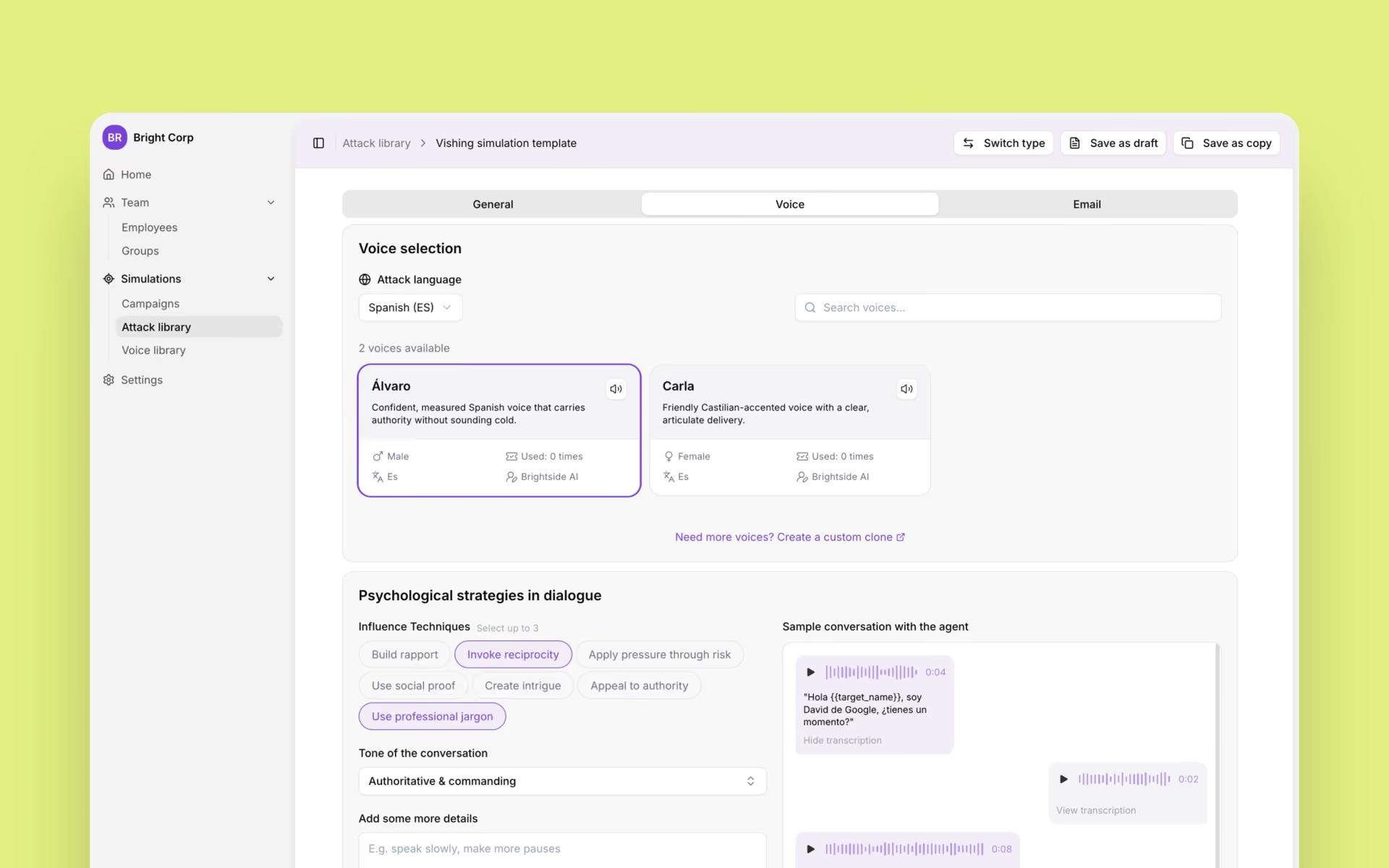
Brightside AI combines security-awareness content with phishing and AI vishing simulations. For email ATO risk, administrators can use BEC, vendor-impersonation, and spear-phishing scenarios selected around an employee’s role, department, and tools. Finance can receive invoice and payment-change simulations while IT teams receive identity or support-themed scenarios.
Brightside also supports AI-assisted OSINT personalization, live AI voice interactions, voice-clone exercises, NIST Phish Scale alignment, performance-triggered follow-up training, and tracking that distinguishes actions such as opening, clicking, entering information, and reporting. Its Gmail Report Phishing add-on lets employees report a message in one click and routes simulations differently from potentially real threats.
That makes Brightside relevant when an organization wants to practice both the initial credential lure and the secondary phone call that may accompany MFA fatigue, help-desk impersonation, or payment fraud. It should be deployed alongside identity, endpoint, email, and financial controls. Brightside is not an inbound filtering or incident-response platform, and buyers should validate which managed deepfake exercises, integrations, languages, and simulation workflows fit their program.
2. Adaptive Security
Best fit: Organizations prioritizing customizable, AI-native training and simulations across several social-engineering channels.
Adaptive Security presents a broad platform covering security-awareness training, email phishing, vishing, smishing, deepfake scenarios, personalization, risk monitoring, and reported-phish workflows. Its public materials emphasize OSINT-informed simulations, executive voice and deepfake scenarios, role- and behavior-based learning paths, and AI-assisted content creation.
For email ATO, those capabilities can support rehearsals involving credential capture, executive impersonation, phone follow-up, and attacks that move between email, SMS, and voice. Custom content can also help organizations teach their own payment, help-desk, OAuth, or incident-reporting procedures rather than relying only on generic examples.
Buyers should pilot the specific channels and workflows they need, review how OSINT and employee data are governed, and confirm which simulation, triage, and risk features are included in the proposed package. Rich multi-channel capability is useful only if the organization has the capacity to operate it safely and turn results into control changes.
3. Hoxhunt
Best fit: Large organizations focused on adaptive phishing practice, reporting behavior, and automated behavior-change programs.
Hoxhunt centers its approach on personalized phishing simulations, gamification, one-click reporting, and short training delivered around the moment an employee reports or misses a simulation. Its current materials describe AI-driven selection that adapts scenarios using employee skill, role, organizational strategy, and threat context.
That model is relevant to email ATO because frequency and difficulty can adapt instead of giving every person the same campaign. Reporting practice can also improve the chance that a suspicious sign-in page or trusted-account message reaches security while containment is still possible.
Organizations should evaluate how deeply the proposed deployment covers the non-email threats in their risk model, how reporting integrates with the SOC, and whether gamification fits the workforce culture. They should also measure outcomes beyond clicks, including reporting speed, repeated behavior, and response quality.
4. KnowBe4
Best fit: Enterprises seeking a large awareness and compliance content ecosystem with mature program administration and AI-assisted personalization.
KnowBe4 Security Awareness Training combines a broad content library, phishing simulations, assessments, risk-based segmentation, and reporting. Its AIDA suite uses AI agents to automate program administration, personalize training, select or generate phishing experiences, support remedial assignments, and align simulation difficulty with the NIST Phish Scale.
For ATO prevention, the breadth can help companies cover password practices, phishing, BEC, MFA, data handling, and compliance needs within one established program. Automation is attractive to teams managing many groups, regions, and training obligations.
Buyers should confirm which AIDA, vishing, smishing, deepfake, and advanced simulation capabilities are available in the relevant tier. A large library does not by itself guarantee behavior change, so the evaluation should include role relevance, reporting workflows, administrative effort, and evidence that employees apply the organization’s actual verification procedures.
5. SoSafe
Best fit: European and multinational organizations prioritizing behavioral-science-based learning, localization, adaptive microlearning, and low-touch program operation.
SoSafe combines personalized security-awareness training, phishing and multi-channel simulations, reporting workflows, and human-risk analytics. Its public materials emphasize role- and behavior-based learning, gamified and story-led microlearning, broad language coverage, AI-assisted simulation and content features, and Sofie, an AI-powered conversational assistant for awareness support.
For email ATO, SoSafe can help train credential-phishing recognition, BEC response, reporting, and security habits across a distributed workforce. Personalization can reduce the mismatch between a generic course and the decisions faced by finance, IT, HR, or executives.
Prospective customers should verify current depth across vishing, smishing, OSINT personalization, and ATO-specific scenarios, along with hosting, privacy, integrations, accessibility, and language requirements. As with every platform in this list, ask how the product helps the organization change a real business process rather than improve completion statistics.
The best choice depends on the program’s control gaps. A company that has not deployed phishing-resistant MFA or payment verification should not treat a sophisticated simulation platform as a substitute. A company with strong technical controls but slow reporting and generic annual training may gain more from adaptive, role-specific rehearsal. Pilot against explicit success measures before committing to a broad rollout.
Frequently Asked Questions
What is the difference between email account takeover and business email compromise?
Email account takeover means an attacker has unauthorized control of a legitimate mailbox, session, or authorized app. Business email compromise is a fraud pattern that abuses business trust, often to redirect a payment or obtain sensitive data. BEC can use a compromised real account, but it can also use spoofing or a lookalike domain. An email ATO can also lead to outcomes other than BEC, including data theft, internal phishing, cloud-file access, and password resets for other services.
Can attackers take over an email account even when MFA is enabled?
Yes. Attackers may steal an authenticated session through AiTM phishing or endpoint malware, pressure a user to approve a push notification, trick someone into authorizing a device code, obtain a phone factor through SIM or help-desk abuse, or gain access through malicious OAuth consent. These methods do not all defeat MFA in the same way. Phishing-resistant FIDO2/WebAuthn authentication, managed devices, consent governance, session monitoring, strong recovery procedures, and user reporting address different parts of the problem.
What are the first signs that a business email account has been compromised?
Common signs include unexpected MFA prompts, unfamiliar sign-ins or devices, lockout, changed recovery details, new forwarding or deletion rules, missing messages, unfamiliar OAuth applications, unusual sent email, and complaints from contacts. A sudden bank-detail change or request that breaks normal procedure is also important. No single indicator proves takeover. Security teams should correlate identity, mailbox, application, file, endpoint, and business-process evidence and contain suspicious access when the potential impact justifies it.
Is changing the password enough after an email account takeover?
No. Change the password, but also revoke active sessions and tokens; remove unfamiliar MFA methods, devices, recovery changes, OAuth grants, app passwords, rules, forwarding, delegates, and roles; investigate endpoints; and review connected applications and cloud files. Determine what the attacker accessed or sent and notify affected parties. Microsoft and Google both publish recovery guidance that separates password action from these other containment and persistence-removal steps.
Who should a company notify after a compromised mailbox is used for payment fraud or data theft?
Notify the internal incident-response team, identity and messaging administrators, the affected business owner, and relevant finance, legal, privacy, HR, communications, and leadership contacts. For payment fraud, contact financial institutions immediately and report through the appropriate law-enforcement or cybercrime channel. Notify affected customers, suppliers, or employees through a verified channel. Legal and privacy teams should determine contractual, regulatory, insurer, and data-breach notification duties for the relevant jurisdictions.
Make the Mailbox a Harder Place to Enter and a Harder Place to Hide
Email account takeover spans identity, endpoint, cloud, finance, and human decision-making. Strong programs use phishing-resistant authentication, watch for persistence inside identities and mailboxes, limit what one account can authorize, verify sensitive changes out of band, and give employees a fast path to report uncertainty.
Passwords, devices, sessions, and people will sometimes fail. The surrounding controls should keep that failure from quietly becoming authority to move money, expose data, or compromise everyone who trusts the sender.
Get a complete live walkthrough
Book a call with our team for a full overview of the platform, and bring any questions you want answered. No obligation exploration call.
Try our vishing simulator
Experience the most advanced voice phishing simulator built for security teams. Create scenarios, test voice cloning, and explore automation features.
Latest articles

Live Vishing Simulation vs Pre-Recorded Calls: What the Difference Actually Trains
The Help Desk Callback Verification Script: What to Say and When

AI Vishing Simulations: How to Run Voice Phishing Drills That Actually Change Behavior