Security Awareness Training Against AI Phishing: A Complete Guide to Defending Against AI-Powered Social Engineering
Build an AI phishing awareness program with role-based simulations, trusted verification, meaningful metrics, and controls that remain safe when detection fails.

Imagine that a finance employee receives a message from the CFO. The writing is polished. It mentions a real acquisition, uses the right internal vocabulary, and asks for discretion. A familiar voice then calls to confirm the request. The employee sees no misspellings, strange branding, or obvious audio glitches.
Traditional awareness programs focus on whether the employee can spot the fake. That objective is too narrow. The requested action should remain safe even when the employee believes the attacker.
Generative AI has made convincing social engineering cheaper to research, produce, translate, personalize, and adapt. It also helps attackers move a pretext across email, text, voice, video, collaboration platforms, and legitimate authentication systems. It has not, however, invented new human weaknesses. The attack still works by exploiting authority, urgency, fear, routine, trust, and the desire to help.
Security awareness training against AI phishing should therefore do more than teach people to inspect messages. It should train them to identify the action being requested, verify authority through a trusted route, use reporting and escalation paths under pressure, and recover quickly after a mistake. Identity, payment, help-desk, consent, and approval controls must then make those behaviors enforceable.
This guide uses safe failure as the design principle instead of assuming perfect detection.
Key Takeaways
- AI changes the economics and reach of social engineering more than its underlying psychology. Personal context, polished language, familiar voices, and legitimate sign-in pages are not proof of legitimacy.
- Teach employees to verify high-impact actions through an authoritative path the requester did not provide.
- Training can reduce risk, but it cannot compensate for weak authentication, payment, reset, consent, or approval controls.
- Repeated, role-based, multi-channel practice is more defensible than annual, generic, email-only training.
- Measure reporting, verification, prevented harm, recovery, lure difficulty, and culture alongside clicks and course completion.
AI Changes the Scale and Fidelity of Phishing, Not the Human Psychology
The phrase “AI phishing” can make the threat sound completely new. In practice, AI strengthens familiar social-engineering techniques. It lets attackers perform more research, create more variations, and communicate more convincingly without paying for the same amount of human labor.
What remains familiar: authority, urgency, fear, reciprocity, routine, and trust
A fake CEO request still relies on authority. A supposed account lockout still creates urgency and fear. A vendor invoice still exploits routine. A fake customer or colleague still benefits from an employee’s instinct to be helpful.
These psychological levers matter more than whether every sentence came from a language model. An attacker might use AI to research a target and draft a first message, then switch to a human operator. Another might use an automated voice agent while a human monitors the conversation. “AI-supported” and “AI-generated” can describe very different levels of involvement, which is why there is no defensible industry-wide percentage for how much phishing uses AI.
What AI makes cheaper: research, personalization, translation, variation, and iteration
AI can summarize a target’s public profile, infer likely business relationships, draft role-specific lures, translate them, and produce hundreds of plausible variants. It can maintain a consistent persona during a conversation and revise its approach when a target hesitates.
A large-scale USENIX Security 2026 study illustrates the economic shift. In an experiment involving 7,741 participants, generic emails produced a 3.9% click rate, automatically personalized LLM emails produced 10.0%, and human-personalized messages produced 24.2%. Automated personalization cost about $0.03 per email.
Automatic personalization materially beat generic messaging at low cost, while skilled human spear phishing still performed better. AI did not become a superhuman persuader in this experiment. It gave attackers a meaningful personalization advantage at scale.
Why personal context and polished language are not trust signals
Employees were once told to look for poor grammar, awkward phrasing, generic greetings, or obviously incorrect details. Those clues can still be useful when present, but their absence proves little. AI can reproduce local spelling, company terminology, executive tone, and information gathered from websites, conference talks, professional profiles, breach data, or previous correspondence.
Training should explicitly retire these unsafe assumptions:
- “Only a real colleague would know that.”
- “The message sounds exactly like them.”
- “The grammar is too good to be phishing.”
- “The person knew about a confidential project.”
- “The request came in my preferred language.”
Context increases credibility without conferring authority. Authority should come from the organization’s known systems, directories, roles, and approval processes.
AI-Powered Social Engineering Moves Across Channels and Trusted Systems
An email-only threat model treats phishing as a malicious message that contains a bad link. Modern social engineering often looks more like a journey. The attacker establishes context in one channel, adds pressure or reassurance in another, and completes the theft through a legitimate service.
The request can move from email or text to voice, video, and collaboration tools
Attackers can begin with an email about an invoice, then call from a spoofed number to “help” resolve it. They can send a text about an account issue, move the conversation to a phone call, and ask the target to approve an authentication prompt. They can compromise one employee’s collaboration account and use that trusted identity to contact colleagues. They can also direct a victim to call a fake support number, reducing the chance that an email gateway sees the most persuasive part of the attack.
Voice deserves particular attention because it adds time pressure and makes verification feel socially awkward. A 2026 survey experiment involving 4,100 US adults found 16.5% overall potential compliance across five AI-generated voice-scam categories, rising to about 36% for a cloned relative-in-distress scenario. The study measured whether participants said they would or might comply after hearing recordings or reading transcripts. It did not observe completed fraud. Its most useful finding for training design was that persuasiveness predicted potential compliance more strongly than how human-like the voice sounded.
That finding points training at the request rather than the voice. Employees do not need to decide whether a voice is synthetic. They need a safe way to handle the request whether the voice belongs to an attacker, a compromised colleague, or a real executive asking them to break policy.
Legitimate pages, device codes, consent prompts, and caller ID do not validate the initiator
Some of the hardest attacks send victims into real systems. Microsoft’s April 2026 analysis of an AI-enabled device-code phishing campaign described role-specific messages, dynamically generated codes, legitimate authentication pages, and automated post-compromise activity. The code and Microsoft page were valid. The request that initiated the flow was not.
OAuth consent creates a related risk. A user may see a real identity-provider screen and a real application name, yet still grant a malicious or unnecessary application access to mail, files, contacts, or other data. Caller ID can be spoofed. A real collaboration account can be compromised. A real support tool can be abused. A valid electronic signature platform can deliver a malicious link.
Training based only on visual authenticity fails in these cases. The decisive questions are:
- Who initiated this request?
- What action am I being asked to authorize?
- Does the action match an expected business process?
- Can I verify it through a trusted directory, ticket, system of record, or separate approver?
Three common cross-channel attack chains
Callback phishing and remote access. An email claims that an expensive subscription has renewed or a security issue needs immediate attention. Instead of including a malicious link, it provides a phone number. The target calls, and a convincing support agent asks them to install legitimate remote-access software. The highest-risk moment occurs on the phone and endpoint, not in the original email.
Personalized lure and legitimate authentication. A supplier, recruiter, or colleague sends a role-relevant document. The target is asked to enter a device code or grant application consent on a genuine identity-provider page. The interface is real, but the attacker controls the transaction and receives the resulting access.
Executive impersonation and payment approval. A message establishes a confidential transaction. A voice or video interaction appears to confirm it. In the 2024 Arup case, an employee transferred HK$200 million after a video conference in which participants appeared to include senior colleagues. The control lesson is not “learn to see deepfake artifacts.” Visual and audible presence must not serve as transaction authorization.
Attackers also target help desks, customer-support representatives, payroll teams, and SaaS administrators because these people can reset credentials, enroll authentication methods, change sensitive records, or grant access. AI expands the number and quality of attempts, but weak process is what converts persuasion into compromise.
AI agents add another version of the same risk. An assistant that summarizes email, reads web pages, prepares purchases, or operates business tools can encounter malicious instructions embedded in untrusted content. Employees responsible for such agents need to understand delegated authority, data boundaries, approval requirements, and the risk of indirect prompt injection. The durable control is constrained action, not confidence that every malicious instruction will be detected.
Does Security Awareness Training Work Against AI Phishing?
The evidence does not support a simple yes or no. Security awareness training is not one intervention. A yearly video, a monthly simulation, immediate feedback, role-specific rehearsal, and a redesigned verification process may all be called “training,” even though they create different learning conditions and measure different outcomes.
Why vendor benchmarks and controlled experiments reach different answers
KnowBe4’s 2026 Phishing by Industry Benchmarking Report reports that its customers’ average simulated susceptibility fell from 33.2% at baseline to 4.2% after a year. This is a large observational dataset and a useful indication of what customers running sustained programs experienced. It is not a randomized comparison proving that training alone caused the reduction. Participating organizations selected the product, ran simulations, and may have changed policies, controls, communications, or incentives at the same time.
By contrast, a field experiment with 12,511 employees found no statistically significant effect on click or reporting behavior from the tested training interventions. It also found that lure difficulty mattered: observed click rates rose from 7% for easier lures to 15% for difficult ones. This is strong evidence against treating a falling click rate as self-explanatory, but it does not prove that every possible program design is ineffective.
A peer-reviewed scoping review of 42 studies reached a more qualified position. It found that current methods still leave a substantial share of users susceptible and that evidence for sustained behavior change is limited. It also found better support for active engagement, repeated practice, detailed process-based feedback, and training designs that address attention as well as visible cues.
The findings diverge because the studies differ in important ways:
- Population: self-selected vendor customers are not the same as one workforce in a controlled field experiment.
- Duration: immediate knowledge, 90-day performance, and one-year behavior are different outcomes.
- Intervention: a static module, embedded feedback, repeated practice, and a workflow exercise are not equivalent.
- Difficulty: a realistic, context-aligned lure should be harder than a generic message.
- Exposure and reminders: employees may be primed by recent training or aware that a test is underway.
- Incentives: reporting can rise because the reporting process improved, not solely because recognition improved.
- Concurrent controls: email filtering, MFA, approval changes, and leadership messaging affect observed results.
What the evidence supports
A defensible program does not promise immunity. It creates repeated opportunities to practice a small number of safe behaviors in realistic contexts. It provides feedback immediately, explains the correct business process, and makes reporting easy. It varies scenario difficulty and channels without turning the exercise into a contest to trick employees.
Training should also rehearse what happens after interaction. The exercise should record whether the person submitted data, approved MFA, granted consent, installed software, changed payment details, or disclosed information. It should also test whether they stopped and reported, and whether the help desk or finance process caught the abnormal request.
What training cannot prove or replace
A low click rate does not prove that employees will resist a new pretext, channel, or high-pressure conversation. A high click rate does not automatically prove that employees are careless. It may reflect a harder scenario, a relevant premise, or an organization that deliberately tested a high-risk workflow.
Training cannot turn a weak authentication method into a phishing-resistant one. It cannot enforce dual approval, block dangerous consent grants, prevent an administrator from bypassing identity proofing, or stop a payment system from accepting an unauthorized bank-detail change. Those are control responsibilities.
Training is one risk-reduction layer, and its value depends on the behavior practiced, the repetition and feedback, and whether systems make the safe action possible under pressure.
Replace “Spot the Fake” With Verification and Safe-Failure Design
Detection training asks employees to classify a message, call, or video as real or fake. Verification training asks whether the requested action is expected, authorized, and being completed through the correct process. The second question is more durable because it remains useful when an attacker produces a flawless artifact or compromises a legitimate account.
Start with the action that creates risk
Every social-engineering scenario should identify the action that creates risk. “Clicked a link” is often an intermediate event. The consequential action may be entering credentials, approving a push notification, disclosing customer data, changing a vendor bank account, installing remote-access software, enrolling a new authentication method, or granting an application permission.
A simple employee decision sequence is:
- Pause. Urgency should trigger the process, not suspend it.
- Name the action. State exactly what the requester wants: money, credentials, access, data, software, consent, or a policy exception.
- Assess authority and impact. Decide whether the requester normally has authority and whether the action is reversible.
- Open a trusted path. Use a known directory, saved contact, internal portal, ticket, or system of record. Do not rely on contact details supplied in the message.
- Obtain independent approval. Use a second authorized person for high-impact changes.
- Report uncertainty. Make it easy to send the message or details to security without fear of punishment.
- Recover quickly. If interaction already occurred, stop, report what happened, and follow the incident procedure.
The sequence avoids asking employees to become forensic analysts. It gives them a reliable way to act when certainty is impossible.
Verify through a path the requester did not provide
Out-of-band verification is useful only when the second path is independently trusted. Replying to a suspicious email, calling the number in it, or messaging the same potentially compromised account does not provide independence.
For a payment change, use the vendor contact already stored in the procurement system. For a password reset, require a help-desk ticket and approved identity-proofing method. For an executive request, contact the executive or designated approver through the corporate directory. For an OAuth prompt, begin from the organization’s approved application catalog rather than the link that initiated the request.
Employees also need permission to delay. A verification procedure will fail if leaders punish staff for slowing an urgent transaction or if executives regularly ask people to bypass policy. Senior leaders must model the behavior the program expects.
Design high-impact workflows to survive a believable attacker
Cloudflare’s 2022 smishing incident is a clear example of safe failure. Three employees entered credentials into a convincing fake Okta page, yet Cloudflare reported that its systems were not compromised because physical security keys were required for application access. The people were deceived, but the authentication design prevented that mistake from becoming account takeover.
The same principle should apply to other high-impact actions:
| Requested action | Trained behavior | Process or technical backstop |
|---|---|---|
| Change vendor bank details | Call a known vendor contact and check the procurement record | Dual approval, change notification, payment hold, transaction limits |
| Reset password or MFA | Use the help-desk ticket and approved proofing path | Strong identity proofing, privileged escalation, reset logging, cooling period |
| Approve a login or device code | Confirm the app, initiating request, and expected session | Phishing-resistant MFA, restricted device-code flow, conditional access |
| Grant application consent | Start from the approved app catalog | Admin consent workflow, least privilege, consent monitoring |
| Install remote-support software | Verify the ticket and approved support identity | Application allowlisting, endpoint controls, limited admin rights |
| Release employee or customer data | Confirm purpose, recipient, and minimum necessary data | Data-loss controls, access policy, manager or privacy approval |
Deepfake detectors and AI-content classifiers can contribute signals to a review process. They should not decide whether a payment, reset, or access grant is authorized. Their accuracy can vary by generator, language, compression, background noise, and adversarial editing. More importantly, a genuine recording can still carry an unauthorized request.
Safe failure accepts that detection will sometimes fail. It then limits what a single persuaded employee, compromised account, or convincing artifact can authorize.
Build Role-Based Training Around Real Requests, Channels, and Authority
Generic awareness content tells everyone to watch for the same warning signs. Role-based training against AI phishing begins with a different question: What valuable actions can this person take, and how might an attacker persuade them to take those actions?
Map roles to valuable actions and attack paths
Start with the workflows that could create material harm, then map the people, channels, systems, and approvals around them.
| Role or group | High-value actions | Relevant scenarios |
|---|---|---|
| Finance and procurement | Release payments, alter vendor records, approve invoices | BEC, fake vendor calls, deepfake executive requests, invoice callback fraud |
| Executives and assistants | Authorize exceptions, expose schedules and strategy, influence staff | Executive impersonation, confidential deal pretexts, voice and video deepfakes |
| IT and help desk | Reset credentials, enroll MFA, install tools, change access | Employee impersonation, urgent lockout calls, fake support escalation, device-code abuse |
| HR and payroll | Change direct deposit, disclose employee data, onboard accounts | Payroll diversion, benefits lures, fake new-hire or executive requests |
| Developers and administrators | Approve code, secrets, cloud access, integrations | Repository invitations, OAuth consent, package or tool impersonation, support fraud |
| Sales and customer support | Access customer records, reset accounts, share information | Customer impersonation, CRM access requests, malicious attachments and links |
| AI-agent operators | Delegate reading, summarization, browsing, or external actions | Indirect prompt injection, malicious documents, unauthorized tool use, data exfiltration |
This mapping keeps the program connected to risk. A finance scenario should rehearse the payment process, not simply present a more difficult email. A help-desk exercise should test identity proofing and escalation. An executive exercise should test whether status pressure overrides independent approval.
Use repeated multi-channel practice instead of annual email-only testing
Annual training can communicate policy, but it is unlikely to preserve a behavior that employees must perform under stress months later. Use shorter, repeated multi-vector simulations tied to the organization’s threat model. The exact frequency should depend on role, exposure, previous performance, operational burden, and legal or labor constraints. Monthly email tests are not automatically better if they are repetitive, easy, or disconnected from real processes.
A mature sequence might include:
- a baseline exercise to understand current behavior;
- short learning on the requested action and approved verification path;
- email simulations with controlled difficulty;
- text, collaboration, or voice scenarios for exposed roles;
- hybrid exercises that move from one channel to another;
- targeted remediation when a process is misunderstood;
- periodic recovery drills that begin after a simulated interaction has occurred.
Not every employee needs a cloned-voice call or deepfake-video exercise. Finance, executive support, help desk, and other high-impact groups may justify richer simulations. For the broader workforce, awareness examples and simpler rehearsal may provide enough exposure. Risk should determine depth.
Simulation design should also reflect channel mechanics. A browser-based voice lesson is not the same as receiving a live phone call. A prerecorded voicemail does not test a conversation in which the target objects or asks questions. A video-awareness course does not test a synthetic meeting. These formats can all be useful, but program owners should label what each exercise actually measures.
Give immediate feedback on the correct process
Feedback should answer three questions:
- What action created risk?
- Which approved process should have been used?
- What can the employee do now to report or recover?
Showing that a display name was spoofed or a URL was unusual can still be helpful. It should not be the whole lesson. A person who learns “the logo was blurry” may fail when the next logo is perfect. A person who practices checking the procurement record and calling a saved vendor contact has learned a transferable response.
Immediate microlearning works best when it is brief and specific. Avoid sending every employee into the same long course after every interaction. If a user reported correctly, reinforce the action. If they clicked but stopped before entering data, recognize that partial recovery. If the simulation exposed a confusing policy or missing contact route, fix the process rather than assigning more content.
Make reporting and recovery part of every exercise
Employees should know how to report suspicious email, text, phone, video, and collaboration activity. An email-reporting button is useful but insufficient for a vishing call or compromised chat account. Provide a memorable security contact, a phone or chat escalation path, and clear instructions for urgent identity or payment events.
Reporting should be psychologically safe. People delay when they expect blame, public embarrassment, or disciplinary action. Cloudflare explicitly described a blame-free response to the employees who interacted with its 2022 smishing campaign. That culture helped the organization obtain rapid reports and respond.
Recovery practice is equally important. Ask employees to rehearse what they would do after entering credentials, approving MFA, installing software, sharing a file, or authorizing a payment. The first minutes can determine whether security can revoke sessions, stop a transfer, isolate a device, withdraw consent, or warn other targets.
Keep three layers separate in program communication:
- Awareness content explains threats, policy, and safe behavior.
- Simulations provide controlled practice and behavioral observations.
- Technical and business controls prevent, constrain, detect, and recover from harmful actions.
A platform may provide one, two, or all three. Buying a training tool does not transfer responsibility for identity architecture, transaction controls, or incident response.
Make Identity and Business Controls Backstop Human Judgment
Training is strongest when the safe behavior maps to a control. If an employee is told to obtain a second approval but the payment system permits one person to release funds, the organization has communicated a preference rather than implemented a safeguard.
Identity: phishing-resistant MFA, session protection, and consent governance
Move high-risk users and applications toward phishing-resistant authentication. CISA recommends FIDO/WebAuthn as the widely available phishing-resistant option because authentication is bound to the legitimate site. This helps prevent a credential entered on a fake domain from being used to authenticate to the real one.
MFA is not one uniform control. SMS codes, one-time passwords, and push approvals can all be phished or socially engineered. Number matching and additional context can reduce some risks, but high-value accounts should have a migration plan for passkeys or hardware-backed FIDO credentials.
Identity teams should also:
- restrict device-code flow where it is not required;
- use conditional access and sign-in risk signals;
- separate privileged accounts from everyday use;
- protect session tokens and revoke them quickly after suspected compromise;
- require admin approval for sensitive OAuth permissions;
- inventory and review enterprise application consent;
- monitor new authentication methods and inbox rules.
The trained message is simple: a familiar login screen confirms the service, not the person who told you to use it.
Money and data: dual approval, known-channel callbacks, and transaction limits
Payment controls should assume that email, voice, and video can all be impersonated. Vendor bank-detail changes should require independent confirmation using information already stored in a trusted system. The verifier should not use the phone number, link, or account supplied in the change request.
Use separation of duties for payments, payroll changes, refunds, and sensitive data exports. Set thresholds that trigger additional review. Notify established vendor contacts when records change. Apply a delay or hold to unusually large or first-time transfers where business conditions allow. Make emergency procedures explicit so urgency does not become a universal exception.
For data release, define who can approve the disclosure, which channel may be used, and how much data is necessary. A senior title should not override purpose limitation or customer-verification requirements.
Help desk and support: identity proofing, reset safeguards, and escalation
Help-desk staff face a structural problem: their job is to help people who have lost access. Attackers exploit that service orientation. A caller may know an employee’s title, manager, device, phone number, or recent travel. None of those facts proves identity.
Provide proofing procedures that do not depend on attacker-supplied information. High-risk resets should trigger escalation, logging, notification through an existing channel, and review of recently changed authentication methods. Staff should be able to refuse or delay a request without being overruled by status pressure.
Customer-support and SaaS administrators need similar rules for account recovery, CRM access, application installation, and third-party authorization. Cisco’s 2025 disclosure that a caller persuaded a representative to grant access to a cloud CRM is a useful reminder that legitimate administration can create the breach path.
Reporting and response: one-click reporting, triage, containment, and recovery
Make reporting fast, then ensure someone can act on it. A report button that sends messages into an unmonitored mailbox creates false confidence. Connect reports to triage, preserve useful headers and context, and define escalation for suspected credential entry, session theft, malware installation, data disclosure, and financial action.
Response teams should be able to revoke sessions, reset credentials safely, withdraw application consent, quarantine related messages, isolate endpoints, notify payment partners, and search for similar activity. A training metric becomes valuable when it shortens the time between employee suspicion and effective containment.
Email filtering, malicious-link analysis, call analytics, and AI-assisted triage can reduce exposure. They do not authorize a payment or prove a caller’s identity. The correct architecture uses them as detection layers around strong identity and business controls.
Measure Risk Reduction Without Sacrificing Trust, Privacy, or Compliance
Click rate is easy to calculate and easy to misread. A program can improve its click rate by sending obvious simulations, repeating familiar templates, or excluding high-risk groups. It can also look worse after deliberately introducing realistic, context-aligned scenarios.
Normalize simulation outcomes for lure difficulty and exposure
The NIST Phish Scale helps training implementers rate the human detection difficulty of simulated phishing emails based on message cues and the recipient’s context. It provides a better interpretation frame for click and report rates than raw percentages alone.
At minimum, record:
- scenario and channel;
- target role or group;
- number successfully delivered or reached;
- lure difficulty or contextual alignment;
- recent training or simulation exposure;
- actions taken at each stage;
- reports received and time to report;
- control outcomes and recovery actions.
Do not directly compare a generic email sent to the whole company with a role-specific voice call to finance. They measure different exposure, behavior, and difficulty.
Measure verification, reporting, prevented harm, recovery, and control performance
To measure security awareness training effectiveness, use a scorecard that connects human behavior with system outcomes:
| Metric | What it reveals | Important caveat |
|---|---|---|
| Interaction or susceptibility rate | Where people take the simulated first step | Must be normalized for delivery, channel, and difficulty |
| Report rate and time to report | Whether employees act as useful sensors | Reporting may reflect tool usability as much as recognition |
| Trusted-path verification rate | Whether employees use the approved process | Requires scenarios designed to observe verification |
| High-impact action prevented | Whether payment, reset, consent, or data release remained safe | Credit both human and control layers |
| Repeat behavior by scenario class | Whether learning transfers over time | Avoid punitive labels and small-sample conclusions |
| Recovery time | How quickly sessions, payments, devices, or consent can be contained | Test after-action workflows, not only initial clicks |
| Control exception rate | Where policy or system design permits unsafe bypass | Treat this as a process problem, not employee failure |
| Culture and psychological safety | Whether people feel able to question and report | Use confidential methods and interpret trends carefully |
Course completion remains useful for administration and audit evidence. Knowledge checks can show whether a concept was understood. Neither proves that a high-pressure behavior changed.
Set ethical boundaries before a realistic scenario becomes manipulative
Realism is not permission to exploit any fear. A Canadian healthcare organization apologized in 2026 after a simulation offered paid leave, provoking anger among employees. Fake layoffs, bonuses, medical emergencies, bereavements, and financial hardship can create harm unrelated to the security objective.
Create a simulation review process that includes security awareness, HR, legal or privacy, and employee representation where appropriate. Define prohibited themes, higher-review themes, target exclusions, data sources, notification policy, and rules for handling results. Consider accessibility, cultural context, and personal devices before using SMS or voice.
Do not publish individual failure lists or turn simulations into surprise disciplinary exercises. A program that humiliates people can suppress the exact reporting behavior security needs.
Use human-risk data proportionately and transparently
Human-risk platforms can combine simulation behavior, training completion, real attack exposure, reporting, privilege, and other signals. This can help prioritize support, but the score is not a stable measure of character or intent. It may reflect job exposure, an unusually difficult lure, tool accessibility, language, workload, or data-quality problems.
Document what is collected, why it is needed, who can see it, how long it is retained, and whether it affects employment decisions. Prefer group-level reporting when individual identification is unnecessary. Limit access and provide a way to correct inaccurate data. Consult privacy, labor, and works-council requirements before deploying employee monitoring or individualized scoring.
Compliance provides another reason to govern the program carefully. For organizations within scope, the EU’s NIS2 Directive connects management responsibility with cybersecurity training, while DORA includes ICT security awareness and digital operational resilience training requirements for covered financial entities. ISO 27001 programs may also use awareness records as part of an information-security management system.
Scope, national implementation, contracts, workforce rules, and supervisory expectations differ. A course completion record or vendor dashboard does not establish compliance, and a platform cannot guarantee it. Map the actual legal and control requirements with qualified counsel and auditors.
A Practical 90-Day Rollout for AI Phishing Readiness
Days 1–30: map actions, roles, channels, and control gaps
Identify the highest-impact actions in payments, identity, help desk, data release, software installation, consent, and remote support. Map who can perform them, which channels influence them, and which controls should prevent unilateral action. Review recent incidents and employee reports. Establish a baseline without using it as a performance ranking.
Days 31–60: define verification, reporting, metrics, and guardrails
Write short, role-specific verification procedures. Make authoritative contact paths and escalation routes easy to find. Confirm response ownership. Select metrics that cover reporting, verification, high-impact actions, recovery, lure difficulty, and culture. Approve ethical boundaries, privacy rules, retention, and review procedures before collecting more behavioral data.
Days 61–90: pilot role-based scenarios and fix what fails
Run a limited pilot with one or two high-risk groups. Use scenarios that test real procedures across the relevant channels. Review every failure across four dimensions: training, process, technical control, and response. Fix confusing or bypassable workflows before expanding the program. Set the next practice cycle based on risk and evidence, not an arbitrary volume target.
Top 8 AI-Powered Security Training Tools for Companies
The following tools are listed alphabetically, not ranked. Evaluate them against your threat model: channels, personalization method, role targeting, feedback, reporting, difficulty controls, administration, privacy, integrations, and connection to threat intelligence. Confirm whether “vishing” means a live call, voicemail, browser exercise, or awareness content. Also separate training and simulation from filtering, detection, and incident response. Product features and packages change, so verify shortlisted capabilities in a current demonstration and contract.
Adaptive Security
Adaptive Security focuses on AI-era human risk. Its public product documentation describes AI-generated simulations across email, SMS, voice, and coordinated multi-channel campaigns, using public OSINT and role context to personalize scenarios. It also offers deepfake audio and video simulations, customizable content, per-employee risk scores, and automated remediation triggered by simulation outcomes.
This makes Adaptive worth considering when an organization wants broad synthetic-media and cross-channel coverage rather than an email-only program. The same personalization depth creates a governance question: buyers should examine which public and internal data is collected, how it is validated, and whether its use is proportionate for the workforce.
Pros
- Native email, SMS, voice, deepfake, and multi-channel simulation claims
- OSINT-informed personalization and automated follow-up training
Cons
- Rich personalization requires careful privacy and employee-trust controls
- Buyers should validate how each channel works in practice and which features are included in their package
Arsen
Arsen presents a simulation-led platform covering phishing, smishing, and real-time vishing, with security awareness training and related human-attack-surface capabilities. Its public material emphasizes realistic recurring campaigns, immediate feedback, employee synchronization, reporting, and scenarios for exposed groups such as finance and IT help desks.
Arsen may fit organizations that want practical multi-channel exercises and a European vendor orientation. Its broader offering also includes threat monitoring for look-alike domains and leaked organizational data, so buyers should distinguish the awareness platform from adjacent modules when comparing scope and cost. Public documentation confirms the main channel categories, but teams should request a demonstration of conversational behavior, hybrid orchestration, analytics, and voice-cloning controls before making direct comparisons.
Pros
- Phishing, smishing, and live vishing coverage
- Simulation-first approach with recurring campaigns and immediate learning
Cons
- Public detail is less complete for some voice and cross-channel mechanics
- Adjacent monitoring features may complicate like-for-like platform comparisons
Brightside AI
Brightside AI is a simulation-first platform for email phishing, live AI vishing, hybrid voice-plus-email campaigns, awareness courses, and deepfake simulations delivered as a managed service. Email simulations use human-reviewed templates that AI selects and personalizes using employee role, department, tools, location, language, and other supplied profile data. Email difficulty can be aligned to the NIST Phish Scale.
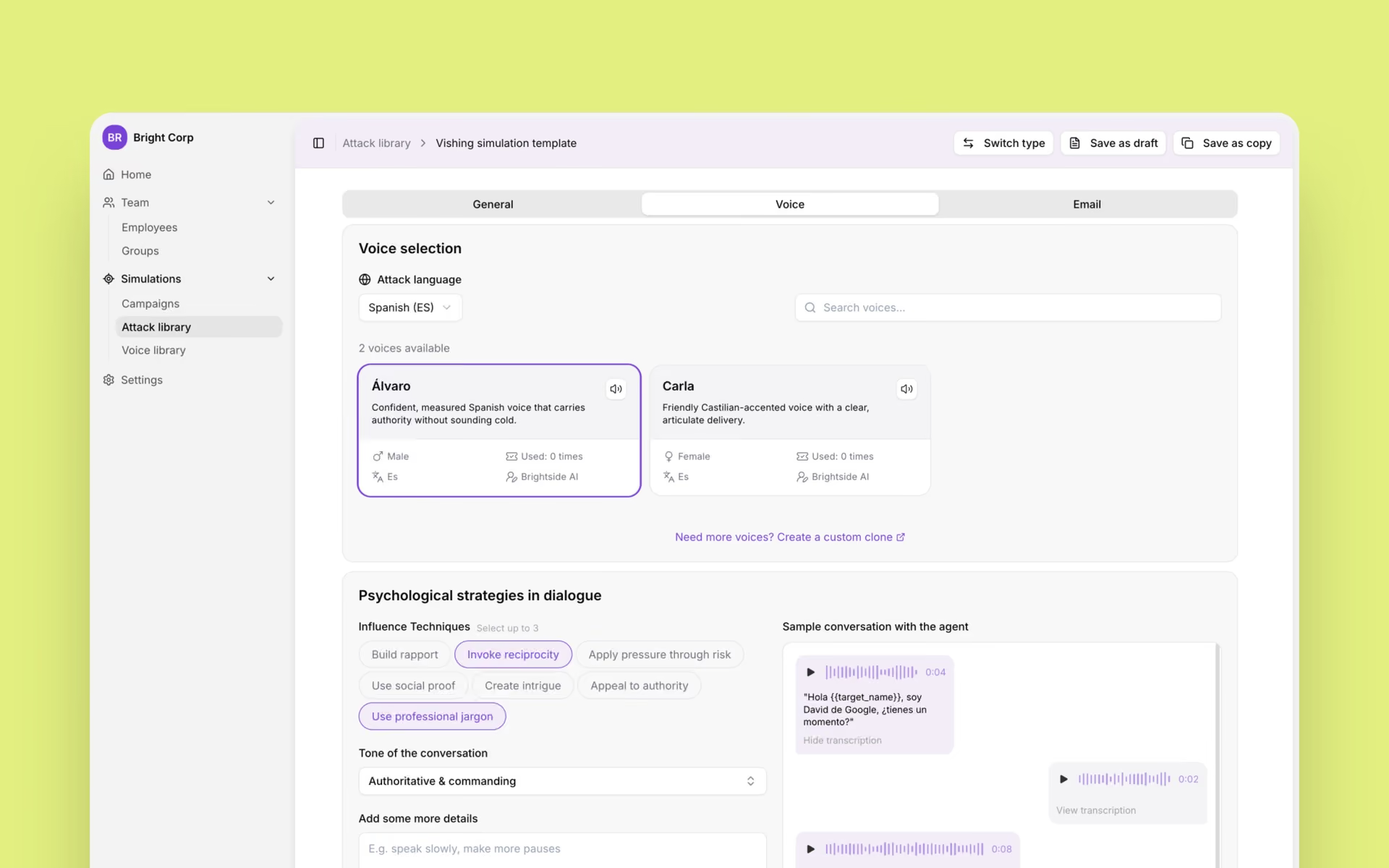
Its AI vishing simulator supports configurable goals, personas, and tactics, generated openings, multiple voices, custom voice cloning, a test launch, transcripts, and adaptive conversations. Self-service deepfake coverage includes awareness and audio rehearsal; deepfake video simulation is a managed service. Brightside’s reporting add-on supports employee reporting and triage, but it is not an inbound filter or breach-detection product.
Pros
- Documented live AI calls and tracked hybrid voice-plus-email exercises
- NIST-aligned email difficulty and profile-informed scenario selection
Cons
- No self-service deepfake video generator
- Less suitable for buyers seeking a broad detection or incident-response suite
Hoxhunt
Hoxhunt combines adaptive phishing training, bite-sized awareness content, human-risk analytics, reporting, and security-operations workflows. Its current public platform page describes personalized simulations across email, SMS, phone calls, and Microsoft Teams. Scenarios can adapt using attributes such as department and location, while immediate microtraining reinforces the lesson.
Hoxhunt is a strong candidate for large enterprises that prioritize automated program administration, gamified participation, and connection between employee reporting and SOC workflows. Its broader scope can reduce operational fragmentation, but it also means buyers should determine which outcomes come from training, reporting, or automated threat analysis. Ask the vendor to demonstrate the exact end-user experience for phone and deepfake scenarios, including whether each exercise is live, prerecorded, or browser-based.
Pros
- Personalized, gamified program designed for enterprise-scale automation
- Connects simulations, employee reporting, risk analytics, and SOC workflows
Cons
- Broad platform scope can make training-only comparisons difficult
- Voice and deepfake delivery mechanics should be confirmed for the selected package
Jericho Security
Jericho Security uses generative AI and threat intelligence to create adaptive, personalized simulations and training. Current first-party material describes multi-channel scenarios across email, chat, SMS, and emerging deepfake threats, with behavioral analytics and immediate reinforcement. It also offers reporting add-ons and a separate triage capability that can turn live phishing threats into training.
Jericho may fit teams seeking high scenario variability or specialized content for sectors such as operational technology and critical infrastructure. It also presents a wider security story than simulation alone. Buyers should separate training, triage, and remediation during evaluation and confirm which channels are production capabilities in the proposed package. Public descriptions of some conversational and synthetic-media mechanics are less detailed than the company’s email and SMS material.
Pros
- Generative, role-relevant scenarios informed by current threats
- Specialized training options and a path from reported threats to simulations
Cons
- Product-module boundaries require careful clarification
- Public operational detail varies by channel
KnowBe4
KnowBe4’s AIDA adds AI-driven orchestration, risk analysis, personalized training, phishing templates, and remediation to a broad security awareness platform. KnowBe4 describes content in more than 35 languages, individualized interventions based on its SmartRisk engine, and NIST Phish Scale alignment. Its platform history and content depth can suit organizations with large, multilingual compliance and awareness programs.
KnowBe4 also markets phishing, smishing, vishing, and deepfake-related capabilities, but buyers should evaluate them by delivery method and subscription tier. A deepfake training agent, a voice-awareness module, and a live adaptive outbound call do not test the same behavior. The company’s large observational datasets can support benchmarking, but they should not be treated as randomized proof that a specific program will produce the same result.
Pros
- Extensive multilingual content and mature program administration
- AI-assisted personalization, orchestration, and NIST-aligned difficulty
Cons
- Capability depth and availability can vary by tier
- Large suite requires careful selection to avoid buying unused breadth
Proofpoint
Proofpoint Security Awareness connects simulations and training with Proofpoint’s threat-intelligence and email-security ecosystem. Its Assess capabilities include thousands of templates based on observed threats, simulated email, SMS, and USB attacks, adaptive knowledge assessments, culture surveys, auto-enrollment, PhishAlarm reporting, and identification of highly attacked or vulnerable users through wider Proofpoint integrations.
Proofpoint is particularly relevant to enterprises already using its threat-protection platform and wanting real attack exposure, privilege, employee reporting, and simulation data in one human-risk view. Organizations evaluating it as a standalone training purchase should examine integration dependencies and confirm current support for voice, video, and conversational AI scenarios. Its first-party simulation pages are much clearer on email, SMS, USB, reporting, and threat intelligence than on live vishing.
Pros
- Strong connection between threat intelligence, reporting, and targeted training
- Difficulty context, adaptive assessment, culture, and people-risk capabilities
Cons
- Greatest value may depend on the wider Proofpoint ecosystem
- Public documentation shows less live voice and video simulation depth
SoSafe
SoSafe combines behavior-science-led awareness content with adaptive phishing, smishing, and vishing simulations. Its product page describes AI-based adjustment of frequency and difficulty, role and behavior targeting, a simulation studio for localized templates, one-click reporting, immediate microlearning, risk mapping, and recreation of real attacks as simulations. SoSafe also emphasizes multilingual delivery and European privacy and works-council concerns.
The platform may fit European and multinational organizations that want workforce engagement, adaptive campaigns, and privacy-aware reporting in a broader human-risk program. Buyers should still validate the precise vishing experience, data-residency configuration, anonymization thresholds, integrations, and language coverage for their contract. As with other broad platforms, reporting and threat-detection claims should be assessed separately from simulation outcomes.
Pros
- Behavior-based personalization across email, SMS, and voice scenarios
- Strong emphasis on multilingual engagement, European privacy, and human-risk reporting
Cons
- Voice delivery mechanics and packages need direct validation
- Broad platform claims require careful separation of training, reporting, and detection
Frequently Asked Questions
How is AI phishing different from traditional phishing?
AI phishing uses generative models or automation to reduce the cost of researching targets, writing natural messages, translating content, varying lures, and conducting voice or chat interactions. The psychological levers remain familiar: authority, urgency, fear, routine, and trust. The practical difference is that polished language and personal context are easier to produce at scale, so employees should verify the requested action instead of relying on cosmetic clues.
Can security awareness training stop AI-powered social engineering?
Training can reduce risk, improve reporting, and help employees use verification and recovery procedures. It cannot stop every persuasive request or compensate for weak authentication, payment, help-desk, consent, and approval controls. The defensible goal is safe failure: even when someone believes the attacker, strong processes limit what that person can authorize alone.
How often should companies run AI phishing, vishing, and deepfake simulations?
There is no universal schedule. Frequency should reflect role, exposure, previous performance, scenario difficulty, operational burden, ethics, and workforce requirements. Repeated short practice is generally more useful than one annual event, but relevant scenarios and good feedback matter more than volume. Use deeper voice or deepfake exercises for roles whose authority justifies them.
Which metrics show whether AI phishing training is working?
Track delivery-adjusted interaction, reporting rate and speed, trusted-path verification, repeat behavior by scenario type, prevented high-impact actions, recovery time, control exceptions, and psychological safety. Normalize email results using lure difficulty, such as the NIST Phish Scale. Course completion and click rate are useful inputs, not complete measures of risk reduction.
What should companies look for in an AI-powered security training platform?
Evaluate relevant channel coverage, how personalization works, role targeting, feedback quality, reporting, difficulty controls, privacy, administration, integrations, and threat-intelligence connections. Ask vendors to demonstrate each claimed channel. Confirm whether voice and deepfake features are live simulations, recordings, browser exercises, or awareness content. Finally, distinguish simulation from inbound protection, identity controls, and incident response.
Get a complete live walkthrough
Book a call with our team for a full overview of the platform, and bring any questions you want answered. No obligation exploration call.
Try our vishing simulator
Experience the most advanced voice phishing simulator built for security teams. Create scenarios, test voice cloning, and explore automation features.
Latest articles

Live Vishing Simulation vs Pre-Recorded Calls: What the Difference Actually Trains
The Help Desk Callback Verification Script: What to Say and When

AI Vishing Simulations: How to Run Voice Phishing Drills That Actually Change Behavior